Wednesday, 19 August 2009

Falling Idols Part 2: Dorothy, William, Mary, Sam and Sara(h)s et al

‘So, Wendy, what is a family?’ kathleen Jones 044

My favourite young man, the one somewhat given to chocolate, asked me recently, ‘What is a family?’

Unfortunately I had, the previous evening, been watching a documentary about murderer Charles Manson, whose gang of young murderous sociopaths called themselves ‘the Family’, so the question floored me for a moment.

When I recovered, I fumbled my way into talk of my own family - my much loved son and daughter, their spouses, my sister and brother and nieces and nephews. Then I thought how my sense of family is also imbued with ever-present memories of my unique mother and my gentle brother. Even my father, who died when I was nine, sits perfectly in my memory and constitutes part of my essential self. I remember how he used to put his little finger up my cardigan sleeve because his hand was too big to hold mine properly.

Then I talked about the groups of friends I made emerging from college into later professional and adult life who are more knowing of me, more intimate even, than my family of the flesh - certainly they are more accurate mirrors for the person I have become.

All of which gets me back to the other part of my holiday reading A Passionate Sisterhood – the sisters, wives, and daughters of The Lake Poets, by the excellent Kathleen Jones to which I turned after the delights of Dan Brown.

I have appreciated the work of Kathleen Jones since she came to the prison where I was writer in residence, to read from her biography of Catherine Cookson, and play unique interview tapes of CC talking: we listened as this odd, phenomenal woman, talked, fulminated, raged about elements of her own story. I later devoured Jones’ scholarly work, which addresses the subtleties and dark, significant areas of the life of Catherine Cookson. This writer, because of her staggering universal appeal, is seen my some luminaries as not so much a writer as a literary aberration.

The women in prison - some CC fans, some not – were fascinated. Experienced as they were in the matrix of abuse that counts to some as family life, they saw aspects of their own life validated - not just in CC’s stories, but in her life.

So here I am, by the seaside, reading Kathleen Jones’s book on the extended ‘family’ that emerged from the emotional, intellectual and erotic encounters between poets Robert Lovell, Robert Southey, William Wordsworth and Samuel Taylor Coleridge and two sets of sisters - the Hutchinsons, Mary & Sara(h), and the Frickers, Sarah, Mary and Edith. The last but not least of this remarkable extended close-living ‘family’ was, of course,the remarkable Dorothy Wordsworth, sister, muse, amanuensis and all-but lover to her brother William Wordsworth.

The stories of these individuals have been told separately but Kathleen Jones weaves her delicate way through this matrix of self conscious geniuses, these eccentric individuals. In doing so she brings the clever women - for once - into the foreground. In doing so she makes profound points about intellectual women sacrificing themselves on the altar of male genius; about the slave- labour involved in being the muse and amanuensis, valued more for their copying labour (thousands of pages…) than their critique; more for their motherly care of these child-men, than for their intellect. This is so, despite the fact that the original attraction to these women was their intellect and bright personalities.

The women’s childbearing faculties (except for the famously childless Dorothy W) were a bonus for these men of acute sentiment, although the gross care of children was in the main laid it the door of the women. So far, so little time, then, for the development of the women’s own considerable talents.

Except for Lovell, who died early. and Roberts Southey, who cheerfully shouldered Coleridge's domestic responsibilities as well as his own, the men come off quite badly here. The radical Wordsworth became autocratic and full of pride. Beautiful Coleridge, who became addicted to opium and was often paranoid, made a profession of running and staying away from his stoical wife Sarah and played a double blame game with his doting friends the Wordsworths , who blamed Sarah as the cause of his woes. Despite the extent of his betrayals and self indulgence Coleridge was still sustained for a long time as a kind of sacred monster by this talented, extended mixed up family.

Then there were the next generation of gifted and eccentric children… but read the book, if you can get hold of it! Let Kathleen Jones lead you through this family maze with a novelist’s skill.

I have to say the book quite put me off Wordsworth, whose poetry I’ve long admired, and Coleridge whose Ancient Mariner was a staple of my childhood. And it made me wonder what Sarah Coleridge might have produced had she not had to love, labour and support in every way this lost – ultimately so unattractive – soul, Samuel T Coleridge.

Idols fall and we suffer and survive betrayal, disappointment, loss and change. But we survive. That’s families for you.

wx

Sunday, 16 August 2009

Dan Brown, Dorothy Wordsworth & Fallen Idols – Part One

On my recent seaside sojourn I picked up that hardy perennial of holiday apartments, Dan Brown’s Da Vinci Code. I usually avoid novels when I am on holiday, as they end up being the object of analysis, deconstruction and fulmination: the opposite of rest and relaxation.

I’m sure I read The Da Vinci Code once and I am familiar with it’s themes, but I can’t really remember it. Anyway, on the one rainy day of my sunny week,  I decide to find out why many millions of readers have found Dan Brown’s novel appealing. Perhaps I can learn something.

It’s a very quick read – thanks to a good admixture of short clear sentences, short paragraphs among the long, discursive, explanatory ones, short - sometimes very - short chapters, that all combine to rollick the story through the mental system almost without touching the sides. The energy  of action is rammed home with quick changes of location and personnel. The quest theme is flagged up by codes and puzzles slipping out fish hooks of curiosity to land us gasping on to the last page.

A technical formula, indeed, for a very successful, engaging novel.

I think I enjoyed all this, first time round. But now I perceive  a lot of sag. For example there are lots of places where one character explains facts at inordinate length to another character - variously:  the nature of The Divine Feminine; the Mary Magdalene myth(s); the legends of the Orders of Sion and the Knights Templar; the genius of Leonardo de Vinci; and so on.

I encountered another sag in the plethora of paragraphs describing at length significant buildings from the Louvre downwards.  I know, I know! The story wouldn’t work without the reader having this information.  Without this they couldn’t join in the quest, could they? (And I also know such informationfiction has wide appeal among people who want to learn stuff from the stories they read.)

Another sag is the contradiction between  a central theme of the novel - about how, historically, the male (church) establishment has excised the significance of the feminine core of our culture – and the characterisation. It is noticeable in this novel that the exciting characters – the professor, the aged curator, the obsessive collector, the colourful villains – are all men, whereas the woman cryptologist (beautiful, of course, and occasionally resourceful) is mostly the passive questioner, the receiver of male wisdom. Funny, that.

My favourite character this time round is the lurking, frustrated French detective. And I relish anew the poignant relationship between the duped archbishop and haunted, deluded, masochistic albino assassin. That is original.

But what surprised me most was my new perception that the novel so reduces the well documented and true genius of Leonardo de Vinci to a mere cipher of a puzzle maker. He’s always been a hero, an idol of mine and this is a trivial interpretation of his genius. Yet it is the central puzzle of the novel, the thing that holds it together. As a consequence  it will be hard to think of him in the future without the propositions of this novel lurking somewhere in my mind. An idol falls…

I told you! There’s  no rest in it. When I pick up a novel on holiday, that’s what I do – analyse, deconstruct, fulminate

I think I have learned something here - probably about pace and indulging in more colourful, extreme characterisation. But also I’ve learnt things that I would not, could not do myself.  And of course, these may be the very things that would make my novels sell by the million.

Wxkathleen Jones 044 2

Next post – Further holiday reading.  Lots to learn from Kathleen  Jones’ excellent Passionate Sisterhood! But still idols are falling.

Saturday, 15 August 2009

Wild Postcards from The South Shore


scarborough 2 026

On the sea-bound temple-stagescarborough 2 015

children sing and dance for prizes 

and people sit in rows applauding.


Do they notice someone’s uncle

scarborough 2 025

hauling beach tents spades  and  buckets ?

Do they notice the tall, tattoo’d girl

shouldering  her orange surfboard?

   scarborough 2 023

Or two old sisters, arm in arm ,

dressed in fawn with wild blue hats,

who watch the  donkeys on the sand,

savouring the memory

of seaside childhood days ?


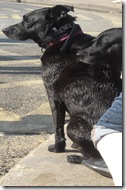
Or two black dogs, slick with sea water dogs

watching out and contemplating:

friendship, long beach walks

and coming First in Show?

Or the woman with green towels,                   

grey hair, purple top and wobbling breasts

dreaming of her butterfly scarborough 2 024 years.              

Or the plush rabbit

trying to escape

the straw basket of the  girl 

in the  moth-white dress.

Or the old woman sitting on her own

smiling as she taps her finger,

keeping time with the music

and talking to someone

who is not there.


scarborough 2 026


Wish you were here

wxx

Saturday, 8 August 2009

Global Interests & Travelling in the Head

globe 008

One of the nicest things in my house is good sized globe of the world. This globe is very tactile, with the mountains and high lands of the world  in high relief. It’s very good for letting your fingers do the walking.

In my less privileged childhood we just had this atlas of the world. We used to pore over it with my mother, as she traced the routes of the explorers  Magellan and Vasco da Gama, Cristoforo Columbus and Sebastian Cabot, Drake and Raleigh, Scott and Shackleton. (It’s worth remembering that this was an old atlas, hatched over with the red of Empire, our attitudes to which we had later to reassess.)

I’ve been twirling the globe recently, checking where I’ve just been in France and where my family were recently in Turkey. I thought of what the distances would have involved in other times, without the power of steam,  the internal combustion engine. and aeroplanes. Going further, I thought of other places we have travelled to between us, in the modern way – Australia, New Zealand, Singapore, Jamaica, Grenada, Boston USA, China, Africa and Indonesia. I thought of my good friends Judy and Judith, who  live half of each year in New Zealand and America respectively almost as though they were commuting.

This global interest has been stirred by my recent researches into travel in the early centuries after the death of Christ. I found myself blinking at the thousands of miles St Paul walked in the countries of the Easter Mediterranean travelling  – on, alongside, or behind - a donkey. I blanch at the death toll involved in travelling by sea, and respected the sailors for keeping in sight of land for fear of shipwreck, pirates and vengeful weather.

Looking at the globe I imagine the difficulty of the three Marys (See Of Loves and Fishes) travelling from Galilee to Gaul with their precious and iconic burden, whatever that might be. (Imagining what this burden might be has been part of my thinking for this novel).

I locate the site of Nicodemia, East of  Istanbul, just between the Aegean Sea and the Black Sea, where the Roman Emperor Diocletian built a city and located his court for a time. Now I have to imagine just how my three characters can make the journey from Gaul to Nicodemia in 303AD without falling off the edge of the world and of my novel!

This travelling in the head is a family tradition. My mother never travelled in reality until she was fifty two. (No funds!). But when she was fifty two she went by boat across the River Tyne in a boat for a week in Denmark and her real travels began.

Now, today, I’m off  for a week in Scarborough -  a mere hour and a half’s drive away on the coast of the North East of England - to read, write, and enjoy the sea air with B. Sounds unadventurous, but then  it’s only a few miles away from the birthplace of Captain Cook, the where that great traveller learned the trade that lead to his great and tragic career as an explorer. I have every hope that the inspiration of Captain Cook and the the brisk air of  the north east coast will help me to imagine the journey on 303AD to greater effect.

I have to say travel in the head is a great resource for a writer.

wx

PS Look for further postings from Scarborough…

Thursday, 6 August 2009

Rings, Romance and Great Expectations

How do I love thee? Let me count the ways.
I love thee to the depth and breadth and height
My soul can reach…     
Elizabeth Barrett Browning (1806-1861)

A few days ago is was my wedding anniversary but I forgot.Frienada At Whitworth 328 What’s more, he forgot too!  We fell into each other’s arms and laughed concluding that living the life meant more than cards and flowers. There was some talk of long service medals, however.

This is a marriage that went to work and loved it, that had flowers in its hair, that wore sober suits and hippy skirts. It walked children in prams, and went to PTA meetings.  It took holidays by the seaside that needed two ponchos to keep warm. It went to the races, to rugby matches and to school plays. It waved off children to their new life and welcomed them back again. It watched cricket and football and cop shows on TV. It read newspapers at length. It read books and wrote them and delivered heavy manuscripts to the Post Office. It visited clinics and hospitals and held its breath. It is a marriage that travels and continues to relish the boy who eats chocolate. It is a marriage that still holds hands.

Once, when we’d been married for about six years (still very young…) I went to my place of work without my wedding ring, having left it in the bathroom. A woman colleague shuddered at the sight of my naked finger, saying, ‘I couldn’t do that, leave my ring off. I’d feel as though I didn’t belong to my husband.’

I thought about this and decided that I’d never felt as though I belonged to anyone. In fact, growing up had been the process of establishing just that fact.

So, for the next ten years I wore no ring at all, thinking people had to get to know me without the ring label. I didn’t want people to have rigid expectations of me, especially the expectation that I belonged to someone. Then, when I felt I’d made my point, I wore a ring again. In fact, in the end, I wore two.

These were the decades when Romance and the quest of belonging to or owning someone were Rife. We’d never had it so good and one symbol of this was the rash of Romance. Romance was the big selling point for films, books, magazines and advertisements for perfume, soap and Martinis. Novels published by Mills&Boon  and their imitators  steepled into millions.

Bridget Jones disguised her quest with suitable irony but Romance and Lifelong love are there in the subtext, like Blackpool printed through a stick of rock. These days chick-lit and mum-lit novels and films -  for all their savvy street style – rehearse the same quest for Romance, although the lifelong bit may have slipped a bit.

The pity of it is that none of us can measure up to the glamorous puppetry of such fictions. In fact there is a yawning gap between these polished creatures and the chunky ill-shapen bodies, mussed up hair and the harassed lives of both women and men in real life. The billion pound glamour industry in all its forms promotes itself very nicely in this gap, thank you!

It’s a good thing then, that despite our lack of glamour,  so many of us rejoice in long term relationships that evolve and develop through the years – larger this year, narrower next, disappointments this year, surprises next. Living here. Living there.  Jobs gained. Jobs lost. Clinging together. Mourning together. Running away. Coming back. Making time for yourself. Arguing your corner. Holding hands.

This life is no film or fantasising storybook; it’s no jolly idyll that leaps from passion to idyllic parenthood to empty-nest-adventure. It’s a bumpier but much more exciting ride than that. It’s two separate  people making it up as they go along, becoming lifetime comrades and mutually appreciative buddies whose relationship continues to change, evolve, soften,  sharpen, as the years go by.

These days I rejoice in wearing two rings on my wedding finger. The second one is my mother’s which she wore for the short fifteen years of her happily married life and for the thirty six years of her not so happy widowhood. I am touched and honoured to wear it.

Perhaps I’ll have another ring – a kind of long service medal. I’d buy him one, but he would never wear it. He doesn’t believe in men wearing rings.

Hey ho!

wx

Monday, 3 August 2009

Writing, Therapy, & Disclosure.

Changing Draft Writing regularly acts to reveal - to yourself and sometimes to the world at large  - your inner thoughts and the wilder shores of your life experience  

Of course, in poetry and prose- fiction the wild surprise of such revelations is codified by metaphor and language, by characterisation and contrived narrative. Even so, the wild things are still  buried in there somewhere, to be excavated - in time - by over-eager biographers.

These wild things are self-consciously present in published diaries and journals - often self censored and edited to construct in retrospect an admirable self.  They are even more self-consciously present it the contemporary rash of ‘Misery Lit’  memoirs that now have special shelves in some bookshops.

The wild things are buried in the stylised, ironic prose of journalists who use their own lives as raw material in comments and commentary. And they are there in cyberspace, in the un-refereed frenzy of websites, weblogs, twitters and chat rooms. And blogs – like this one, you will say!

You might also say, of course, that getting the wild things ‘out there’ is all to the good. Aren’t there  courses and workshops in writing as therapy? Don’t some psychologists ask their clients to keep diaries to help with analysis?

But in my experience we have to be very careful about this process. I think that just to express and organise your thoughts is an empowerment in itself. Submitting them to outside analysis may be to surrender control - yet again - of your own life.

I have had the privilege  of working with many people, new to writing, who experience a magical release and self realisation when they find they can write down what has been inexpressible.

Some of these writers have turned up in workshops. I remember one man - jolly, likeable, easy going - who wrote a hungry, chilling account of  his slavish existence  in an orphanage. He was proud of and (as we all were) moved by his own writing. One of his stories told of a Christmas when the orphanage had  an official visit from the mayor. Lavish food was laid before the hungry hordes of children. But the mayoral party was delayed for more than two hours and the children had to sit there with the food before them. Then the mayoral party arrived and boiling gravy was poured on their cold dinners and they were forced to eat and show their relish as a public display.

I have worked with women in prison,  for some of whom writing was like lancing a boil. (See The Self Revealed, left) I have wept with them over more than one  free-flow articulation of a catalogue of abuse, confusion, despair and corruption of the self. Much of it was so dark as to be unpublishable – even on those special shelves in bookshops.

I was - and am - always careful to say I am not a therapist. All I could and can do is help them with the process of expressing, editing,  laying out and  producing a good looking document. But I have observed that this level of control over the uncontrollable aspects of people’s lives seemed and seems to be an empowerment and is of itself therapeutic.

The writing is enough. As a writer myself, I know this .

DSCN0465

Friday, 31 July 2009

Easington, Changing Landscapes & Storytellers

Yesterday I went across to Easington to work with writers there on the Tall Tales Morning%20in%20Easingtonproject. Every time I go there now I am struck by the wooded hills and denes that surround the village and the colliery areas. I especially like long straight road down through Easington colliery ending in the sea, which seems to rear up to meet it. I can only imagine - in a kind superimposed sepia - the surrounding tangle of historic but now absent pit heads and mountainous pit heaps that are deeply (affectionately, even nostalgically) embedded in the minds of my writers.

One of our objectives in this project is to pay respect to this honourable and dramatic past, but also to evoke stories with a modern feel and a modern context.

Our objective today is intense, high level editing of some of the stories they have already produced, which Avril and I have read and treated to an initial edit. There is some great stuff here, fresh and interesting - a new take on this village which already rejoices in great natural storytellers.

Editing oneself is not easy - the big task is to gain some critical distance and to be prepared to develop instead of defend. And everyone here is wonderfully up for it. Having read a lot of these early drafts Avril and I evolved Ten Golden Rules which will definitely allow these good writers become better.

The Tall Tale stories have strengthened and deepened in the process: Agnes has written a wonderful evocation of fear in a mother living in these streets, showing courage under stress, nervous about the drug culture that is threatening her beloved son; Ann has written a story of people in a close knit street community who turn on a stranger; Terry has written a lyrical and quite modern tale of early marauders on this ancient coast; Mavis has written a tale of a missing child that turns into a ghost story; Joan has produced one of her intricate and rhythmical rhyming verses that are not only funny but finely crafted; Susan has written a truly comical, well crafted story about dancing miners; Mary’s insightful story returns us to the drug problem as a woman sits on a bench outside a chemist and tells a stranger how and why drugs are rife in this innocent village.

In the afternoon I work one to one on individual story tellers and Avril gives a poetry workshop to generate poems focusing on a changing place. The writers set to with vigour and the poems that are emerging are so very original and promising.

On the way back, both over-stimulated and exhausted , we stop to have tea and biscuits with my friend Judith, looking out over her tree lined garden. She serves tea in her grandma’s delicate cups and we are revived. The talk is always good with Judith. We talk about nearby Easington, and her husband Bill - who is passing through to the garden - tells us Easington people are the salt of the earth.

Just so!

Wx

PS To leave a comment – or just say hello - click on 'Comments' below. Write your comment in the box and, if you don't have a website, choose to click on Anonymous and leave your name (or nom de plume) at the bottom of the message. Then hit Publish

Tuesday, 28 July 2009

Star Climbs The Wall

When do we know we are truly psychic? How can we recognise that our experience of insight is more than just a very common sixth sense? In the ‘work in progress’ extract below  from my new novel At The Maison d’EstellaStar - also called Stella, begins to recognise the greater depths of her psychic gifts and get to grips with what they imply.

                                           ***** 

… In all the times I played here with Mae as a child, I’d never been inside this place. We found it forbidding then, like a witch’s castle. Now I peered into the  pitch black and smelled the rotting leaves and the faint ripe scent of dead animals. But then I looked upwards to see that the tower held a bowl of lighter night sky, enclosing the beltBishop's palace etc 005 a of Orion the Hunter.  

Halfway up the wall was a platform. ‘That’s for us,’ said Ludovic.   ‘You must be joking,’ I said.  ‘I’ll show you,’ he said. ‘It’s possible. I tried it. You have to do it rock-climber style.’

He made me face the wall and stood behind me. I could feel his chest against my shoulder blades, his thighs against mine. Then he took my hands and made me reach up and curl my fingers into stone crevasses. He reached down, slipped off my shoes and showed my feet where to grip. So we climbed the wall, he like a crab’s shell on my back. He smelled faintly of sweat and turpentine and his breath was like honey on my cheek.

After some hauling, gasping and giggling we were standing upright on the platform in the darkness. I peered through a glassless window into the mantle of the night, screwing up my eyes to make out the giant trees, each with its own core of darkness.

Suddenly a wave of intense feeling rippled through me from my heels to my head and back again. All at once I could sense every living being who had ever been in this spot on the earth - from eighteenth century gardeners, back to seventeenth century revellers, back to Roman camp  followers, back even further to Celtish men in hoods, following one after another, in a line. The place was teeming with these people, talking, shouting, pushing. My head and my body were aching with their presence on the surface of my time.

Ludovic gripped my arm tight and pushed me forward. ‘Look! North!’ he said. So I turned my head towards the North,  where the polluting lights of the town no longer stained the night. There, the sky had retrieved to its dense night-time  blackness and the stars were intense points of light. Orion, Calliope, the Pleiades and Pisces were all there, shapely in their dispensation. Perhaps the gods were here with us, to witness to the events of this night.

I shivered….

*****

Not done yet, but it’s on its way…..Wxx

PS To leave a comment - or say hello - click on 'Comments' below. Write your comment in the box and, if you don't have a website, choose to click on Anonymous (below) and leave your name (or nom de plume) at the bottom of the message. Then hit Publish.

Monday, 27 July 2009

Magpies, Canal Boats, and a Bottle of Red

I was thinking how we writers are like magpies. picking up bright things here and there, shaking them around like bits in a kaleidoscope so to make a grand, brand new pattern. If the shaking up works, then  the diamond seeds of the original  elements will - with luck - create a new truth that shines out and strikes a universal chord in those who encounter it.

DSCN0293

Let me travel back with you a month in time: I am walking along a narrow tree-lined path along the Canal du Midi in southern France. The canal glows greenish silver, the nightingales are treating me to the longer version of their song. A turtle  is keeping pace (or is it keeping flipper?) with me in the middle of the canal.

I am relaxed, relishing the experience second by second, but my sharp magpie eyes are missing nothing.

DSCN0304

This part of the canal  is lined with boats of all kinds and sizes –many houseboats;  some rather up-market tourist boats; some boats housing summer water gypsies; one boat which looks like a junkyard on water.

On the covered verandah of one houseboat I note DSCN0297 a man of about sixty - a long, fit, silver haired, well-seasoned kind of man in drill trousers and bare feet. He’s lying on a long garden seat with his legs over one end, reading one of those old green and cream Penguin books – battered and well used. He looks English but I would not swear to it.

I walk on and by a long boat I pass a group of men on the bank, barbecuing something that smells of garlic and tomatoes and burnt flesh. Their v0ices rumble. They don’t look like tourists. Just further along is a girl with glossy dark hair swinging from a rope-swing fixed up on one of the great trees that line the canal. On the back- swing of the rope she glances back towards the men, the image of flirting temptation.

FurthDSCN0308er along I note a plump elderly man who  is organising his water bottles on the roof of his narrowboat, filling them from a large container. He smiles politely. ‘   ’jour  Madame!’  I bask in this French politeness and move on.

Half an hour later I return the same way. (I like doing this, whether driving or walking. The perspectives on a return journey are entirely different from those on the outward journey).

Now, the plump old man from the narrow boat is way ahead of me on the path, a bottle of red wine in his hand. The girl on the swing is  talking to the barbequing man.  A small child  is clinging to her, his arm around her neck. When I finally reach the houseboat again, the plump man is sitting at the table with the silver haired man. The bottle of red is open on the table, glasses half full. And these two men are talking, gesticulating. It looks like some pleasurable nightly ritual to me.

So there you are: a magpie’s collection from a summer afternoon walk, ready for the kaleidoscope. One shake of the kaleidoscope and I could have a short story. Another, and I could have the makings of a novel. Another could give me a pilot of a TV Series and … and….

Mrs Wood, my wonderful, very original, art tutor once said. ‘Once you learn how to look, you will never be bored.’  She was right there wasn’t she?

wx

*********

PS To leave a comment - or say hello - click on 'Comments' below. Write your comment in the box and, if you don't have a website, choose to click on Anonymous (below) and leave your name (or nom de plume) at the bottom of the message. Then hit Publish.

Friday, 24 July 2009

Cafe Culture, Julia Darling & Things Overheard


I relish the fact that writer Natalie Goldberg and my late, Juliagreat, very lamented, friend Julia Darling have both, in their times, been great advocates of writing in cafes.

While I was in Agde in France I posted here a eulogistic piece about scribbling in the Cafe Plazza and the cafe on la Place de La Marine. In fact my delight in getting away from the desk, out into the street, into the inspiring neutrality of a cafe did not start in France. It is an old habit that I found I shared with Julia.

Julia was not just a great tutor, poet and playwright, she was a novelist and lyrical poet who wrung every last drop of joy and delight, love and affection, out of her writer’s life, before her tragically early death.

For several years she came here to give wildly popular workshops on her own and sometimes alongside me. Despite her great gifts she was modest and comradely - as well as merry, enabling and respectful of others’ talent. She always worked alongside the work-shoppers, never sat on a pedestal above them. She risked herself alongside them in the read-around, saying, ‘Well this is mad, but…’

Julia was the mistress of original, telling, firecracker metaphors and knew the magic of the right word in the right place. The work-shoppers would go off inspired to write closer, to do better.

When lunchtime came around she’d rush off, either to swim, or go to the nuts and bolts cafe near the old Post Office. She did this for rest, for refreshment, and inevitably, for inspiration from the other tables, where bin men and office workers would stoke themselves up with cake or a good fry-up for the afternoon’s work. Things overheard there would be filed away in that considerable intelligence and become natural resource for her in her writing. She had a sympathetic and an empathetic ear for the natural dialogue of so called ordinary people.

This is interesting, as although she was a bit of a maverick, she came from a distinctive upper class intellectual background. But she was uniquely classless in her apprehension of the life and people around her - so very refreshing in writing circles that can be riddled with all kinds of snobbery.

Much has been made of the graceful and poetic way in which she tackled the process of dying - writing of its challenges with frighteningly forensic insight and luminous grace. To be honest, though I prefer to think of her in terms of the way she lived. She was a joy to be with, wryly witty and always kind. She was inspirational and prepared to be inspired. She lit up any room she was in with her broad smile and wide eyes.

In my own cafe sojourns eavesdropping is of secondary importance to a clear table not far from the window and staff who will both take care of me and ignore me. Mostly I sit here and fill my diary with plans; make both creative and practical lists; draft these posts for my blog; scribble the next chapter for At The Villa d’Estella; read a heavy tome about ‘Gaul in Antiquity’ for said novel. And so on.

These times away from the desk are essential for someone who works from home. Surrounded by strangers, I work very quickly, get a great deal done. (I’ve been thinking that this perpetual desire to get away has something to do with my Pisces star sign, which I wrote about recently…)

But yesterday as I was walking to the cafe I passed two men talking. One man was saying to the other. ‘…and as well as that I’ve got this cancer ripping away at my insides…’ This so perfectly expressed a combination of anger and stoicism that it made me want to cry.

And it made me think again about the exceptional and radiant Julia Darling.

WX

(AFTERNOTE I see now that Julia’s star sign was Leo - Generous and warm-hearted - Creative and enthusiastic - Broad-minded and expansive - Faithful and loving. But her sign tipped into Virgo - Modest and shy - Meticulous and reliable - Practical and diligent -Intelligent and analytical. I am thinking about all this because my mind if full of Stella, the astrologer in my new novel. But thinking now about Julia, all this fits…)

PS To leave a comment click on 'Comments' below. A window will come on your screen. Scroll down in the window until you come to the empty comment box. Write your comment in the box and, if you don't have a website, choose to click on Anonymous (below) and leave your name (or nom de plume) at the bottom of the message. Then hit Publish.

Tuesday, 21 July 2009

The Dictionary Game and The Boy Who Likes Chocolate

Angus, sixteen - who likes chocolate - has been feeling restless after a year of The Joys of ChocoLATE living industriously in preparation for pending GCSEs and more latterly deprived by temporary injury of the explosive relief of his beloved rugby.

The really hard times begin when the exams are done and dusted. Being advised to rest! chill! take it easy! is difficult when one has a black hole in a head which had - until very recently - been packed with facts and figures, concepts and theories, poems, plays and sophisticated equations. Games on TV and occasional sessions with the guitar go nowhere near filling the black hole in the head. And this, I feel, is where the restlessness comes in.

I want to help, and - being the pedant I am - I suggest a bit of challenging reading to fill the black hole. I have just been reading about the Dead Sea Scrolls (research for At The Villa d’Estella) and had come upon a very sharp series of Very Short Guides by OUP, including one very well written one on my subject, by Timothy H Lim. In the back of the book is a very comprehensive list of subjects from Archaeology to Machiavelli, from World Music to The Russian Revolution.

The chocolate eater gets his eye on the VSG s to Philosophy, to Consciousness, and to Logic. Then, while the little books whirr here from the Planet Amazon, he picks up from my shelves Fear of Freedom by the wonderful Erich Fromm. As he gets stuck into this book he whoops with delight, discovering that Erich Fromm has ideas that fit in with his own – sometimes very original – worldview. Then the little books arrive and the whoops continue right through the consumption of the books on Philosophy, Logic and Consciousness.

Then one day he throws the last little book aside and asks I fancy playing a game ‘for a bit of a rest’? He calls it The Dictionary Game. He’ll pick ten words at random and test me on them and I have to pick ten words to test him. And so on. We amaze ourselves with how many words we actually seem to know.

Then something strikes me and I tell Angus that when I was even younger than he is, my mother used to play this very game with my brothers and sister and me. That was in a tiny house a tenth of this size of this one, where the money was in very much shorter supply than the love and the language.

So we agree, he and I, that playing these clever games does not depend on wealth or privilege but on the nature of the people who play. And he tells me of this new word he has just invented – lucaviatic. He says it means eccentric but brilliant.

That must be a compliment.

Wx

PS To leave a comment click on 'Comments' below. A window will come on your screen. Scroll down in the window until you come to the empty comment box. Write your comment in the box and, if you don't have a website, choose to click on Anonymous (below) and leave your name (or nom de plume) at the bottom of the message. Then hit Publish

Sunday, 19 July 2009

Astrology and Blooming, Buzzing Confusion

Researching novels leads you down strange pathways.

Star signs? All nonsense of course. But which of us does not have the desire for some 12-pisces[1]shape, some purpose in the randomised pick-and-mix of human experience? We might discover that shape in the certainties of organised religion or the world of science and the academy.

Last week I talked with David S about coincidence. He doesn’t believe in it. He thinks there is something more than coincidence behind coincidences. We talked about ideas from CJ Jung which refer to synchronicity and the conscience collective – a kind well of human experience, wisdom and perception which, some say now, may be genetically accumulated.

So far, so unscientific!

But we seem to need it. Look at the way some of us unscientific folk embrace the work Einstein, Schrödinger and others, who have challenged to notion of a linear time in warping, bending, reversing, and even breaking the received wisdom of time’s straight arrow, using the mechanics of relativity and quantum physics.

It seems we live in this world of blooming, buzzing confusion and look always for patterns which will explain it all. Religions of every sort - as well as the schools of scientific theory and academic concepts – flaunt their holy books, their heroes and their villains and offer us comfort, in that if we follow their rules they will make shapely sense for us, out of our individual confusion.

Reading the stars in the night sky and interpreting them to ascribe character and to predict the future - if time’s not linear then the future is there to see! - is the most immediate and possibly primitive of these processes. And like many people, over my morning coffee, I read my stars in newspapers and magazines. There is a lady in Easington who has offered to do it for me in person but I haven’t as yet taken her up on it. She calls her self a shaman, which is interesting,

My own favourite thing is to check out personality types designated by the stars . I am Pisces -‘ impressionable, compassionate, sensitive, artistic, mystical, meditative, spiritual, a medium, also escapist - tendency to flight, dependent , masochistic. Can be mendacious. (ie tendency to tell lies – come to think of it I tell lies (ie stories) for a living!) And paranoid. (eg Why is nobody in Germany reading my deathless prose?)

I have to tell you that, in my case, all these aspects of personality are more or less true. I might have dozens of other characteristics but even these link back to these qualities one way or another.

Looking at other Pisceans I can see these qualities coming through. Lots of actors (including Ellen Terry, Elizabeth Taylor and Bruce Willis); many writers(including Anais Nin, the inspiration for this whole blog); politicians (including Gordon Brown and Bill Clinton); inventers and thinkers (including the aforementioned Albert Einstein). I imagine as well that prisons and psychiatric units will have their fair share of rather more anonymous Pisceans, with their mendacity, paranoia and desire to escape.

du_scorpionhy1b Talking of prisons, the joint star sign of the Kray Twins (see my novel The Lavender House) was Scorpioresourcefulness, penetrating insight, strength in crisis, psychic power, charisma, strong sexuality, interest in occult, secretiveness, jealousy.’ This case illustrates that given characteristics are not value free. They can be turned on their heads and applied with death-dealing negativity.

So far, so very unscientific, you might say.

But I am preoccupied by all this at the moment because Stella, the central character in my new novel At The Villa d’Estella, is a professional astrologer. Even through her life-changing adventures in France she still posts her astrological columns to the magazines that employ her. Although she is somewhat creative in generating her copy – she’s a Piscean, after all – she has taken to the work like a duck to water because all through her life she has sensed dead people and seen through time.

As I say, researching a novel takes you down the strangest pathways but this might be the strangest yet…

wx

PS To leave a comment click on 'Comments' below. A window will come on your screen. Scroll down in the window until you come to the empty comment box. Write your comment in the box and, if you don't have a website, choose to click on Anonymous (below) and leave your name (or nom de plume) at the bottom of the message. Then hit Publish.

Sunday, 12 July 2009

Metro Centre, Marble Halls and Concrete Jungles

I dreamt I dwelt in marble halls…

The words of this song drummed through my head yesterday as I walked the bright white malls of the Metro Centre, marvelling at its day-lighted openness and its seemingly endless colourful array of goods to buy.

Even my best friend wouldn’t call me a shopper but I have to admit I'm very tempted as I move through Marks & Spencer and make my way to my destination: WHSmiths

I have always loved WHSmiths – buying school stuff for my kids at the beginning of term and for myself - ink pens, ink, notebooks , biros, pencils, paints and art books. As well as all this, in the recent decade I’ve enjoyed the way WHSmiths' book stock has expanded to incorporate a wide range of titles, from useful factual books to an extensive range of fiction, including prizewinning titles, well priced classical works as well as fiction ranging from the so-called literary to the so-called popular mainstream fiction: all great to pick up after you've bought your pens and protractors!

So it’s a wonderful treat to see my own books on their shelves - Sandie Shaw and the Millionth Marvell Cooker amongst others. My special treat today is -alongside my writer friend Benita Brown and Headline’s petite Scottish whirlwind manager Gillian Mackay - to have tea and cakes with WHS manager David Shapiro and his assistant manager Darren.

David (whom I met last year alongside the dynamic WHS Northern boss Peter Day) is both a keen reader and very interested in the writing process, so we have lots on common. Add to that the fact that he - like me - loves France, and we are away! David tells me a very good ghost story which I've tucked away to think about later. Anyway, after coffee, cakes and much talk, Benita and I get down to signing piles of our books, while Gillian and David stick on the pretty silver stickers.

Too soon, we have to leave, to get to Waterstones, where they are very polite and have their nice piles of books, but sadly we have no opportunity here for book talk. So now we break for a sandwich lunch in Debenhams (scarlet blouses, nice shoes…) More book talk here - about what makes a good cover, a good agent, a good editor, a good story location and an historical novel as opposed to a contemporary one. And we talked about Gillian's cats - 'the girls'.

I have a great fancy for a cat. I tell her about my daughter Debora's cats

Then on, on, from the faux marble halls of the Metro Centre to the concrete jungle of Washington, a Sixties new town, built near Washington Village, the ancestral home of the family that bred George Washington, father of the American nation.

Norman (Benita’s husband) is kindly driving us but when we reach the town his satnav goes crazy, sending us up blind alleys and - one time - nearly back out of town. At last, though, we're saved by a lone taxi driver who tells us to aim for the Gala Bingo and the Police Station. So we edge our way nearer the library.

We end up in a Kafkaesque spot – all grey walls with their backs turned to us and concrete steps leading nowhere. We venture up one flight of concrete steps, then another, then along a concrete walkway. Still we are lost. We ask a lone passerby where the library might be and he points towards a wall of glass just beside us.

Glory be! Here it is! Once inside the building we’re in another world: a brand new state-of-the-art library with curving shelves, bright open spaces and friendly faces. Library heaven! We're treated to a good welcome with tea and biscuits before we go to meet a wonderful crowd of readers who ask intelligent and interesting questions - not just about our current novels, but about earlier ones (eg The Lavender House ( my London novel) and A Woman Scorned (about Mary Ann Cotton, allegedly a 19th Century Mass murderer) - which they had also read!

They are a great bunch of people. So, the odyssey through the concrete jungle has been well worth it. Such a pity that the forbidding concrete, the back- turned design, the baffling, unlabelled roadways, should hide away this community of great people.

Come to think of it, there may be a novel in there somewhere…

wx

Wednesday, 8 July 2009

Fenwick Frolics

Sandie Cover One upon a time in my well spent-youth Newcastle was a happy hunting ground for unusual clothes and frothy coffee in good company. On occasion we would hitch-hike down from our small Northumberland college - I lived in Harry Potter’s castle, but that’s another story – and spend the afternoon in Newcastle trying on clothes we couldn’t afford, drinking frothy coffee in juke box cafes, and once – I think it was someone’s birthday – having high tea in Tilley’s restaurant where the waitresses still wore black dresses and white aprons.

Years later, with our children, my friend Pat and I would meet in Fenwick’s cafe for coffee and cakes. In those innocent days we used to let the children take the escalator to the next floor on their own (!) to play in the toy department. Meanwhile Pat and I would talk up a storm about the meaning of life – perhaps particularly our lives – and drink more coffee. After a while we’d go up to fetch the children from the toy department and bring them down for ice cream - and get on with being mothers.

I remember now that I bought my un-weddingy wedding outfit for daughter Debora’s wedding in Fenwick’s French salon – a long narrow skirt and jacket in navy blue velvet. I’ve worn it happily many times since.

And now this Thursday (tomorrow!) I’ll leave my desk to be on the othebooks Etc 028r side of the counter at Fenwick’s – signing copies of the paperback edition of SANDIE SHAW AND THE MILLIONTH MARVELL COOKER.

People often ask me what a book about. Well, I wrote about this one in an earlier post, saying.
Sandie Shaw and the Millionth Marvell Cooker’ is about:
Friendship and salvation between women & authentic factory life when industry was booming & the birth of celebrity culture & changes in access to higher education & college life & about changing cultural attitudes brought about by the
Sandie_Shaw_RHB_small[1]Women’s Movement & the nature and hesitancies of young love & the experience of immigrants moving into British life & the ironies, assumptions and secrets of institutions

But most of all, I say, I think – and hope - it’s a very good, funny, touching, rites of passage novel about this student from a small Northumberland college who works in a factory one summer in the 1960s ….

I’ve been wondering what I should wear for this particular Fenwick Frolic. Perhaps I should have found time to fit in a visit to Fenwick’s French Salon.

I’m certainly looking forward to it. I wonder if my good friend Pat will turn up. I hope you’ll come too. wx

12.30 pm Fenwick’s Book Department. Thursday 9th July 2009

Monday, 6 July 2009

Sunny Gardens and Very Special Booksellers

Apart from being a crash course back into Old_Whitworth_Hallmy own over-busy life, coming home from the sunny Languedoc to sunny Britain has been full of treats. One is seeing all my special people again. Another is driving today with B through the Durham Dales under a Turner sky, the car just about brushing the full green hedgerows that are now looping urgently onto the narrow roads.

Everything today seems so very English, superbly English. We stop for coffee and sandwiches at Eggleston Hall (recent location for that rather surreal Ladettes to Ladies TV Programme with its quaintly old fashioned air). I wonder briefly whether I’m lady enough to eat their smoked salmon sandwiches.

And on to the Eggleston Hall Gardens, immaculately laid out, nurtured, and lined up in the original walled garden of the Hall. We know from experience that plants we buy here are sturdy and survive, so we buy a dark red carnation plant for my back yard where I sit and read and sit and write. It’s a plant- filled suntrap and less windy than the gardens themselves. At Eggleston I look longingly at bright, bold lupins - my favourite garden flowers - but they are forbidden treats. Try as we may we cannot make them thrive here. Could be slugs, but we don’t really know.

Whitworth Hall Garden This week I’ll also go plant hunting to Whitworth Hall Gardens , very near here. The walled garden there, restored by horticulturalists who know what they’re doing, is very close to my heart. In its prime historical (imagined) state it plays an important role in my historical novel Honesty’s Daughter. In fact I wrote much of the novel in the Hall itself and my artist friend Fiona Naughton painted pictures of the Hall and garden (see here) which were shown at the launch.

But with my return, life is so busy that I’m still waiting for a space to get down to the new novel which powered on so well in France. There is other work to do, as well as some good events. This Thursday I’m at Fenwick Newcastle for the launch of the paperback of Sandie Shaw and the Millionth Marvell Cooker (12.30. If you are around do call by …) Then on for signings at Durham WHSmith and Bishop Auckland WHSmith. Then on Friday I will be doing signings at the fabulous Metro Centre in Waterstones and WHSmith. I have this feeling that there’ll be always something there to remind me of the lovely Sandie. I’m looking forward to spending time in these bookshops where I know, having met some of them , that the booksellers are rather – no, very - special.

Before I forget, if you like short stories, I have this rather quirky one in next Sunday’s Express magazine. It’s about a old Dormobile that … well, just read it and see! There are so few outlets for short stories these days that it will be lovely to see this one there in S Magazine.

Sailing Boat (2) But really, really I am dying to get back to the France that now has to reside inside my head. The Maison d’Estella along with Star, and Modeste and Tib are all crying out for attention from the pages of my manuscript which is sitting in its special place on my upstairs desk….

wx

Wednesday, 1 July 2009

Last Walk to La Guingette

The last treat of my two month stay in the Languedoc is - for the second time - to take the mile long walk along the banks of the River Herault to La Guingette, the bohemian music cafe evoked so well by Avril on her post.

As I weave my way with Debora along the narrow mud footpath overhung by trees and encroached by wildly blooming undergrowth, the silver glitter of evening light filtering through the trees reinvents the notion of chiaroscuro. My eye is caught by a cobweb caught in a bush shot through by the late sun. A white butterfly darts around blackberries which are beginning to plump up in the tangled undergrowth. The soaring elderflowers have been transformed to fruit, half green, half red, nearly ready for harvesting. In the distance the we can hear the hum of the train on its way south or north to more sophisticated places than this small town.

And here is the book’s portion! Let me explain. Every good experience that has happened to me here in this place seems by some magic to have relevance to the novel. Tonight’s book’s portion is the slap of oars on the river: the sound of an oarsman as he dips his oar in the river and drives his small skiff forward, slip-slop, plip- plop, in and out of the glassy water, creating ripples that surge right to the edge of the wide river.

It occurs to me that this, more than anything, must have been the sound here on the river in those early years about 290AD, when part of my novel is set. In those times the strong arms of men combined with the winds of heaven were the motor in times when travel, commerce and war all depended on the beat of an oar - or two oars or three oars, or triple decks of oars on triremes, quinquerimes all driving boats to carry, boats, to deliver, boats to batter.

I'm interested that this ancient skill is reflected in the present-day sport - right across this region - of the Joute, a kind of water-jousting where two teams of rowers in painted boats do battle with each other. Their champion, balancing on the high-thrusting bow of the boat, armed with a heavy lance and defended by an stout shield, attacks the opposing champion head on. It is a very brave, fierce sport with local leagues and teams and keen supporters.

The skill here is the speed and the manoevrability of the boats in the hands of the rowers. It’s not hard at all to imagine such ancient skills being put to daily use – in commerce, trade and war - at the time of my novel, in this place whose name, translated from the Greek Agathe Tyche, means Good Fortune.

A bit like a frontier trading post in the Old West of America, perhaps…

Tuesday, 30 June 2009

Conversation With an Adventurous Woman

As readers here know, a regular haunt of mine in Agde has been the Maison de Savoir, the library down the hill from the house, where I go to connect with the internet and write these blogs and work on the novel.

This glamorous building was transformed in recent years from an historic Lycee (secondary school) to a library whose elegant atrium was once, I imagine, the school courtyard.Children in Library

Well, I’m in there one day and get into conversation with Ann Vaudreuil, who - seeing my computer screen - asks if I’m English. She is tall, has this big smile, an elegant silver-white haircut and sports a gleaming tan that I know now is only achieved on a boat. It turns out that she’s retired and had been living on a boat on the river here for some time.

‘Have you always sailed?’ I ask.

‘Oh no,’ she says, grinning and shaking her head.. ‘Just for two years, since I found this new bloke who has this boat. It’s junk rigged.’

I look blank.

‘You know. Like a Chinese junk. One big square sail.’

Now I know.

‘So, what did you retire from?’ I say, imagining her to be a retired doctor or accountant or PE teacher.’

She shrugs, ‘Oh I’ve done a few things. My last job was a bus driver.’

Right.

WP1010049e talk names and she spells hers out for me. V-a-u-d-r-e-u-i-l.

‘Sounds French,’ I say.

‘One branch of the family’s French Canadian,’ she says. ‘But I’m from Hampshire. That’s why I like the sea. Always lived by it.’

‘How interesting,’ I say. ‘So, how did your family get from Canada to Hampshire?’

She shrugs. ‘Long story. But my direct many-times-great- grandfather was the French Governor of Quebec,when it was defeated by the British under General Wolfe. He had the same name. Vaudreuil.'

I'm very impressed, but unsure of what to say. Perhaps I should apologise.

‘Fantastic!’ I say.

I change tack. ‘So – what would you like to do next in your adventurous life?’ I say.

‘Well,’ she says. ‘I’d like to be a professional gambler.’ She holds up her notebook computer. ‘That’s why I’m here. To check my racing results.’

We go on to talk briefly about an attempt to sail to Algeria with her partner, which aborted in a storm where they lost some of their gear. Then we settle down to our various tasks, she to checking the racing results, me to checking commercial shipping in Roman Gaul.

As she goes out of the library I check on the spelling of her name again and tell her – if it’s OK with her – that I will write about her here on my blog..

She nods. ‘Ann,' she says. 'Ann Vaudreuil. I used to be called Olga. But that’s a different story…’

********

Monday, 22 June 2009

Borrowing Characters from History

It’s heating up down here. The municipal flower beds are blossoming in an entirely different configuration to those at home. Penstemon, lavender, gaura, marigolds, - all subtly planted in an apparently random fashion that mimics the natural wildness of the riverbanks that we saw here earlier this season. A far cry from much brighter, jolly bedding plants packing out the centre of roundabouts at home.

Outside the city in the numerous vineyards the plants in their lines are a hot bright green and the grapes are plumping up under the sheltering leaves. The corn is as high as an elephants knee – it’ll be a while before it reaches his eye… And we’ve actually witnessed the harvesting of a golden field of wheat months before such events back at home.

In the heat, one cool place - in more ways than one - to sit and talk or write is la Place 195de la Marine at the far end of the quayside, past the rather grand cafes bobbing about on their river pontoons. In years gone by this square was where the fishermen would land their catches and they (or their wives) would sell their wares.

But now la Place de la Marine is a dappled open space, lined with plane trees which shade blue tables belonging to a small, elegant cafe called Cafe Capitaine where charming people bring you coffee, wine, or fine food to fuel your thinking, talking and writing

Interestingly, inside the cafe is a very colourful, illuminated picture of a large boat. Before it is a small sailing boat where stand our own sailor adventurers, Nira and Allan and their black dog. (see Nira and Allan)

Even on the hottest day at this end of the quayside, you can rely on cooling offshore breezes, as well as catching the last rays of the sun at the end of the day. I’ve drafted chapters of the new novel here. I’ve watched children play independently in family groups, the big sisters and brothers taking care of the little ones. I’ve watched droves of visitors arriving on their bikes, or off the small ferry that works its way up and down the Herault and stops at this small landing.

The children play around the statue at the centre of the square - a creamy evocation of Aphrodite, spouse of Poseidon, the God of the Sea. She’s wielding a paddle and stands atop a globe of the world. This statue is dedicated to navigators who have set out from this place and sailed the world’s oceans.

My own current favourite navigator is a sailor called Jean-Victor CannAsrtolobeac, who made a voyage round the world in 1826 in a ship called l’Astrolobe. The Astrolobe story has royal connections: hoping to find the last traces of an expedition led by a Captain Lapèrouse, which had disappeared in 1788 in the Pacific, King Charles X entrusted the search to a Frigate, Captain Jules Dinant d’Urville. This Captain loaded up at Toulon on 7th February 1826 on the corvette L’Astrolobe with a crew of 80 men, one of whom was Jean-Victor Cannac.

Now then! This young man’s family owned the Maison d’Estella – the house at the centre of my new story! And the Cannac family lived in the house right to 1916.

We have direct information about nineteen year old Jean-Victor from his sailor’s ticket. He stands 1m60 tall, has black hair which covers his brow; the same colour eyes. He has an oval face, a large nose, a small mouth and a dimpled chin. These fine attributes, his qualities as a sailor, and his willing attitude on board, were much appreciated by the Captain who eventually named an unnamed Pacific island after him.

How can any writer resist all this? It is either another novel in itself … oh dear I might have to come back!… or perhaps I might just borrow Jean-Victor as a prime example of brave Agathoise manhood and plant him in the middle of my story - either in the present day or in 300AD .

As everything here, this is all very tempting for a poor writer….

Wx

**********

Work in progress from At The Maison d’Estella

AD 396

As he and his hefty mate rowed their way between lush banks of the river, away from the city, the curly haired sailor talked rapidly to his passengers about how to make the frail craft work for them. ‘You put your weight so, messire,’ he said to Modeste, ‘then pull back hard. Then pause. Let the water do some of the work. The flow of the river towards the sea will pull you back a little, but you will make progress if you row, steadily, steadily.’

Then he nodded at Tib. ‘And you, young man, you know how I taught you to use the sail when you were small? Test the wind, then raise the sail. But we won’t raise it yet, The wind will be better for you up stream.’ He paused in his efforts and the boat drifted back downstream. ‘See? In this sweep of the river the offshore breezes could drive you back out to sea, And there you will both be lost, lost to us all.’

*********

Monday, 15 June 2009

Powering Your Way Through a Long Novel …

It’s been somewhat weird, after a lifetime of writing books under all kinds of challenging situations, to create this opportunity here in France to write my novel in a single sequence of uninterrupted time – two moChanging Draftnths, to be exact.

When my very first novel was published I was working full time at a very demanding job . I also had a house, a partner and two older teenage children to take care of. Now and then I even had a social life.

In fact that first novel LIZZA was a young adult novel – but I didn’t know that. I had no idea whether anyone in the distant publishing metropolis would be the least bit interested in it. I wrote it when my daughter was fifteen-ish and it is based on a story from my mother’s life when she was fifteen.

I wrote the whole of LIZZA one summer vacation. (Academic life did afford such professional space at that time…) In my naiveté I sent the novel to two major publishers, picked at random out of the Writers and Artists Year Book. I really didn’t know what I didn’t know! But neither did those (now delightful) metropolitan people. The first publisher said yes but would I make some changes? The second said yes please we love it. And I was away.

Changes, Changes

Today, the story I am writing here in France is about the nature of miracles. But LIZZA was my first personal miracle. In a remarkably short time it was in hardback then in paperback; it got some good good reviews, was in print for a good number of years and was in libraries being borrowed for at least ten years.

That was a good number of novels ago. Any writer will tell you that each and every novel has its own special story, but that first success, like a first real sweetheart, remains a very precious memory for me.

And now, this new novel, which I am writing here has its own extraordinary Sunday 13 105 story. It was inspired by a very special place, a dramatic time, and some extraordinary coincidences. I have researched it for two years, I have imagined it, thought about it, and dreamed it.

It was the need to write this novel that inspired me to organise my life to come here for two months, to rid myself of other (sometimes delightful) duties, obligations and responsibilities and try to write the whole of it here - just as I wrote LIZZA all those years ago in one summer vacation, in one great glorious blast. The rule here in France has been no domestic constraints, no newspapers, no radio, no TV, of any kind. Just explore, think, feel. dream. write and be!

Well, as you may note from my brief ‘work in progress’ abstracts in these posts, I have been getting on with it. The influence of being here and writing the novel has been inspirational and amazing, but hard to quantify. Important to the success of this process has been working alongside my writing friend Avril and (for part of the time) my writing daughter Debora – both working just as hard on their writing projects. Working alongside like souls definitely keeps you going – workshop of two or three it you like

Has it worked? It certainly has! Is there a novel here? There certainly is! Two weeks to go now, and I have a draft of the novel, having had just two scraps of writing when I came. This draft is a worked, not a rough draft - one hundred and forty pages of typescript and the rest in ink in my two big drafting books.

I get impatient with the typing; I find that transcription keeps me back, it dogs the inspiration. Onto the screen too quickly, the prose is too deceptively finished, inaccessible to change. I like my drafting books, written only on the right hand side, blank on the left so I can scribble comments corrections, suggestions, annotations and alterations to my heart’s delight. It looks quite a mess, but is much more an image of an imaginative thought process than a neat screen too full, too early, of text in 12 point Times New Roman.

So, you may say, you have this novel in a few typed pages and two big, scribbled-over drafting books. All those changes and that self questioning! Isn’t all the work to do? Transcription, editing, shaping, cutting and pasting. consistency, syntax…

Drafting Charoscuro

Well, yes and no. The hardest part - (nearly!) done – has been imagining this extraordinary story, reflecting the surprises and the true magic that so moved me on that original inspiration.

The easy part is to come - working on the novel at home under more ordinary and familiar conditions, to get these more workaday details right and the novel itself in really good heart for many readers to enjoy.

As with LIZZA, perhaps the miraculous best is yet to come…

wx

PS What will it be called? Miracle At The Maison D'Estella. Probably

LinkWithin

Related Posts Plugin for WordPress, Blogger...