Showing posts with label writing. Show all posts

Saturday, 23 November 2019

Finding Myself in My Books,


About Finding Myself In My Books.

The following poem, Finding Myself in My Books , was inspired by the task of organising all of my books as part of the creation of an Archive of all my work
including my notebooks, my novels, and my other published works.


This mammoth task is being spearheaded by the truly Doctor Donna Maynard, a  literary authority on the works of George Elliot, Lewis Carroll and  Charles Kinglsey.  And me now, perhaps.

My contribution to this task has been to survey and organise all the books on all of my shelves. In its turn this exercise has inspired the following short line poem, Finding Myself In My Books. You might be interested to know that this was first drafted while I was waiting in hospital for an eye injection

Finding Myself In My Books will be included in my newest collection of stories, called Kaleidoscope –A View from the FrontierThe short stories in this collection have emerged  from shaking my own life-kaleidoscope and being surprised by the special patterns which have emerged from the virtually random elements locked up in my life-storehouse. This has liberated unique stories to spring out of elements in different times in different places, finally fused  together through the art of fiction - viewed from what  the inimitable Diana Athill called the Frontier of Older Age. 


Here goes 


Finding Myself In My Books.

I am here at the frontier, reorganising
and encouraging my reading self
to revisit all of my books – a lifetime’s
books borrowed, bought and stolen if.
Some, acquired for research, have
driven me to dive into time and power
in order to colonise people, language and places.
Some contain  esoteric matter –
magic, ritual, ghosts, exotic plants
the mysterious powers
of the natural world.
Some explore ways of growing children –
their language and their secret inner selves.

The books remind me of myself, pondering
on society with its inexplicable shifts,
its organic twists and bizarre beliefs, which
out-play solid facts and  iron-clad ideas,
rendering them fluid –identity,
class, perversions, norms –
making imperative the changes
fundamental to our new millennium.

Then there are the stories, written in a lighter fashion
now dusty and dated - yesterday’s dramas.
Alongside these work of great poets and writers
resists the depredations of time;
refreshing me with every reading.

Weighing heavy on the shelves are books laden with
the phenomenally detailed minutiae of war –
gruesome images and experiences laid bare
to enable us to learn anew all about
the horrors perpetuated on our behalf
in the name of nationality at the behest of greed.

And there in the corner stand two cases filled with
my own writing. The books still looking bright and new
despite their long existence. They wait  patiently for me
to open the pages and rediscover some new things
about myself –  things I thought, things I felt, things I thought
I knew and really didn’t know.

The words inside these covers
Differentiate between who I am now
and who I was then.
November 2019


Tuesday, 28 February 2017

A writer defining Dips – the Ups and Downs of Low Mood.


So, you’re sailing along, feeling great.
Even greater.
Then you take a dip, a curtsey, a nod to fate,
a dark dip into the black, a mind filled with
storming thoughts: Rachmaninov’s brain fever -
a creeping paranoia that makes the world your enemy
crowded with open mouths, crying and wailing,
demanding attention, Attention.
Achtung! Achtung!

Now for the first time flirting with death.
No. Flirting with the idea of that unspeakable state
brought into being by the recent death of a friend -
other deaths punctuating my long life,
going back to the deepest loss.

There you have it: a great big dip. Proving that this
is not just  a chapter setting the future theme
but a timely reversal,  a dip to keep you grounded
on the way back to normality.


Monday, 21 November 2016

WIP Another Patch for the Quilt that is my Big Novel

Primrose’s Kingdom

                      12th  November 1942

There was no doubt that Primrose Baggot loved men. This was useful because there were many men in her life. She dealt with them in business. She dealt with them in the bar. She had a different banter for every customer. . Maggie, who admired her free and easy ways, thought that Primrose had something of the man about her. She didn’t kowtow to anyone. ‘I’d never fettle for any man,’ she once told Maggie. ‘That’s why I never married. Bed, board and body, that’s all they want. But when they’re that side of the bar they’re canny enough,’
Maggie thought there was no doubt that the men liked Primrose. Her regulars  liked her free and easy, near the knuckle banter and they laughed and joked with her as they never did with their wives, as they sat down to  their Sunday dinner on the dot at three o’clock before they went to bed for a snooze before returning to The Bell at six o’clock on the dot.
Maggie had a suspicion that one part of Primrose’s life with men had been more professional in nature. One night an old man picked up his pint from the bar and leaned forward till his face was close to Maggie’s.  ‘Like our Primrose, do you?’
Maggie smiled. ‘Doesn’t everybody?’
The old man winked, ‘Ye should’ve seen our Primrose before she had the pub. Glamorous as any film star. That Katherine Hepburn was nothing on her. A lady she was, like, but hard with it. She had them queuing up. He slurped his beer. ‘That’s how she got the pub, like.’
Maggie moved down the bar to pull a pint for another customer.
In time Maggie realised that a version of this was still going on at The Bell. In the first week she realised that she wasn’t the only one on the top floor. Her cluttered room took up only half the space. Sometimes when she was settling Alice down at eight o’clock she could hear bangs and laughter through the dividing wall. That night as they were gathering dirty glasses she asked Primrose. ‘Is someone else living in the attic Primrose?’
Primrose hefted a heavy tray onto her hip and drew on her cigarette. ‘Malisi? Well she doesn’t actually stay in the loft. She lives back of Princess street in the old court. She works here at The Bell .’ She smiled, her white teeth beaming in the smoky pub light.
‘Works?’ said Maggie.
‘Works!’ Primroses nodded. She wedged her cigarette in her mouth,  squeezed her eyes against the smoke and put the tray on the bar. See to these, will you? I’m just off to put my feet up.’
After finding out about the woman called Amisi Maggie started to notice men slipping through the door that led to the stairs. One day  as she was coming down the stairs to the bar at twelve she passed an olive skinned girl with a cloud of black hair.She nodded at Maggie. ‘Mornin!’ she said, a slight smile on her face. ‘Off to work? Me too.’ Then she went on up, her gait somehow lopsided.
Maggie nodded at her and later, as she took the tea-towels off the pumps, the image of the girl’s smooth olive face came to her mind. It had been somehow familiar. As she pulled a starter half-pint from each pump, it dawned on her just why the girl seemed familiar. She was like Amoss, Alice’s father. She looked like him. Almond skin; dense black hair, dark liquid eyes. Maggie wondered if she like him was from Egypt. She saw Amoss again, in his sailor’s coat, his sailor’s cap. She watched him again, with his rocking sailor’s gait as he departed from her, down the Quayside to his ship.
And that day in the bar that day she noticed now the men who came in, bought a pint, out it down on the bar and slipped away through the staircase door. Forty minutes later they would come bar and pick up their pint and join their table, as though they’d just been to the toilet. But Maggie knew the toilet was not upstairs. It was across the yard. Maggie looked at the other men at the man’s table. They went on playing their dominoes.
The next night she met the woman agin as she went up with the sleeping Alice in her arms. The woman flashed a smile. ‘Is she yours?’ she said.
‘Oh yes,’ Maggie smiled back. ‘She’s all mine.’ She stopped and pulled the blanket away from Alice’s sleeping face.
The woman put out a slender hand and stroked Alice’s face.  She looked up at Maggie. ‘A beautiful bairn, so peaceful.’ She paused. ‘I’m Amisi. You must be Maggie?’
‘Amisi?’ Maggie frowned over the name.
‘Egyptian,’ the girl said. ‘It means flower.’
Maggie frowned at her. ‘I met an Egyptian once. His name was Amoss. He was in the merchant navy.’
Amisi smiled. ‘That name means child of the moon.’ She glanced back at Alice. ‘You must be Maggie? Primrose told me about you. Getting out from under the bombs at Shields, like.’
Maggie nodded. ‘Seems like a world away from here. Looks like they’re still getting it in London.
‘My cousin was in Coventry,’ said Amisi. ‘They didn’t half get it.’
Maggie wondered how many babies were born in Coventry, like Alice with the bombs raining down.
‘So you’re working here now?’ said Amisi. ‘Me too.’
‘How do you like it here, then,’ Maggie instantly regretted her slipshod words.
Amisi beamed, ‘It’s all right for the time being. Pretty nice working for meself, I’ve gotta say. Primrose doesn’t even charge me for the room. Really, though, I fancy being in pictures, me. You never know. Mebbe if I were in London. I might just get into pictures.’ She paused, ‘I might just get blown to bits meself, but.’
Maggie wrapped the blanket more closely around Alice.
Watching her closely, Amisi said, ‘Do you like the pictures Maggie? ‘
‘Not since I came here,’ said Maggie,
‘You should get yourself there. There’s everything there, in a film. War, love, life death, murder, crime. They are just like real. That’s what I want to do. To be in pictures. I might just do it. This man gave me an address to send my photos too.’ She turned and made her way further up the stairs. ‘Nice to meet you Maggie.’ And then went on singing. My darling, hold me tight and whisper to me, Then soft through the starry night I hear a rhapsody.

When Maggie got there the bar was full, but the noise was down to a murmur. There was no loud, deep chatter, no clink of glasses. Primrose’s corsets creaked as she stretched up to turn on the beautiful polished radio lodged safely behind the bar. A few squeaks and whines exploded from the wireless and the bar fell silent. Then a voice boomed out. This is the BBC news and this is Alvar Liddell reading it… They listened to the routine, unvarnished news of the war and then a cheer went up as they heard of General Montgomery’s successes at El Alamein. There was another cheer for snippet of news a about a British soldier captured in Dunkirk who had escaped from a prison castle in Germany. The news ended and the hubbub rose again in the bar. At one corner table two old men, who had fought in the trenches on the Somme, raised their pint glasses to the General for sorting out those Huns in the desert,

Alice was whimpering when Maggie got back up to their room after her shift.  She picked Alice up, undid her blouse and held her close to feed her, relaxing now after a hard day.
She was aroused from her own drowsy state by a knock on her door. Still holding Alice, she went to open it but it wasn’t Primrose, as Maggie had expected. It was the girl Amisi, looking tousled but still glamorous in a fine red blouse and a narrow black skirt with a slit above the right knee. ‘Is the bairn all right?’ she said. ‘I heard her crying.’
‘Come in.’ Maggie opened the door wider, ‘She’s fine.’ She sat down on the bed. ‘It’ll take her a little time to settle down again, but she will.’
Amisi sat down on the only chair, an ancient thing with brown velvet cushions and a seat that slid forward and backwards. She pulled off a high-heeled shoe and rubbed the arch of her foot. ‘I was wondering if you’d like to go to the pictures on Saturday afternoon? There’s this American film, Citizen Kane. A customer told me it was the best film ever. He says go and find out a bit about America that’s not about the war.’ She pulled a packet of Players from her sequinned bag and offered Maggie a cigarette,
Maggie shook her head. Soothed by Alice’s contented sucking, she was feeling sleepy. ‘About the pictures, I don’t know if Primrose…’
‘Go on! Primrose is a good sort! She telt me you don’t get out enough. You’ve worked here day and night since you ducked the bombs. I know that.’
Maggie unhooked Alice and wrapped her snugly in her blanket and placed her in her cot.
Amisi stood up and pushed her hands down her thighs to straighten her skirt. ‘Well, better get off home.’
‘Do you live near here?’
Amisi drew on her cigarette and spoke to Maggie through trailing smoke. ‘Yeah, with my old mam and dad. Ancient they are. Me grandparents really.’
‘Don’t they mind that you …’
‘Do what I do? Nah. They don’t know. They think I’m an usherette at the  Tivoli.’ She laughed. ‘They’re very old, like. Mam does know the time of day, but not him. Born underground, worked underground, lived underground. A bit like a little old mole putting out his snout now and then. The money suits them, like. I give them the usherette’s wage and keep the rest.’
‘You keep the money?’
Amisi flashed a smile. ‘Yeah. I’m saving it for when I go to London. That’s where things will happen.’
As she closed the door behind her Maggie wondered how an exotic creature like Amisi was related to Mr and Mrs Mole. It might just be that Amisi had something in common with Alice. And, she thought,  with Maggie herself.


(c) Wendy Robertson 2016

Tuesday, 15 November 2016

Work in Progress: The Door


The desk in the window was making a difference. This was, she thought, down to the light streaming in and the grass and the trees. It was easy to sit there for three or four hours and concentrate on a book or a blank, naked page. It was not so intimidating as the other place.

The other space which was the back room with its big dark door. She had wanted this to be the perfect workroom with a living fire, space for shelves and tables for papers.  And, of course,  a desk for the big computer.

But there came a day when she could not pass the door without a shudder or enter that room and had to move into this room with the sunny window.

She began to think that her revulsion the back room had something to do with essence, spirit. In her life she had glimpsed and heard things that she knew where not there. She’d learned not to speak of this because of the knowing looks, the half-smiles. As a child she’d been accused more than once of being away with the gypsies.

Now she thought about this essence, spirit, Perhaps the feeling of dread came from the spirit of some eighteenth century maid or wife for whom the room was a much feared place. Or perhaps it was world flooding in through the firecracker gateway of the computer: a world which was too vast, packed with too many people, too many things, too much pain, staining the screen with cruelty,

Then she thought, perhaps this revulsion was to do with her own guilt about work undone, tasks untackled. Or perhaps it was the timid soul which knew was at her core.

The morning in the sunny window space she decided to pull herself together, to get out of the house and away from its essence, its spirit. It would be too easy, she thought, to  stay locked in and fall asleep yet again,

So she had fled the house and driven out through  trees to find a calm. strange space where she could attend  to her life, manufacturing order out of chaos and make decisions to move forward.

She thought this new strength was all about being away from the house, freeing her from the inner strings that pulled her away from herself. Away from the dull routine which made her dislike the person she had become. She knew she was not that person. She had manufactured that person to meet the low expectations of her partner. She knew she loved him in her own way, She knew they were woven into each other after so many years, love or no love. Caring for him was no different to caring for herself, Revolting against him was revolting against herself.

It was complicated.


And it was truly best to get away often from the house and its threatening back room with its dark door.  Then the rest could fall into place.


Sunday, 10 May 2015

SHE WAS THERE ON VE DAY

Picture this:
She was there on VE Day

Flags festoon the bay windows and the grown-ups buzz  like bees and, the little girl thinks, they are laughing too much. It's all very worrying.
Something is certainly up today. There are even tables and chairs in the street with dishes of jelly and mounds of sandwiches. On old man is  sitting on a low wall squeezing songs from the wireless out of  his accordion, a bottle of beer by his side.
Everyone is dressed for Europe. This little girl is Holland. Her clever mother had transformed one of her nurse’s caps into a Dutch-girl cap with turn-back white wings. Her sister was a dressed for Spain with a flamenco skirt and her brother was dressed for America with a cowboy hat.
Yesterday she fell off her own low wall and broke her arm. Today they crowd  around her and try to sign her plaster. One man writes V for Victory on the underside.  A woman writes V for Victory May 8 1945.on the top.
Somehow she's feels frightened by all this laughter, this strong feeling. It's all very worryong.


Picture this:*

About that time this little girl began to know she was a writer.
'A little girl of three in a Fair Isle cardigan, playing outside a house in Lancaster. With her head of Shirley Temple curls she’s winsome, prettier than she’ll ever be in the many years to come. She’s chalking on the sill of the big bay window.
She stands back and looks at the zig-zag scribble. That looks right. It looks just like her mother’s writing, when she writes her letters. But then the little girl frowns her characteristic frown. Are the squiggles all in one or are there breaks in the line? She runs inside and climbs up to the mantelpiece where she knows there are letters. Letters and envelopes are big in her house these days. There are letters from her Daddy who’s making aero engines in another city. Mammy reads these out to them all, the four of them sitting round the table. The letters always end with Love, Bill.
The little girl likes the way her mother smiles as she reads them. But there was one letter that made her mother cry, about someone called Jimmy, whose plane crashed in America. There’s a photo of Jimmy in uniform on the mantelpiece, a sharp face with smiling eyes under a peaked cap.
Now, the little girl takes one of her Daddy’s letters and looks at it carefully. Ah, yes! There are gaps between the squiggles. So she goes outside and - with the corner of her cardigan – knitted by her Auntie Louie who once told her a tale of swinging a milk can – the little girl rubs the sill so there are now spaces and it is real writing.'

  From my memoir The Romancer 


Getting to be a Writer


Friday, 24 October 2014

A Novelist’s View of the Emerging Characteristics of the Novella

 All  novelists have their own vision of the nature of the novel,

Me? As a novelist I come from a lifetime of reading hundreds, probably thousands of novels and writing a couple of dozen , I guess I have taken
Reading, writing, research -
all part of embarking on a novella
the novel form for granted. 

On reflection, in addressing the task of writing a novel I have seen it as a long piece of work: a story of between eighty and a hundred and twenty thousand words - with a distinctive range of characters; set in an authentic time in history up to the present day;  in a recognisable place or moving between recognisable places in the world.

I would see the novel  as having a core group of varied and characters with one or more probably two characters at the centre of this group, one of whom may be the narrator. In the action of the novel the spotlight might fall on different members of the core group at different times, often to illuminate the life journey, the transformation and the quest of the central character.

Of course this is a lot of stuff , but the length of the novel allows elbow-room to explore and illuminate all these aspects of a narrative. I like the form because in many ways it fits the size and hyperactive nature of my imagination. A novel can be leisurely, exploratory, urgent and illuminative in part and in turn. It can explore different points of view and leave space for the reader to join the narrative with her or his imagination and link it all together into a shared fictive world.

Tension has greater or lesser a part to play in the long novel – it informs the strong forward movement of the narrative and the character development. Tension can be evident more strongly in the thriller, adventure or crime genre – sending the reader hurtling through the novel alongside the hero or villain figures. Other novels allow themselves a more leisurely approach to their heroes’ journeys, allowing psychological exploration and thematic speculation more space for the reader to enter the action.

So what might the novella – sometimes called the ‘short novel’ - lose of all this in a form that only runs to a length of – arguably - thirty to fifty thousand words?

One might argue that it should lose nothing  - except perhaps bodies. As one studies this form with its long history in European literature and its hidden history (for reasons worth exploring) in English language literature –one begins to realise that where the novella is concerned, anything goes. Having recently read novellas in some numbers it seems to me thar the only common denominator between novellas is that they are short.

Brainstorming my new novella 


Read some of my  initial thoughts in relation to JL Carr's Month in the Country. HERE 

And  log in for  further thoughts on the Novella on this page after our exploratory Workshop at the Lafkaido Centre in Durham City tomorrow. Look HERE for Avril's take on our event.


Sunday, 22 June 2014

Mary's Garden opens for Marie Curie.

Even buttercups find a place
 in Mary's garden.

I had a great treat on Saturday afternoon organised by the Bishop Auckland Branch of the Marie Curie Organisation - part of their national series of Blooming Great Tea Parties 

 Mary Smith - an original  member of Wear Valley Writers - opened her exquisite garden to raise funds for this excellent charity.

 I went at the invitation if my Room To Write friend Gillian Wales who also has an exquisite garden which she will open for the National Gardens Scheme on July 6th.

Another treat in store...


The garden meanders down a slope
is structured around mature trees originally
 plated by Mary and her husband/

The hostess - a gifted gardener and a good writer 

The garden is planted to surprise you with
contrasting colours and textures  

Achemillla Mollis tumbling onto the path.,

Symbol of the Marie Curie Blooming Great Tea Party 
- made from a beach ball.

Tender contrasts

Home made cakes for the Blooming Big Tea Party.

This reminds me of a fairy dell.

A poppy leads the eye.

Dramatic perpendicular scene 

 The afternoon raised more than £350 for the Marie Curie Charity.


 Planting for colour, direction and contrast


Delicate mixture 

Pergola on a green pathway.


Pink flowers like stars.

Large pool, elegantly postioned,
perfectly planted.

Wild planting by the small pool.


Thank you Mary. It was a privilege to be there. Wendyxxx


Friday, 3 January 2014

Small Aspects of Courage for the Writer


Being a writer demands acts of courage, large and small:


Among the large ones are:

Working entirely alone and sustaining your self belief


Writing with honesty and telling the truth

Tapping into strong elements of your own experience and telling some kind if truth that will relate to more generic human experiences.

Having faith in your vision of the world even if it doesn’t fit the genre-ridden business model of modern publishing,

But in thirty years of writing I have discovered other small acts of courage which involve opening a new notebook and making a start on new work.
 

I’ve written here before about the significance of notebooks - and writing by hand with an ink-pen - as the first stage in serious work, letting the blood flow from your heart down your arm into the ink and onto the page.

One consequence of trumpeting this theory all over the place is that good friends have given me fine notebooks to work in. I’ve just finished working through two such notebooks (fine board covers and stitched spines so the book lies flat …) I left the second one in London with LickedSpoon and am waiting for it to come to me through the post.

So now, beginning a new year and new work I cast around on my shelves and pick up a blank notebook – a present from a friend from the Middle East. This is a wonderful notebook – its cover is a lump of thick hide and its 150 pages in five hand-stitched sections are made of handmade pages pressed with wisps of tiny flowers and leaves.

It takes a small act of courage to mark, to write on such pages.


I see on the front page I wrote New Journal November 2006  Dreams etc and Other Things. Very grandiose. Perhaps fitting for such an extraordinary notebook, there follows some four pages about the death of a great friend and something about leaves on the ground. And about my grandson being away and missing him.

Then, nothing! This notebook has clearly been too beautiful to use - the beautiful pages too precious to mark.

But 2014 is to be the year of courage. So I have decided to use this magnificent object as an ordinary notebook – for writing lists, observations, inspired paragraphs for the new book, for scribbled drawings, and blog drafts like thus

At first it’s like writing my way up a hill, my ink-pen finding its way through a new landscape, dislodging here and there a tiny pressed petal or a strand oif grass. The ink suffaces.
In the end, like many things that seem hard, almost impossible to begin it has been easy. And, as a tiny petal floats off the page it seems like an experience worth writing about. As you can see

I only wish you could feel this paper. Wx


Saturday, 21 December 2013

Happy Christmas Dear Friends.

A Heartfelt Happy Christmas Season to all the lovely people -both readers and writers - join me time and again at Life Twice Tasted time and to share with me the oddities that obsessions  that preoccupy my butterfly mind. You are my delight.


Here at LifeTwiceTasted Manor Christmas has arrived 
and at last the tree is up


My good intention for 2014  is

is to shrug off my delight with the idiosyncrasies of grammar. It does tend to split the reading and writing world. Although (as it's still 2013) I am wondering about the subtle magic of prolepsis and litotes ...

Thinking about  2014 I heard this good saying on  - of all things - an American cop-show: 

'If you always do what you've always done you always get what you always did.' 
Makes sense to me. 
So it looks as though 2014 will be a year of change in my life. 

Goody! 

Best wishes for a brilliantly written and well-read year in 2014

Love Wendy


Monday, 27 May 2013

Chelsea and The Accidental Gardener


The lower bank. If you leave this land alone at all
 then bluebells sprout up everywhere.
(More pictures below...)
Walk around my garden with me...
I spent some coffee times last week enjoying the elegant and perfectly coiffed perfections of the Chelsea Flower Show. Debora   was there, as was gardening friend   Gillian. My friend Avril  was going to go but did not quite make it.                                   

 I did not envy them, as for one thing I don't like crowds; for another I am merely an accidental gardener. Oh and there's this third thing - flower names do not drip off my tongue like honey. The only one I remember is Alchemilla Mollis because its name scans and because it holds drops of rain like tears in its exquisite leaves. And it thrives in shade and my garden has lots of that . Oh, and I know Forget-Me-Nots and Love-Lies-Bleeding from my childhood fascination with the names.

Many years ago I did plant and grow things fairly successfully but once  I plunged myself into the compelling career of writing it totally engulfed  my planting, growing and making instincts,my hot-housing  and propagating energies. I stopped sewing too.

More then thirty years ago we bought this house in the middle of a small market town,  Built in 1870, the land on which it was built was carved out of a bit of ancient woodland. So  apart from a useful  lawn, our garden is  mostly trees and a long lumpy  bank. And it cannot be tamed; it  can only be gardened by accident.

I have featured the house - in various guises - in several of my novels but only this year in my new novel has the garden appeared as a significant part of the story. To do this I had to imagine this plot of land 1600 years ago when this area was a forest. That was fun
Extract: (Elen) '... No wonder they call this Oak Place. I walk and walk and the trees open out making a green space on each side of a trickling spring which steadies itself in a pool then spouts down the hill to join the bigger stream that I’ve just crossed.  Around the pool is a low wall cunningly built without joining mortar  - a thing they do very well in these parts. In one place the wall widens into a shelf lined with golden stone. Here are wilting flowers crowded together and already smelling of decay;  three finely crafted clay jugs;  two glittering bronze bracelets and in the corner  a sheaf of barley. I add an offering from my mother for whom this pool holds happy girlhood memories: a silver pendant set with green glass. As I set out on this journey she told me she hoped Branwen would be here at the pool to meet me....'                                                  Work In Progress,
Walk around my garden with me ...

Last year we cut down this giant tree but left the base as natural scuplture.


These grow wild right at the bottom of the garden, beside the long wall.


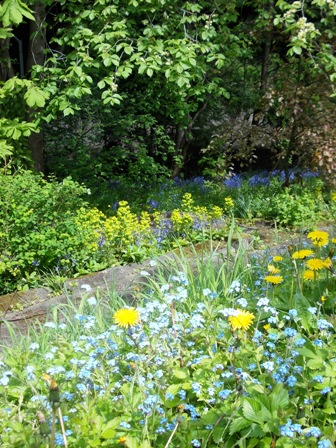
Companion growing - bluebells and well behaved dandelions


Forget-me-nots tumble onto the curving path

Bluebells are promiscuous. They go with everything/

Bluebells against the long bottom wall. I think the deep blue says these come from seed through several years, not from old bulbs. Here and there we have white flowers which I think suggests ancient bulbs still flowering.
The bottom bank. There was an old apple tree here once, but we lost it,

Glorious greens with Love-Lies-Bleeding


Dandelions mingling with buttercups and bluebells.

Champion campions keep the bluebells company

Trees dominate the garden,

Forget-Me-Nots and bluebells near the bottom path.


And more trees 

Neighbours through the trellis in what is, after all, a town garden.


LinkWithin

Related Posts Plugin for WordPress, Blogger...