Showing posts with label Romans. Show all posts

Friday, 1 February 2013

Making them live – Peopling your novel


I think perhaps you have reached the end of the beginning of your novel. I don’t know about you but I begin a novel with three things – a time, a place, a person. My feeling is that they all come at once, although I could be wrong. I have written here about  the place which is my present obsession with my  invented map of a particular place. The time is unambiguous: the year 383AD. Research for this involves many umpteenth-hand stories, only marginal written evidence and many objects. Not easy but in the spaces in between there is luminous space for inspired fiction.

But before all this there was always the person, lets call her H. Now after these months working on the beginning she breathes; she talks; she is fully clad in clothing that suits her time and her place. Much of the story is told from her point of view. The more I write about her the more she lives.

So I can think about her in a non-literal way I have drawn her at the centre of a web. Spiraling out from her at the centre are the other characters in the novel: the great and the small and small. Some of them I know almost nothing about, except that they touch her life and influence her fate. Others I am beginning to know much better - both through her eyes and by flexing the well flexed muscle of my imagination.
Now I have five characters whose voice I hear and whom I can see when I close my eyes.

Top tip for you: In your notebook but not in your narrative write a top-to-toe detailed description of a character first in physical terms – height, weight, face, hands, feet, stance, expressions, speech style, expressions. Secondly write a psychological profile – personal history, attitudes, pains, pleasures. (You will discover much about them in this process.) Now write a paragraph from their point of view of how they see another character in your story. And one line of speech. Then he or she should be there in your head, available to act and react in your story. Almost none of your description should actually be there in your narrative. However they will influence your writing and will be bedded down underneath the surface of your story.

Work in Progress extract from my beginning:  

... I look up, water streaming into my eyes and down my face. I flick my plait out of the pool, creating an arc of water that fragments and glitters in the sun. The man walks out of the  green glow of the forest,  leaving his horse with the other man, the dog skulking at his feet.  He says some words in Latin, telling them to stay back.
I focus now on a wind bronzed face under thick black hair threaded through with silver. He’s quite old, perhaps as much as forty years.  He’s as tall as Konan but more thickset. He wears his hair forward in the imperial way, held in place by the thinnest of golden bands. His thick black brows almost meet over a thin finely arched nose. His eyes are bright and blue as cornflowers.
When I first meet him I notice everything about him. But of course he’ll never realise this. Not now and not later...

Happy writing!

Monday, 22 June 2009

Borrowing Characters from History

It’s heating up down here. The municipal flower beds are blossoming in an entirely different configuration to those at home. Penstemon, lavender, gaura, marigolds, - all subtly planted in an apparently random fashion that mimics the natural wildness of the riverbanks that we saw here earlier this season. A far cry from much brighter, jolly bedding plants packing out the centre of roundabouts at home.

Outside the city in the numerous vineyards the plants in their lines are a hot bright green and the grapes are plumping up under the sheltering leaves. The corn is as high as an elephants knee – it’ll be a while before it reaches his eye… And we’ve actually witnessed the harvesting of a golden field of wheat months before such events back at home.

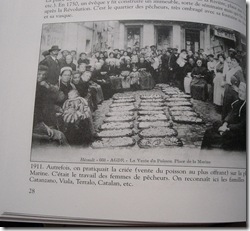
In the heat, one cool place - in more ways than one - to sit and talk or write is la Place 195de la Marine at the far end of the quayside, past the rather grand cafes bobbing about on their river pontoons. In years gone by this square was where the fishermen would land their catches and they (or their wives) would sell their wares.

But now la Place de la Marine is a dappled open space, lined with plane trees which shade blue tables belonging to a small, elegant cafe called Cafe Capitaine where charming people bring you coffee, wine, or fine food to fuel your thinking, talking and writing

Interestingly, inside the cafe is a very colourful, illuminated picture of a large boat. Before it is a small sailing boat where stand our own sailor adventurers, Nira and Allan and their black dog. (see Nira and Allan)

Even on the hottest day at this end of the quayside, you can rely on cooling offshore breezes, as well as catching the last rays of the sun at the end of the day. I’ve drafted chapters of the new novel here. I’ve watched children play independently in family groups, the big sisters and brothers taking care of the little ones. I’ve watched droves of visitors arriving on their bikes, or off the small ferry that works its way up and down the Herault and stops at this small landing.

The children play around the statue at the centre of the square - a creamy evocation of Aphrodite, spouse of Poseidon, the God of the Sea. She’s wielding a paddle and stands atop a globe of the world. This statue is dedicated to navigators who have set out from this place and sailed the world’s oceans.

My own current favourite navigator is a sailor called Jean-Victor CannAsrtolobeac, who made a voyage round the world in 1826 in a ship called l’Astrolobe. The Astrolobe story has royal connections: hoping to find the last traces of an expedition led by a Captain Lapèrouse, which had disappeared in 1788 in the Pacific, King Charles X entrusted the search to a Frigate, Captain Jules Dinant d’Urville. This Captain loaded up at Toulon on 7th February 1826 on the corvette L’Astrolobe with a crew of 80 men, one of whom was Jean-Victor Cannac.

Now then! This young man’s family owned the Maison d’Estella – the house at the centre of my new story! And the Cannac family lived in the house right to 1916.

We have direct information about nineteen year old Jean-Victor from his sailor’s ticket. He stands 1m60 tall, has black hair which covers his brow; the same colour eyes. He has an oval face, a large nose, a small mouth and a dimpled chin. These fine attributes, his qualities as a sailor, and his willing attitude on board, were much appreciated by the Captain who eventually named an unnamed Pacific island after him.

How can any writer resist all this? It is either another novel in itself … oh dear I might have to come back!… or perhaps I might just borrow Jean-Victor as a prime example of brave Agathoise manhood and plant him in the middle of my story - either in the present day or in 300AD .

As everything here, this is all very tempting for a poor writer….

Wx

**********

Work in progress from At The Maison d’Estella

AD 396

As he and his hefty mate rowed their way between lush banks of the river, away from the city, the curly haired sailor talked rapidly to his passengers about how to make the frail craft work for them. ‘You put your weight so, messire,’ he said to Modeste, ‘then pull back hard. Then pause. Let the water do some of the work. The flow of the river towards the sea will pull you back a little, but you will make progress if you row, steadily, steadily.’

Then he nodded at Tib. ‘And you, young man, you know how I taught you to use the sail when you were small? Test the wind, then raise the sail. But we won’t raise it yet, The wind will be better for you up stream.’ He paused in his efforts and the boat drifted back downstream. ‘See? In this sweep of the river the offshore breezes could drive you back out to sea, And there you will both be lost, lost to us all.’

*********

LinkWithin

Related Posts Plugin for WordPress, Blogger...