Friday, 9 August 2013

High Quality Self Editing Skills for the Self Publisher


Here are my own recent conclusions and advice regarding the importance of high quality self editing in the world of contemporary publishing. These are highly personal and come after a lifetime of writing many novels and working with gifted professional editors – see my last post.

HyperEditing
I’m at the moment very absorbed in hyper-editing my Big New Novel for publication later this year. (More about this in a later post.)  Also have just re-edited and republished my novel Paulie’s Web for Kindle and for hard copy publication later this month (Hooray!).

So it occurs to me that if we – as I am at this moment –   are in the present day climate editing ourselves to the point of publishing we certainly need High Quality Self Editing Skills to produce our work to a professional standard.

Being Your Own Editor
As I said in my last post I’m a great believer in writing the novel that is in your heart, the novel you need to write, not a novel to someone else’s rubric or model.  But editing is different from writing. This hyper-editing process has made me realise that I’m beginning to take the more editorial position where I have become absorbed an editor’s perspective on my book. This does not mean I’ve discovered that I should change the substance or content of the novel; it just means that I’ve become much more aware of the reader and how she or he will see and read the novel; how they will read it and want to read on; how they will enjoy it and look for another novel by you.

The Process
My suggestions below might seem a little elaborate. But if you take it step by step you should end up with a readable, well edited and publishable novel to be proud of. I have to tell you this – elaborate thought it may seem - is much easier than actually writing a novel. I’ve been there and I know this is true.

My basic assumption before we start this process is that you already have on your table a well written novel with a good storyline in whatever genre, and interesting content. All it needs is good quality self-editing.

Setting about High Quality Self Editing

Layout – How it looks is the first thing the reader first sees when they handle a book.

Don’t forget that your computer may be automatically formatted business reports, brochures, and letters. You need adapt these to make them suitable for fiction. There’s nothing worse than trying to read a novel or short story laid out like a business report.

Some guidelines for tackling layout.
  1. Place Chapter Titles a third of the way down the page. I like to use titles but numbers are OK.
  2. Always insert a structural page break between chapters
  3. Text size 11 or 12 points – not larger – that looks amateurish.
  4. Line space I.5  
  5. Indent every paragraph except the one at the head of the chapter when you   place first line on the margin.
  6. If you change place, time or action within a chapter, leave a doubles space and place the first line of the new paragraph on the margin and then continue indentation.

Laid out in this fashion your original drafted, transcribed manuscript begins to look professional. Now you’re looking at it more like a reader. This is a help for the next stage which is -

Passionate Substantive Editing – essential for High Quality Self Editing.
Some tips:

1.Read the text out loud chapter by chapter, right through. Just mark anything that sounds lumpy or doesn’t flow. Scribble in self suggestions. Have - and enjoy – a reader’s dialogue with the text. Insert amendments  that enhance your meaning or improve the flow of your text.

2. Sort out the paragraphs.
Paragraphs can be a puzzle. I meet good writers in workshops who haven’t yet got paragraphs nailed. It’s a bit of an ambiguous area. To a degree paragraphing can be a matter of taste and style. Paragraphs in modern literature are distinctly shorter that those written in novels – say – before 1946.
If we aim for High Quality Self Editing we have to make our own choices regarding paragraphing. Me? I’m of the opinion that white space on the page makes text more accessible and helps it flow forward.
So here are my useful rules of thumb.
·         New speaker, new paragraph
·         New idea, new paragraph
·         (As stated in Layout, above). If you change place, time or action within a chapter, leave a double space and place the first line of the new paragraph on the margin and then continue indentation.
·          
3 That sorted you can now move onto other things
·         Carry out a computer spell and grammar check to iron our residual mis-spellings, expressions and extra spaces.
·         Read the whole text again (I know! I know! But this is still High Quality Self Editing Skills after all.
·         Now get your notebook and make list of the names you use in your story. Check back through your novel and make sure they are consistent.
·         Turn a page in your notebook.  Now go through your novel and check the physical characteristics of your characters (hair eyes etc). Are they consistent? (I had a novel where a central character mysteriously lost a limp half way thought the novel.)  Make amendments to remind the reader of these characteristics as the novel unfolds.
·         Spell/grammar-check any changed sections. Or the whole novel again if necessary.

Hooray! Now you have your complete well edited novel, well laid out and easy to access.

SO NOW give your novel to a literate, well-read friend and supply  a pen and a pack of Post-It notes.  Of course you can could use (expensive?) proofreading services but the highly literate friend can be just as good for those aspiring to High Quality Self-Editing, Attend to her or his queries and make amendments to the manuscript where you think it appropriate.  Make useful amendments but don’t alter the nature of the novel.

Then one final and rigorous spelling/grammar check on your computer and you have what I call a novel in Good Heart.

Finally –More grammar/spellchecking. What, you say? Well, this is about high quality self-editing skills.

So it is near perfect. This is your final chance to look at your novel as a near-perfect whole and you can ask yourself some useful questions,
·         Look at the beginning and end of each chapter. Are there valid connections here in terms of words, phrases or ideas? If not, think about inserting some. It could be a single word or phrase.
·         Look at the end of one chapter and the beginning of the next. Is there forward movement? Is there flow? Is there some energy on the forward movement?
·         Consider the first and last chapters. Do they convey a kind of symmetry in the novel, however ambiguous?  I don’t mean here cute resolutions. Endings are not about explanation or expiation. However there should be a valid connection that momentarily gives the reader (however subliminally) a sense of the novel as a whole.
·          And if you have made your characters live and breathe the end of a novel is just the end on a beginning,
·          
Now …er… one last mechanical spelling and grammar check. Ouch! Don’t hit me!

But now your novel has really benefitted from your High Quality Self Editing Skills. You have become an editor as well as a writer. Your book will enjoy a credible professional presence out there in the world, whether you publish it yourself or allow someone else the privilege of publishing it,


The key to this success is to relish and enjoy the process of producing your novel’s best self -  a self which will appeal to readers because in the editing process you have truly thought of their pleasure in reading it. 

Monday, 5 August 2013

Visionary Publishing

I am currently preoccupied with two exciting editing tasks:


  1.       Having completed nine tenths of my Very Different New Novel  I have gone right back to the beginning to tackle the super-edit of all time before I flourish with confidence, knowledge and insight on that vital last section.
  2.        I am re-editing an earlier novel - already popular on Kindle -to publish it in hard copy and to publish the revised edition again on Kindle.


This has made me think anew about the nature of publishing.
My Current Cave


In what now seems like the good old days my books were edited by experienced professional editors, the main one of whom was brilliant, insightful and enabling.  In writing and publishing more than twenty novels, having worked with this great editor and a couple of good ones.  Their informed, functional and ultimately visionary approach to editing has been an education. All of this contributes to my own  present exciting task of last-stage editing.

Nowadays the responsibility for proper last-stage editing for publication is more and more the responsibility of writers themselves. This is very much the case with the varied and very different aspects of self-publishing, including Kindle and other eBook publishing.

One has to admit that one outcome of this is the problem of under-editing that one does witness in eBooks. Although I reflect that in their hurry to sweep through a story very fast this might matter relatively little to modern readers. The jury’s out on that one.

Fundamentally I think there’s been a sea change in the nature of professional editing. One aspect is that modern commercial non-writing editors who – often before the fact of writing -  guide, commission writers to produce what they see is ‘hot’ in the market. This is why we are treated to variations on  Fifty Shades of Vampires, Mutant Teenage Masochists, Uncaged Rampant Soldiers, Uncaged Rampant Housewives.

The outcome of this in the commercial field is a body of competently written, derivative  narratives as consumable, digestible and forgettable as cornflakes and going in the same direction.

Now no wonder the Writers in the Caves are turning with relief to various forms of self-publishing.

The current Business Model that dominates publishing forces even idealistic editors to root around frantically for the Next Big Thing. What seems to escape them all is that the Next Big Thing only becomes visible in retrospect and such a novel will be the outcome of some writer obsessing away in her or his own writer’s cave, producing some idiosyncratic story that will find a very new way to pluck the heart- and mind-strings of dedicated readers.  

It’s ironic that some such books do in the end become commercially successful through being  ‘found’ by commercial publishers, having been market-tested for then in the eBook or self-publishing process. (Less risk for them here, of course.)

 To discover the Next Big Thing good editors and their managers need to value risk-taking. This is so even when serving the Business Model that appears to demand a Sure Thing for its investment.

For them – however idealistic they are - the Writer in the Cave is no Sure Thing investment at first. They need to learn again to take risks to nurture interesting fiction which will still be enjoyed by a very wide readership. They need to have a new vision.

Until then we Writers in Caves need to become better and better end-stage editors of our own work so that when it gets out there into the public domain it’s as good as or better than the commercial competition.    
  

NEXT POST: Visionary Editing – My Top Tips for First Class Last-Stage Editing.

Not the next Big Thing
but an original novel
bought and borrowed by
many thousands...


From my Writer’s Cave.W

Wednesday, 24 July 2013

On Not Being a Futilitarian

  
 'Sontag was among the first critics
 to write about the intersection
between 'high' and 'low' art forms,
and to give them equal
value as valid topics...', 

I found this quotation (see  below) - by the magnificent Susan Sontag -  on the brilliant Brainpickings Website which provides insights from  all kinds of writers and writing. I turn to Brainpickings when I need something inspiring to spur me on in my life and my writing. Take a look at   Brainpickings    


My favourite phrase here is ‘I choose not to be a futilitarian.’ Being somewhat depressive I have to avoid the company of negative people, whom I shall now - following Susan Sontag - call futilitarians.


Susan Sontag quotes From Rilke:
'… the great question-dynasty: … if we are continually inadequate in love, uncertain in decision, + impotent in the face of death, how is it possible to exist?’' Then says ...

'...Yet we do exist, + affirm that. We affirm the life of lust. Yet there is more. One flees not from one’s real nature which is animal, id, to a self-torturing externally imposed conscience, super-ego, as Freud would have it– but the reverse, as Kierkegaard says. Our ethical sensitivity is what is natural to man + we flee from it to the beast; which is merely to say that I reject weak, manipulative, despairing lust, I am not a beast, I will not to be a futilitarian. I believe in more than the personal epic with the hero-thread, in more than my own life: above multiple spuriousness + despair, there is freedom + transcendence. One can know worlds one has not experienced, choose a response to life that has never been offered, create an inwardness utterly strong + fruitful.'  


Friday, 19 July 2013

Nobody Dances Any More

I went to Hartlepool Art Gallery  for a writing  Workshop and  was inspired by the  sensitive video installation by artist Neil Armstrong - a detailed  tribute to the iconic Rink Ballroom in Hartlepool which attracted thousands in its time. The installation features  images and interviews with dancers and Hartlepool people - a wonderfully poignant evocation of a time and a place which will strike a chord with anyone who recognises the importance of the 1950s and 1960s as an historic sea change in British popular culture, whether or not they come from Hartlepool.

Here below is something I wrote in the gallery cafe in  response to this strong inspiration.

Join  me at my workshop next Wednesday 24th July  at 6 o'clock at Hartlepool Art Gallery and be equally inspired - to write or just reflect on a significant time in our history.


Nobody Dances Any More

The Benny Nelson Orchestra at the Rink. C 

Nobody Dances Any More


You going to the dance tonight?
Yes. See you there then
More couples in this town
met there at the Rink
than anywhere here

People with white hair are planted
in a circle of padded chairs
smiling, gesturing the hand jive
rhythm embedded in their brittle bones
Remembering the Rink

White swans, black swans swim
on the pool in the park. On the beach
white Punch wallops black Judy against
chemical towers on the skyline
Remembering the Rink

My dad was a panel-beater on ships
- that not a good thing
-  asbestos was a curse and
it was not an easy time 
Remembering the Rink

Long views of Hartlepool, beneath the
blue sky, against the grey sea, the long beach
I’d just started work at ICI.  I got
one pound a week pocket money
Remember the Rink

Now the space is bald and vacant
once a glittering palace of dance
We shuffled through the crash barriers
Bouncers at the door
Remember the Rink

Benny Nelson and his men 
made me want to shout, shout
as we danced  round our handbags
bopping in black and white
Remembering the Rink

My Dad sailed on ships
then in the war transported stuff
in convoys to Russia -
never talked about it after
Even at the Rink

Nobody dances any more
except when sitting in a cosy circle
gesturing the hand jive -
shades of their former selves
glitter in their eyes
Remembering the Rink


'...they did play at The Rink and the same 'Rink' jackets as the photograph just above from Paul Flush. It's the same line up here with Paul, Johnny Blackham, Pete Trundley, Terry Metcalfe, Russ Nicholson (of Russ and The Nickels fame) and Al Flush.'

Great info about dancing in th 60s and 70s in the North East at http://stanlaundon.com/rink.html


Wednesday, 10 July 2013

Walking Naked with W.B.Yeats

Sorting out my books after my holiday  I came across this glittering poem by  the ineffable W. B. Yeats. Although  it's in my own  book I'd never read this poem before. There in my bedroom it came to me like a warning. It has so much to say to any writer - particularly me, now when I'm trying to embroider my own story out of a particularly arcane mythology.

Walking naked looks like a possibility.

A Coat
I made a song with my coat     
Covered with embroideries
Out of old mythologies
From heel to throat;
But fools caught it,
Wore it in the world’s eyes
As though they’d wrought it.
Song, let them take it,
For there’s more surprise
In walking naked.
W. B. Yeats


Sunday, 7 July 2013

Postcard from Agde Last Day Blues

 From my notebook, written in the café the day  I came away:

Last day

Last morning sun hits the pavement     
glittering through plane trees

Last walk around the market,
dazzled by bright colour

Last laden market stall,
selling striped tablecloths

Last encounter with the Russian,
three euros for café crême

Last laden woman,
straw basket on each arm

Last child on bright bike,
racing round the fountain

Last walk down narrow streets,
making for the shady side

Last circle of old women
on plastic chairs, talking.

Last man with dog in basket,
pushed under the table

Last sight of two men kissing,
clasping hands in greeting

Last taste of peaches,
juice dripping down chin

Last loving touch, dressed up
in careful cuisine

Agde 2013


Wednesday, 3 July 2013

Postcard From Agde: Elen in Trier - Work in Progress


The Porta Nigra.
The Porta Nigra Trier 
 A sense of place has been the theme of my recent posts. My new novel  has three locations – Romano British Wales, the Brigante North, and Roman Trier.

Here is a girl who  has risen to great heights  but still longs for home

Elen in Trevorum: 383 AD

‘….One big problem here in Trevorum is the heat. There are times when I dream of the storm rain coming off our great inlet at home; and I dream of the cool air on my face as I walk down the mountain to the Other Place. And in my dream I feel the wind in my hair as I urge my grey horse forward on the track by the salt flats. Most of all I dream of that first time I met Macsen in the Brigante North when I was washing my hair in the cool water of the holy well.

…I met this man in the great receiving chamber in Trier. Macsen and I were sitting on our thrones – a great throne for Macsen and a smaller throne for me. I have to say that ne either of them is as grand as my father’s throne at home, made of the tusks of a great dragon that roamed our land in ancient times. They’re not even as grand as the gold and silver throne of my Brigante grandfather. But I suppose they w’ll have to do.
… In those early months I’d got used to the parade of people coming to pay tribute to the new emperor. They are escorted into the chamber and bow and scrape and luxuriate in the ceremony. They bow deeply before Macsen and less deeply to me. Truly these people only have eyes for the new emperor. After a while the ceremonies make me weary, especially now that I have this wriggling child growing inside me.
But on this day, just as I about to rise and tell Macsen I need to rest,  I keep quiet, aware of a mutter of expectation among the crowds of people in the long room. All eyes turn to the great golden doorway. Some of the people are standing on tip-toe to get a better view.
That  was when a tall rangy man in very simple clothes walks in. Macsen mutters in my ear. ‘This is Martin, the holy man out of the city of Caesarodunum. Remember I told you about him.’ As he approaches I note a big bluff fellow, more farmer or fisherman than priest; in height and girth and straight gaze he reminds me of my father. 
He approaches the throne and greets Macsen first with the soldier’s greeting of a hand slapped across the chest. Then he bows to him. I know from Macsen that he was twenty years a soldier before he became a holy man.  Now he turns and bows equally deeply to me and looks me closely in the eyes….
Model of Augusta Trevorum - Roman Trier 


Sunday, 30 June 2013

Postcard from France: Living Inside Your Own Stories

It can be a problem, as a writer, to know where work starts and play ends, or work ends and
play begins. This is never more so than on holiday when I feel I am living inside my own stories.

So, here I sit, in this café at the end of and ancient quayside – in use since this town was a Phoenician trader’s port in 600BC. Like the 17th century Maison D’Estella where we stay the quayside plays in a recent novel :


… Now we’re on the quayside and I stumble on the uneven lava blocks that pave it and – quite naturally – he takes my arm. I can hear the jingling of boat tackle and the shout of seamen’s voices but these there are no boats drawn up on the quay just waiters and waitresses setting out cutlery and napkins in the smart pontoon cafés huddling here in the place where ships once docked, drawn up side by side, ready to unload. Madame Patrice said that, didn’t she?
‘You know Madame Patrice? You said you knew her,’ I say.
‘I think I probably do. I knew her husband Ettiene from another time. He was a great scholar. And I am acquainted with Madame Patrice. But I’ve not been here so long, this time...’ From my novel An Englishwoman in France.

And this week I walked around the corner fromthe Maison d’Estella  to a tall thinhouse on the Place de la Glacière – visiting the apartment of my writing friend Avril. This is in another ancient building which has cut into its roof the highest terrace in the town. Here from the same novel the time slips back to 300 AD and nine year old Tib is looking down over the town from the ramparts of the house of his father, the Roman governor of this part of Gaul.  

;…Tib: Good Fortune, 301 AD
A warm, salty breeze lifted the bright reddish hair of the boy, sometimes called Tib, who was sitting with his legs dangling from the flat roof of the house of his father, Helée, governor of this city which was now laid out below the boy like a map.
In front of him the neat road – square blocks of basalt – led straight down to the busy river harbour, widening halfway where it joined with both the straight road down from the barracks to his left and the narrower road to his right  that led down from the  graceful Temple of Venus. The clusters of houses on either side of the road were laid out in a grid, their black stone walls relieved by clumps of wild fig and bulging garden plots.
Tib raised his eyes and watched closely as the elegant ships hauled down their sails and resorted to the power of muscle and oar to manoeuvre their vessels into the teaming river port finally to squeeze into spaces alongside vessels already drawn up at the long harbour wall.
But however fast or elegant the ships were in reaching and tying up at Good Fortune, they had to wait their turn to be unloaded by the labourers and slaves working for the long-haired man – looking more like a pirate than a harbourmaster – who goaded them on with a combination of roars and threats which they answered in good measure. Even up here on the hill Tib could hear the deep, gravelly sound of their throaty curses.
Tib felt proud of the order and efficiency of hundreds of years of harbour routine that drove the port to such success. His father’s tax scrolls were witness to that. Now he watched the shouting workers on one part of the dock heaving ashore great jars containing fine goods – silverware, spices, pottery and wine imported into Gaul from lands across the Great Inner Sea. Then he leaned sideways to see slaves manhandling racks of  the equally tall earthenware jars now containing wine and grain, salt and oil , ready to take them in the other direction,  to the Imperial City of Rome…’ Also from my novel An Englishwoman in France

These days, of course the pink tiled roofs of 2000 years of town development obscure the grid and prevent a direct view of the quayside. But, further to the right within  the sweep of the River Hérault - whose wide estuary attracted the Phoenician traders to build the port – is the exquisite Art Deco façade of the early 20th century Maison Laurens.
Avril Joy's image of the Chateau Laurens
 from her terrace....
Now then, this location on the river plays a part in my new - not yet published -  novel to be called The Search for Marie France. In the novel I have a fictional building used as the headquarters of  the occupying Germans. In the real history of this town the Chateau Laurens actually did fit this ambiguous role. 
‘… Alone at last, Marie France could glance around herself with open curiosity at this familiar yet not familiar place.  She thought of the day she saw the cloister opposite - now just a pathway to the orchard -  used for target practice.  She wrote in her notebook:   “Three soldiers, two with their jackets loosened and one in his shirtsleeves (as white as Auguste’s mother could wash them) cleared the cloister and   brought out a sweating, terrified man – a Gitan by his looks - and tied him to the medieval stone column which must in its time have absorbed the sound of a thousand plainsongs. The soldiers took black pistols from their leather belts, exchanging grins. Other soldiers strolled across from their trucks and motorbikes to view the fun. Auguste, fear in his own eyes, backed away into a corner of the opposite cloister.
Then the three soldiers began to play this strange game - a not-to- kill game - where the soldiers fired at the man with orders not to kill him. He jumped and jerked as the pistol shots splintered the old stone around him. The soldiers jeered as the poor man wet himself and held their noses and shouted ‘schmutzigen Zigeuner‘ when he shit himself. It was a relief when he was dragged off, eyes rolling but physically unharmed, out to a truck then onto the camp down the coast where we know now that gypsies, politicos and people like my own mother and father were interned  before being transported East. The cloister smelled differently then. The scent of blood and excrement was in the air.”  Marie France put down her pen and absently rubbed the swollen joints on her writing hand…’
From The Search for Marie France.


I’m now - fuelled by great company and wonderful imaginative food from Licked Spoon - working here on a new novel  at the Maison D’Estella.
More about that – actual work in progress! - before the end of this week.

Certainly, alongside bookish company, drinks on Avril’s high terrace have been an extra inspirational treat this time.

Wish you were here

love

Wendy

Wednesday, 19 June 2013

Post from Agde 2: The Window


Early dry thunder then swirling seagulls precede the dawn. They hawk and laugh like old men at a wedding. Now later some smaller bird is chirruping. Not a starling. I’ll ask around.

The sky is overcast this morning but the air is warm and soft with the sea.

I’ve finally set up my writing table beneath my bedroom window which overlooks the courtyard with
the staircase that goes nowhere.

This morning I intend to venture into the flea market in the market place. This was where last year I bought a 1940s leather handbag, and three wartime postcard messages from occupied France in World War 2. 

 This reminds me that these objects feature in my novel which will be titled The Search for Marie France – which is not quite out there yet. perhaps today I'll find some new inspirational objects.

And I recall that  this house The Maison D’Estella and this town Agde both feature strongly in my novel An Englishwoman in France which is out there.

Wish you were here
Love
Wendy


Tuesday, 18 June 2013

Postcard from Agde: The Courtyard


Balsalt Paving
Escaping the cluttered house and the cluttered life and the writing of an intense (though not cluttered … ) novel, I am now at the Maison D’Estella a medieval house lodged tightly in the centre of the  2,700 year old small Languedocean  port town of Agde - my favourite place in Europe apart, perhaps, from Bishop Auckland.

Originally built by Greek traders and occupied by the Romans, who both left their marks on the town it ‘s now an intricate,un-touristy coastal town in the Languedoc tidying itself up for next year’s election.

New door in old doorway
Around us are doors and windows
 from several eras
of this mediaeval building.
We have our breakfast in the high walled courtyard which is paved with blocks of volcanic basalt,


Windows are set in older doorways. Doorways are set in older doorways. There is a medieval staircase which leads nowwhere.

Breakfast is fresh bread and croissants, made this morning, with fresh butter and marmalade made at home and brought here by Licked Spoon.

And a little posting.

Heaven or what?


The biggest problem here is to decide just what I want to read. More about this later.

Monday, 27 May 2013

Chelsea and The Accidental Gardener


The lower bank. If you leave this land alone at all
 then bluebells sprout up everywhere.
(More pictures below...)
Walk around my garden with me...
I spent some coffee times last week enjoying the elegant and perfectly coiffed perfections of the Chelsea Flower Show. Debora   was there, as was gardening friend   Gillian. My friend Avril  was going to go but did not quite make it.                                   

 I did not envy them, as for one thing I don't like crowds; for another I am merely an accidental gardener. Oh and there's this third thing - flower names do not drip off my tongue like honey. The only one I remember is Alchemilla Mollis because its name scans and because it holds drops of rain like tears in its exquisite leaves. And it thrives in shade and my garden has lots of that . Oh, and I know Forget-Me-Nots and Love-Lies-Bleeding from my childhood fascination with the names.

Many years ago I did plant and grow things fairly successfully but once  I plunged myself into the compelling career of writing it totally engulfed  my planting, growing and making instincts,my hot-housing  and propagating energies. I stopped sewing too.

More then thirty years ago we bought this house in the middle of a small market town,  Built in 1870, the land on which it was built was carved out of a bit of ancient woodland. So  apart from a useful  lawn, our garden is  mostly trees and a long lumpy  bank. And it cannot be tamed; it  can only be gardened by accident.

I have featured the house - in various guises - in several of my novels but only this year in my new novel has the garden appeared as a significant part of the story. To do this I had to imagine this plot of land 1600 years ago when this area was a forest. That was fun
Extract: (Elen) '... No wonder they call this Oak Place. I walk and walk and the trees open out making a green space on each side of a trickling spring which steadies itself in a pool then spouts down the hill to join the bigger stream that I’ve just crossed.  Around the pool is a low wall cunningly built without joining mortar  - a thing they do very well in these parts. In one place the wall widens into a shelf lined with golden stone. Here are wilting flowers crowded together and already smelling of decay;  three finely crafted clay jugs;  two glittering bronze bracelets and in the corner  a sheaf of barley. I add an offering from my mother for whom this pool holds happy girlhood memories: a silver pendant set with green glass. As I set out on this journey she told me she hoped Branwen would be here at the pool to meet me....'                                                  Work In Progress,
Walk around my garden with me ...

Last year we cut down this giant tree but left the base as natural scuplture.


These grow wild right at the bottom of the garden, beside the long wall.


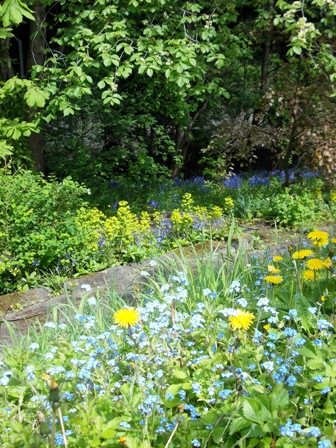
Companion growing - bluebells and well behaved dandelions


Forget-me-nots tumble onto the curving path

Bluebells are promiscuous. They go with everything/

Bluebells against the long bottom wall. I think the deep blue says these come from seed through several years, not from old bulbs. Here and there we have white flowers which I think suggests ancient bulbs still flowering.
The bottom bank. There was an old apple tree here once, but we lost it,

Glorious greens with Love-Lies-Bleeding


Dandelions mingling with buttercups and bluebells.

Champion campions keep the bluebells company

Trees dominate the garden,

Forget-Me-Nots and bluebells near the bottom path.


And more trees 

Neighbours through the trellis in what is, after all, a town garden.


LinkWithin

Related Posts Plugin for WordPress, Blogger...