Friday, 28 May 2010

Crime on The Writing Game

clip_image001Novelist Anne Cleeves in conversation on THE WRITING GAME. “What do you need to be a writer? The biggest thing is concentration – because you need to create this fictitious world and if it’s not solid and real in your head then it’s as though you’re writing from memory, not imagination, and you can’t expect your reader to join you in that world..…

(About her success) There was the chance of being on Shetland one winter and people on Shetland encouraging me to write that first Shetland novel. And then having a wonderful editor who will get behind you in a good publishing house you need an advocate for your book within the house. Mine was wonderful. She did things like send the first chapter to all the reps. She really got behind it.

I’m still of this big learning curve with my community programme The Writing Game but am making progress. I now know how to edit my own tapes that comprise the segments of the programme and spent yesterday afternoon with James Burrage of Bishop FM putting the segments together into one smooth flowing programme. (A new process which I’m just learning…) I glowed with pride when James nodded wisely and said the tapes were spot on. o now that one is put to bed ready to be broadcast next Tuesday 1st June at 7pm. Do listen if you are in the area or watch out here for the podcast.

It has been worth all the work because the production on this programme is much better. One improvement is that, on the advice of Al from Australia (he got hold of the podcast of Prog 1) I have not used music links. He was so right. Thank you Al. So my Crime Writing programme features conversations with Anne Cleeves the Gold Dagger Winning Crime Writer, Peter Walters: Wear Valley Writer Leader and a new Crime Novelist and we have Crime Novels of the Month from Glyn & Gillian Wales.

There is so much great stuff on there. Such great voices. Listen to Ann Cleeves dispensing fresh wisdom about her particular writing game. She's very generous and inclusive and has lots of really fine advice for new writers.

Part of my contribution was …

“‘Perhaps we all think we can write a story with a puzzle, a detective and a solution! Perhaps we could all have a stab at exploring the dark recessed of a criminal’s mind! Crime Fiction is the most widely read field of fiction and covers a whole range of styles from cosy whodunits to murder most gruesome. In this programme I will explore how working writers tackle this widely differing genre. Listen in on June 1st and share their world, and perhaps be inspired to have a go yourself…”

Happy listening. Happy writing.

wx

Friday, 21 May 2010

Ah, Bluebells…

and more

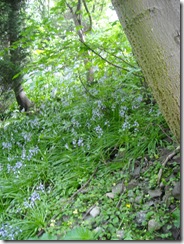
In this household we know that the summer is on point when the bluebells arrive to strut their stuff our garden. We have this bank to the side of the house which, if left to its own devices, sprouts thousands of bluebells. In recent months/years it has rather been left to its own devices because of writing and other work. So up sprout those bluebells. Everywhere.

I read somewhere that when this happens it’s a sign of very ancient woodlands, even a thousand years old. As this house is in the middle of a small, busy town I think this is very precious.

G is setting up his very neat vegetable patch G Keeping and eye one things down at the bottom, with its small miracle of carrots, garlic, leek and cabbage, all now putting their tiny seedling heads above the parapet.

cABBAGE

But it’s a bonus now, in going down there, to relish this mall miracle and be reminded that the large thousand year miracle of the bluebells and more b...is still with us.all set with 140 year old wall

Another bonus is witnessing A, the boy who likes chocolate role-playing a social realist Russian Poster of the 1930s…

Angu being a Russian Social Realist Poster

bluebells again

Ah, bluebells…

wx

Thursday, 20 May 2010

Getting Off The Gear

There is no Idea Dump, no Story Central, no Island of the Buried Night VisionBestsellers; good story ideas seem to come quite literally from nowhere, sailing at you right out of the empty sky: two previously unrelated ideas come together and make something new under the sun. Your job isn't to find these ideas but to recognize them when they show up. Stephen King

‘….He himself was lately dodgy rather than just dodgy because the gear started to make him throw up and he had somehow heeded the Dire Warning from a guy called Cragan whom he met in the Black Bull.

Cragan – a strange, uneasy sort of man - turned out to be a doctor and it was he who got Tegger off the gear. Cragan convinced him that he didn’t have an addictive personality. He’d just been having a really bad time and was self-medicating. They only ever met in the Black Bull but in those months Tegger got himself clean. He’d even shown Cragan some of his writing. There was trust between them. That last time they met Cragan brought him a pile of novels - battered paperbacks - and said he was going away to America, where he’s got this job in a psychiatric hospital.

Tegger never saw Cragan again. He read Cragan’s books, line by line and as he read them it was as though he were in the Black Bull with Cragan, arguing the toss. In the stories were people he recognised. There were even people like himself…’

wx

Monday, 17 May 2010

Writing and Knowing

Writing teachers invariably tell students, ‘Write about what you know.’ That’s, of course, what you have to do, but on the other hand, how do you know what you know until you’ve written it? Writing is knowing. E L Doctorowhats etc 042

‘As the plane taxis, charges, and then rises into the sky, I find that Aurelie is a businesswoman to the fingertips. The free way she talks about herself and asks me questions tells me she’s not English. It seems she’s a buyer for superior English shops, shipping all kinds of goods from France to England. ‘And you? What is it you do, Ruthie?’ she murmurs.

We finally dispose of the fact that I’m a writer and she’s never-heard-of-me-but-will-look-for-my-books-in-the-future, when the flight attendant comes with her trolley.

We have tea and – at Aurelie’s insistence – brandy. Then we sit back in our seats, assessing each other as people do. Aurelie is tall, anything between forty and sixty years old. She’s fine boned, with a delicate, intricate face. In her faintly accented English she begins to speak of her love for the English countryside and I find myself telling her about the Foxe’s house and my plan for writer’s retreat. ‘In the end,’ I say. ‘It didn’t quite come off.’

Wx

Wednesday, 12 May 2010

Text , Sound and Cultural Taboos.

Putting your head above the parapet is often proscribed by powerful cultural taboos.  This is particularly so in the regions of the English working class from where I emerge. The old childhood maxim of not ‘making a show’ of yourself or drawing attention to yourself can bite deep into quite mature  personalities.

As a child and young woman I was achingly shy, didn’t like encountering strangers or being at a crowded gathering. In those early days, not ‘making a show’ of myself suited me fine. But it seems to me now that underneath the surface self of this watchful, tongue-tied girl, a raging exhibitionist was hiding.

It was hidden well. When I first went to college I lost my voice for a week before things normalised, But the inhibitions stayed. When I first started teaching I lost my voice for two weeks. I had this very boisterous class of twelve year olds in my first school. So I had to write QUIET!! in very large letters on the board quite a few times in those two weeks. They were great kids, though.

All that time,  though,  the exhibitionist was at work - writing articles, stories, mapping novels. It was a secret  nobody knew about. Writing was a perfect medium for this shy tongue-tied girl. She could say, imagine, invent what she liked without drawing attention to herself.

But the fact is that in teaching it only works if you do draw attention to yourself. Teaching children taught me not to hide behind my shyness, to let the exhibitionist inside have her airing.  She could be funny, daring, expressive. She could be herself. The children loved her, They didn’t know you shouldn’t put your head above the parapet or make a show of yourself so it was OK. That was a comfort.l

After that  working with adults in large groups was a very big leap for this shy girl, But she’d learned in school that there was something in her that could really teach people, really do this thing,  as long as she became her other, more exhibitionist self.

Then, when the books and stories began to be published it seemed that I was not just looking over the parapet , I’d leapt onto it. But now  I had the book to protect me. Or the books. It was not really me, it was them. They were the things  ‘making the show’. The shy, embarrassed  person that is still me was only holding them.

And now we have the crazy situation of the community radio programme. This voice that repeatedly let me down in the early days is put to work, up there to be judged.  I hear my voice on the tapes and think how strange it is, how thin and nervous I sound. But I’m pleased now that I’ve learned the basics of sound editing. Editing sound means that I can nip and tuck the excesses of the reluctant voice.  Just as I nip and tuck the texts of my novels and the stories, making them their best selves, I can begin to nip and tuck my voice so its becomes its best self for the programme. Which best self it expresses, the shy girl or the exhibitionist, I’m not quite sure.

I’m loving the creativity of putting The Writing Game together, and talking to and listening to these great writers and readers. Still though, the shy girl and the exhibitionist live on in me side by side and I have to deal with them.

The learning curve continues.

wx

Sunday, 9 May 2010

The Joys of Cranking the Engine of a Novel

Recently, for the programme, I’ve been asking other writers how they start a novel and how they get on with completing it. I’ve also spoken specifically about how I was inspired to write my own novel The Lavender House. So, as I’m beginning a new novel, I thought I’d tell you how this process works in my case.

All writers work in their own way. I think I must be a seasonal writer. For years now, in late Winter/ early Spring I will be puzzling, speculating, making false starts, writing sketches (short scenes that may/might be in the novel) waiting for characters to walk onto my roughly prepared stage, into my dreamed landscape, demanding to be named and styled.

Notes, labels, names, sketches, images and maps start to litter the walls of my little room. My computer becomes petalled with notes and reminders. The novel grows first in a kind of impressionistic collage. The big table is stacked with opened books post-it-ed and ticker-taped with wild notes to myself.

In real Spring ( when the bluebells at the bottom of the garden are out) I feel impelled to start to write, to get into gear properly with this job . The story is bubbling up from the depths of my imagination, throwing up sentences and paragraphs like fire and gas from a volcano.The characters are elbowing their way out of the wings into the spotlight, moving from monologue to dialogue. Occasionally there are shrieks. Let me out! Let me out!

This is when I’ll write novel-stuff in my notebook wherever I am – car, cafes, hotels, park bench - taking pages like stored treasure back to the little room for the painstaking and rewarding process of transcription. Sometimes I’m amazed how brilliant the scribble is. Sometimes I can’t make it out, so perhaps it was too brilliant for this world… It's a mad, mad phase. I become more and more excited, and as the Summer moves into place I am buzzing away, writing every day, living the narrative and not noticing too much around me.

Sometimes at this midpoint there is a worrying haitus. Is it really a novel? Am I kidding myself? Am I deluded into thinking I can do this very hard thing? (Some people label this the Writer’s Block. I think it’s just the imagination muscle screaming for a rest.) So I take a good breather then I go back to the beginning and move more slowly forward again, editing and writing as I go.

With the coming of Autumn the days draw in and the growing darkness helps me to focus more closely on the way the narrative works. These latter stages are just as demanding and interesting but are as much intellectual as imaginative. This is the time when the firecrackers that I set away back in early Spring have to take their place in a coherent and interesting story. And in the end the form has to be right, The facts have to be right.

I don’t at all see this part of the process as a chore – it’s the final careful, creative act in making the novel work. It's like taking a garment you’ve just designed and made, and pressing it with care to make it fit and elegant for anyone who chooses to put it on.

By the beginning of December, with Winter set in, the novel is complete and ready to go on, on its own hopeful journey.

But now, with this lovely new novel (called so far XXX), I’m just at the beginning of this journey. I relish the familiar delight and and excited tension threading through my body. Writing like this is a visceral thing. Of all the things I do, my novel is where I am completely myself – travelling alone and enjoying it.

wx

(Pic tomorrow…)

Friday, 7 May 2010

Books on The Writing Game

(Stop Press - Was invited by Norman Geras be profiled on his great weblog You might like to check it out Wx - http://normblog.typepad.com/normblog/2010/05/the-normblog-profile-346-wendy-robertson.html )         Now back to books…

One feature of my radio programme will be a focus on the delights of reading, and how writers can use their reading to inform their writing. In the May programme we featured:  Books of The Month - chosen by Gillian Wales (Chartered Librarian & Ex Arts Centre manager) and Glyn Wales (Historian, ex Head teacher & University Lecture ).Their criteria are – Plot, Place, Character & StyleBishop FM etc 001

Their choices this month choice were   Chris Mullin: A View From the Foothills. (Profile Books) ‘A political diary of a Labour MP from 1919 to May 2005. Reading it restores some of my (Glyn) faith in MPs for it shows a humanity, selflessness and humanity notably lacking in the present parliament. The book’s also witty and entertaining and throws light on the roles of a back bench MP, a home affairs committee member and Junior Foreign Office minister. Uniquely Mullin remained a minister despite his opposition to the Iraq war… A man of principle.’(Timely in this week where we are left with a hung parliament. W)
David Lodge Deaf Sentence (Penguin) Good on style and character. ‘Retired professor coping in a good humoured was with the vagaries of the post professional and eccentric family life Touches on themes of a recession his and an increasingly electronic world of 2009 2010 Britain, Recommended.’

William Boyd: Ordinary Thunderstorms. Chatto and Windus
Better in plot and place, we think, though perhaps not so good in style. A conspiracy novel – a sort of 39 Steps for the Naughties It is about a man’s loss of identity and flight from pursuers. The Thames from London to the sea mirrors the hero’s own journey into the depths. A good read.’
Margaret Forster Isa and May – Deals with the relevance of the grandmother in today’s society and the controversial question of nurture versus nature. Novel will keep you guessing right to the end, despite, we think, an occasional overload of information
Philip Pullman The Good Servant Jesus and the Scoundrel Christ. Pullman’s retelling of the gospels. Here Jesus and Christ are a pair of twins. Pullman destroys the gospel story and articulate his own disbelief in the myth of Jesus Christ Pullman believes in the democracy of reading and doesn’t think it’s the task of the author to tell the reader what the book means. He says he is in the “Once Upon A time business” not the “Message” business.’

And Some Books Mentioned during the Programme Avril Joy:     The Sweet Track: Flambard Publishing In her interviAvrilBookHomeew Avril talks about the significance of place in her writing – in this book, the Somerset Levels

Wendy’s Novels    I used my novel The Lavender House (Headline Book Publishing) to demonstrate the slender and exciting starting points when setting about writing a novel.
Wednesday, 5 May 2010

On Air and In Shock

Well, the Writing Game went out last night on Bishop FM!!

It’s been the epitome of the cliché of a steep ‘learning curve’ in the Radio Times 002 Lisettelast month, learning absolutely new skills and gathering together ideas and people to generate this one hour radio show for this community station.

The programme was now all on tape so a few of us gathered to listen to it in my sitting room over glasses of white wine. Writers Lisette Rebecca Grout and Geri Auton were there already to record their piece for a future programme, and Avril was there for moral support.

The programme before The Writing Game was a very jolly, chatty, drive-time music show presented by two lively gRadio Times 001uys who were obviously having a good time. Like me they are amateurs but they sound so much more confident and polished than I know I feel about all this.

Then my music (Dave Brubeck) and my show. It’s very scary. I do sound nervous but I think I get better during the hour. I hope I’ll get more laid back and natural with more experience. My commitment shows through, I think. The contributors – Avril, Eileen, Hilary, Debora, Gillian and Glyn – are all marvellous. Apart from Debora, it’s their first time too. I have to say I feel there’s good, interesting content in the programme for both readers and writers.

Radio Times 003 Geri

Despite the great efforts of the lovely James Burrage of Bishop FM the continuity is just a bit bumpy – all my fault and I know I’ll make it easier for James next time.

One thing that surprised me was the surge of the sound of the advertisements half way through – a big contrast to our restrained voices discussing books and things, I’d forgotten about the advertisements. But it was very reassuring in its own way.

It finally dawned on me that this was the real world. That my programme, my Writing Game was really out there. On the radio. On air. Crikey!

*****

People have been very kind – here are some reactions:

First from Station Manager Gillian Campbell

‘Oh, and the show was fabulous - thank you. I had a house full sitting
around the radio staring at it (that doesn't happen very often in my
house, trust me!)’

…and …

Fan mail already - wow, I'm very impressed - well done! ‘

From people who listened

  • ‘Congratulations. The Writing Game was such a success - a brilliant new programme that will be a treat to look forward to each month.’
  • ‘Congratulations! All your hard work paid off and The Writing Game comes across as well presented, interestingly structured and inspiring, The features were short enough to hold the listener’s interest and sufficiently varied as magazine-type programmes ought to be. Well done.’
  • ‘Many congratulations on a good first programme.. Here's to many more.’

That’s it – here’s to some more. Crime next time. I’ll just go and put a cold compress on my head

wx

Monday, 3 May 2010

Crime , Ann Cleeves, and The Art Of Interviewing

On Saturday we drive across the moors to the HexhamAnn Cleeves Book Festival. PD James, whom we hear speak later, says she’s rarely up here but how wonderfully beautiful is the countryside her. Perhaps, she suggests, we don’t talk about it much because we didn’t want people coming up in hordes and spoiling it. Well deduced, PD.

We’re in time to witness this Empress of Crime Writing in conversation with the shrewd, flamboyant and generous VaL McDermid. This is no ordinary interview. It’s a merry, respectful conversation between two fellow professionals who know their art inside out. The generation gap between them is invisible. Their mutual admiration is evident. It’s all peculiarly intimate, given that they’re before a tiered audience of several hundred people.

The informality of the conversation is deceptive. It fosters a stream of insightful talk about the nature of the crime novel and its place in literature. It celebrates the diversity of the way writers work and think. It allows us to grasp something of the high professional commitment of this woman who has operated on top of her game through forty years who is till playing hard. She talks of just one more Dagliesh novel…

Then we have a rather surreal lunch at a Wetherspoons pub located in a rather lovely Art Deco venue that was once a cinema. (This reminds me of the Golden Age of Crime Fiction – ladies sweeping down staircases flaunting cigarettes in long holders, and all that.)

As well as sustaining the life of unusual buildings, these Wetherspoon pubs never fail to interest me in the diversity of their clientele – families equipped with drawing books, lone fathers with their children, brooding individuals, men in work clothes, blokes in groups, ladies who lunch lightly. It’s not Groucho’s, where like seeks like and where wannabes try on the Emperor’s New Clothes. It’s much better than that. More stimulating, So much more real life.

But the real purpose of my day is to interview crime writer Ann Cleeves for The Writing Game, my new community radio programme. Ann, Avril Joy and I sit in an upstairs room and talk about Ann’s writing life and how - after writing steadily for twenty years or so - she became an overnight success when she won the crime writer’s Oscar, the Golden Dagger Award and has not looked back since. Translations, film series have followed. One of several keys to her success has been the locating of the last series of detective novels on the Shetland Isles. She has a great sense of place. In fact she’s off to Fair isle tomorrow to celebrate - along with her agent, her publisher, her friends, fans and press - the launch Blue Lightening the last of her Shetland Quartet.

That will be some journey (13 hours from Aberdeen and then another boat trip…) and some party!

Our conversation is wide ranging and absorbing, reflecting, I think , the writer-to-writer style of the on-stage conversation this morning between Val McDermid and PD James. I know for certain that listeners to the programme with be fascinated with what Ann has to say about writing, crime, location and success.

Ann’s interview will go out in my second programme on Crime Fiction on Tuesday 1st June. I hope you get to listen to it.

wx

PS I’m getting used to the little machine with the formidable general 009 broadcasting power, but on the way back over the moors I had a terrible panic that I'd not switched it on properly and the magic moment of this lovely interview was no more. When I got home and slotted it into my laptop, there is was, in all its verbal glory. Phew! I almost cried with relief. It was like one of those silly moments when you think you’ve left the iron on and your house is burning down …

Just to remind you:

The first programme will go out on Tuesday May 4th at 7pm and after that will be available as a podcast to download from http://www.bishopfm.com/.

This first programme focuses on starting points in writing and features Avril Joy in her role of published author, and local writers Eileen Elgey and Hilary Smith.

Forthcoming programmes:

June 1st Crime Fiction Featuring Ann Cleeves

July 6th Children’s Fiction Featuring David Almond.

Thursday, 29 April 2010

Just A Hole In The Ground?

G has decided he’ll make a vegetable garden in the sunny corner on the bottom dRAIN hOLE WITH PATHright hand side of our garden. It’s the only flat square patch on that side of the house which is really a long bank with a few large old trees,  soon to be  undercut with thousands of bluebells – a glorious sight for a week or so but a bit of a flopping- about mess afterwards. But worth  it.

I read something somewhere which said that when bluebells pop up anywhere and everywhere like this – as they have here for thirty years - it’s a sign of ancient woodland. I love that thought.

When we arrived here all that time ago this bottom right hand corner actually was a vegetable patch. I remember in those early days we found a lady’s silver watch down there. (Lost again now…) Drain Hole 2 But we were too busy writing and working to earn our living to grow vegetables and the corner became overgrown. I do remember planting some herbs down there once. My gardening - like most things then and now - happened in my head rather than on the ground. I dream a very good garden just like I dream a very good dinner.

So G, armed with two reference books and tips from his Auntie Susan who is a brilliant gardener, got down to digging and  clearing this patch,, doing a brilliant job.   Then one day there is this long whistle and G shouted up the bank, ‘Come and see! Come and see this!’

‘This’ is a yard deep hole in the ground. In the bottom of the hole is a terra cotta drain. G has just pulled off a long capping stone.

He tells  me that this is a Victorian dRAIN hOLE WITH HOUSEwater pipe, a drain to lead the water down the bank and prevent it from being a swamp.

On the other side of the boundary wall is the filled-in stone arch of a drinking trough which this pipe must have lead to. The narrow road beyond it was once the main road through this small town. The stream, now piped underground,  must have fallen down this slope before this house and the other houses in the road were built a hundred and forty years ago.

Before our road existed this area  was a flattish plateau  called a Garth, owned by the Dean and Chapter – that is the Bishop Of Durham. G knows all of this because for his dissertation for his history degree he researched the land, the houses and the people who eventually lived in these streets after 1860;. It’s a fascinating stDrain Hole 1udy.

Now we think there must have been a stream meandering across this land. And probably a well. One clue to this is that  our house has always had Springwell in its name. We didn’t really know why, till now. As we are talking we look down at the drain and it has filled up  with a good trickle of water. The stream is still running. – well, trickling!  This feels like magic. It’s so touching that I could cry. G leans down and touches the pipe and says with a craftsman’s  reverence,

‘I was thinking that the last person who touched this was the guy who put it in some workman in the 1860s.’ So many levels of time are sitting in the air around us. We have always shared that wonder.dRAIN hOLE 5

When everyone – including neighbour Terry who took these pictures - had actually witnessed this marvellous hole in the ground, G  rebuilt the stone slab and tile super-structure of the drain and filled in the hole.

I looked up the hill and realised that the stream  must have originally flowed through my kitchen. Still running water, then.

We’d acted as good archaeologists and documented the find (see Terry’s pictures here…) and replaced it as we found it.  The plot is now beautifully dug, raked over and criss-crossed with stamped-down paths to make six small beds. The potatoes are in, as are the garlic and carrots. There are more plantings to follow.

I think they’ll crop well. They’ll certainly never be short of water.

w

Drain Hole 3

Saturday, 24 April 2010

Writing, Planning, and The Tentacled Monster

‘Fantasy abandoned by reason produces impossible monsters; united with it she is the mother of the arts and the origin of marvels.’ Goya.

Writing novels is both a simple and a very complex process.

On the one hand I just sit down and write and write and write - and write - until the words on the page grow into the story that - in some ghostly pre-knowledge – I know it always was. This organic model is very attractive – it implies that we writers are extraordinary vessels for a pre-existing story, conduits that act to give form to random elements of our subconscious.

This makes great sense to me.

On the other hand my novel can become a wild creature. It can grow tentacles and flail about. It can grow wings and fly. It can spurt legs and go clumping down the road away from me. For a time this is exhilarating, exciting. Fantastic.

Again, this makes sense to me.

Then there comes a day my monstrous story gets wild, too wild to hold onto. I have to rein it in, to give it form, to shape it up. This process, done well, can have its own more intellectualised creative charge, profiting from the conscious rather than the unconscious mind.

Each time I ask myself how is it possible to pull this material into a readable state without losing the original organic energy?

One name for this process is planning. The very word sounds deadening, institutionalised doesn’t it? Like forcing the tentacled, winged, heavy footed creature into a rectangular box. But there comes a time that I must think of cause, consequence and shape, and make the novel do its work to transform the organic material into a coherent form. This is the other, necessary side of the creative coin that spins, eventually, into a publishable novel.

For me this more conscious planning happens in stages as the whole story evolves. Inside these stages there have to be open cycles of organic speculation, feeling, risk-taking. But it is the planning that takes the story forward.

But I’m becoming aware that when one has written quite a few novels, as I have, there’s the real danger that the planning itself may have become too embedded in the subconscious and can stifle the organic energy of the first writing. The creature’s wings are clipped and the tentacles not allowed to flail.

So I've made a decision to cultivate the wildness, the riskiness again, to let the creature rage, to grow tentacles and wings. And fly.

So far, so very exciting

w

Thought You Might Like To See The Press Release …

Been working hard on this project for the last month so I thought you’d like to see -

THE PRESS RELEASE!

clip_image002

The Writing Game

with Wendy Robertson

Bishop FM Community Radio

Author Wendy Robertson is embarking on an exciting new venture – a monthly, hour long, radio programme aimed at both writers and readers, and broadcast on community radio Bishop FM 105.9

Wendy’s programme will feature discussions and interviews about all aspects of the writing process which will be of interest to both aspiring and established writers and to readers. During the programme Wendy will give her informed take on the world of writing and its craft – The Writing Game. As well as this The Writing Game will feature conversation with authors of national standing and will act as a showcase for a wide range of new, unpublished writers.

Joining Wendy as regular contributors will be Avril Joy, Gillian and Glynn Wales presenting their Books of the Month selections, Theresa Robertson carrying the banner for children’s books,. and Debora Robertson who will have spot talking about quality food writing and journalism.

The first programme will go out on Tuesday May 4th at 7pm and after that will be available as a podcast to download from http://www.bishopfm.com/. This first programme focuses on starting points in writing and features Avril Joy in her role of published author, and local writers Eileen Elgey and Hilary Smith.

Forthcoming programmes will feature conversations with:

· Crime writer Ann Cleeves, winner of the Duncan Lawrie Dagger Award

· Internationally acclaimed David Almond, winner of the 2010 Hans Christian Anderson Medal, the world’s most prestigious prize in children’s literature

‘Our intention is that the programme will celebrate and showcase the fact that the north east of England is an acknowledged hotbed of literary talent.’ Wendy Robertson

What do you think???

wx

Sunday, 18 April 2010

Congrats to Grazia Magazine

I rather like Grazia Magazine. I’m told its informal category is ‘News and Shoes’ which fits very well. It is a glossy weekly magazine that’s not really glossy. (It has a pleasing matt finish.) It cites celebrity but does not lean back on it. It highlights style and beauty without being slavish. Most importantly to me, it highlights significant public issues without being preachy or didactic.

Last week, amid the shoes and scandal, was a very good piece focusing on women candidates of all parties who are standing in the forthcoming election. These are women who don’t just sound off about subjects; they step up to the mark in their high heels and say their piece. They are young and savvy and all have their own particular ambitions and sense of their potential for power. They don’t want to be anyone’s babes or beauties. They don’t want to be trophy female politicians. They want to be politicians and they feel they can make a difference.

Recent research among young women indicates that when asked to name women in politics, they name Mr Cameron’s wife or Mr Brown’s wife. Politics by association rules. It is no coincidence that these wives/women are bright and well turned out and attractive role-models for young women of this generation.

The inability of these young women to name an actual woman MP could be down to the fact that as a group, women MPs are on the tidy side of dowdy and often sound defensive, even when what they say makes sense. Their earnestness comes over as uncertainty and lack of authority. (Unlike the tousled, charismatic ex MP Shirley Williams who is a delight when she turns up on something like Question Time and exudes knowledge and authority. And smiles. The other exception was the charismatic equally tousled late lamented Mo Mowlam.)

I hope that this collection of potential female MPs produces some sound parliamentarians who don’t dowd down like the current crop and don’t have their bright ideas dumbed down by the processes of a male dominated parliament.

Articles like this in popular women’s magazines are a great source of informed insight for young women who can’t be doing with the effort of burrowing through the pages of The Guardian or The Telegraph for their political education. The are intelligent and can enjoy their political education alongside the latest shoes and celebrity fairy stories.

Why not? I say.

One proviso - I wish Grazia had carried a coverline on its front about this excellent article. You’ve got this level of credibility, so flaunt it…

w

Thursday, 15 April 2010

Auntie Mim and Her Talent With Bullets

Auntie Mim 

Auntie Mim’s name was really Alice but throughout her life she was known  as Mim. They said it was because as a small child she would say me-mim-me a lot. She got a lot of attention.

Like all in our family she was fascinated by words. Her brother, my father, wrote wonderful letters and read and did crossroads. My brother not only did crosswords but made them as well. My sister has written and was a keen cross-worder until seduced by Sudoku.  I write. My daughter and son write and love words.  And so- on …

In the present day this blog is part of contemporary word-play, as is Twitter,  which I have just begun to ‘play’.  For the uninitiated this involves writing something in 140 characters or fewer and posting it  (see sidebar here). Then anyone who reads it can respond to it  in 140 characters or fewer. And so on. Anyone can respond to anyone.

They are all out there. There is a lot of verbal  flotsam and jetsam floating about.  But the ones I enjoy are cryptic, punchy, imaginative, speculative, fluid, quick. It’s amazing what you can get into 140 characters (ie letters, not words…)

Back in Auntie Mim’s day she was obsessed with this thing called Bullets. I can remember her hunched over a competition in either the People  or the News Chronicle  where you created cryptic phrases of under so many letters (can’t remember whether it was 140 but it was tight) creating cryptic phrases for the ‘Bullets’ competition and sending them away. She won prizes now and then.

In recent days,  getting to grips with Twitter, my Auntie Mim came to mind for the first time in some years. It occurred to me that she would have loved the mental gymnastics of Twitter but would have been disappointed, I think, that there were no money prizes involved.

I thought you might be entertained by a few of the tweets cooked up by me in response to those of others. The other people are highlighted if you want to know what they said…

@paulmagrs Friendly Whitby ghosts mean I can be there in spirit, writing.

@nwndirector Alnwick Castle water falls beat all earthly dress, even Phillipa's

@daneetsteffens Truth is only the first step to understanding perhaps. Or understanding is a precondition for truth, more likely.

@normblog An old friend of mine had a party to decorate her straw coffin, thus introducing meaning to her funeral - but not yet...

 about @Adelica Politicians wives wheeled out to order, in the old tradition of the vicar's wife or the wife of that old devil at the manor?

I have to say, as a word-junkie, Twittering is fun. As I say, Auntie Mim would have loved it.

wx

Monday, 12 April 2010

Radio Times and Cafe Writing

Cafe Writing 001

There is a myth or tradition in the writing game to do with writing in cafes. I have written about it here. before but this is to show that I’m not a one trick pony and the cafe habit still continues.

On Saturday morning I attended an induction programme for our local community radio station Bishop FM to learn just how such a place works. This is because I have agreed to present a programme for them that I’m calling Writers Readers and Books. First programme is out in May and I’m learning a lot.

After the meeting I went to the Cafe on the Corner and made a few notes so I would remember the main points of the meeting. Then I took out my other newer notebook the one which is dedicated to my newest novel – as yetunnamed.

One way in which I like to start a novel is to get to know the people involved. These notes come in the form of a kind of chapter about that person – which might or might not end up in any part of the novel. Whatever happens, it helps me to know the person.

I have written four of these character/ chapter/fragments already. So, after scribbling my radio notes I wrote a thousand words or about on of my new characters, Anne Marie

…’Anne-Marie always travels light

- One pair of ventilated trainers. (She had paid too much for them, encouraged by her young friend Celine, who had more money than sense.

- Two pairs of serviceable canvas trousers . One pair is very old, bought in the Army and Navy Stories in 1975. They washed very well.

- One pair of very expensive slim sandals – again Celine having her say.

- The shirt blouses - Lands End – such good value!

- The usual Marks & Spencer’s knicker-stuff,

All these went into the bottom of her carry-on case. On top of these she pressed her vary fat notebook and a very slim laptop - a present from her agent when her seventieth birthday coincided with the publication of her thirtieth book. On top of all these she pressed copies of her two latest novels in case anyone didn’t believe her.

Beside them she squeezed in the ancient plastic bag that she bought in Harrods in 1950. Such quality then. Quality lasts, that what she always said.

Last but not least she pressed in her plastic box of ‘bobby pins’ . These magic clips have transformed her thick straight (once red, now white) hair into a cloud of curls every single day in her life since 1945 , when an American she met – who became her first her first husband – presented them to her, saying, ‘All the rage in the States , honey. My mom and my sister swear by them.

At first Anne Marie had been irritated when Celine got her involved with this French thing. ‘Just think of it AM.,’ she said .’Ten days in the sun! The company of writers! They’ll take care of you, cherish you, darling.’

Celine – first her editor, and then her dear friend - was always very keen to find people to take care of Ann Marie. She had never quite got to grips with the fact that Ann-Marie needed a friend like a fish needed the safety of nets.

But still, thought Ann Marie, Celine mean twell and that went a long way in terms of forgiveness. ….

Nots The Art of Retreating 001

And, sitting there at my corner table looking out on the market place I wrote more about the remarkable eighty year old Anne Marie and the journey on which she was about to embark. When I walked out of the cafe I knew a lot more about Anne Marie than when I went in. She has now found her place in my story.

Two more people to go, then I’ll start my new novel. Now I’m experiencing the real relish – even exultation - I feel when begin something very new.

wx

Another aspect of exultation: if you like cooking as well as writing and reading check out my dear daughter’s blog called Love and A Licked Spoon at (http://lickedspoon.blogspot.com/ It has just been selected as one of the five best blogs by Psychologies Magazine. Hooray I say. I’m proud of my girl.

Thursday, 8 April 2010

Changing Lives and the Boston Connection

Avril J’s comment on my last post on the seriousness with which many Americans take their literature reminded me of an experience we shared ten years ago when I was writer in residence in a prison picture 31 of 65 in series bs in directory 2002/12where she was teaching. We became interested in Changing Lives Through Literature American project lead by Professor Bob Waxler of the University of Massachusetts. There instead of prison, some offenders – armed robbers, thieves – were sentenced to a twelve week seminar on Modern Literature lead by Bob Waxler.

At that time I was reading substantial literature to and with the women in my care and delighting in the reactions and changes of view that that brought about. So we inaugurated our own small Changing Lives project from the inside. Of course this was different. Even if they did volunteer for my project my students had no option but to be there in prison.

In Boston prisoners up before certain judges participating in the scheme, were allowed to choose the Changing Lives project instead of a custodial sentence.

This groundbreaking initiative came about after a discussion between Professor Waxler and Judge Robert Kane (I think it was after a game of squash or tennis or something) when the Judge bewailed what the swinging door experience where he sentenced people again and again they came back through the swinging door of his courtroom. Bob Waxler said that the judge should sentence them to six months in his seminar room and maybe the door would swing less.

In the American way, this came about. If you are interested in the details of this and its qualitative success, read my article Erasing The Chasm between Bench and Dock which is on my website (link below). You could also look at their now very sophisticated Changing Lives Website (also link below)

To cut a (very) long story short on blustery, hail-ridded spring, Avril and I eventually went to Boston to visit the project and talk to Professor Waxler, Judge Kane and their colleagues about the realities of this idealistic project.

Three reverberating memories of this seminal visit are

- being cut down by vicious hail-ridden wind on the city’s crossroads

- coming into the glittering city at night,

- and having dinner – early, in the American way – with three judges and two probation officers where the table full of very good talk.

But the most important memory is sitting in the University of Massachusetts, at an almost Arthurian round table alongside eight of the Changing Lives Students, two of the Judges who had sentenced them and two of the Probation Officers responsible for them. The ringleader was the charismatic but laid back (even then I thought this an impossible combination…) Bob Waxler.

The table was round, the ethos was democratic. Everyone – not just the students – everyone had to have read the book and around this table no one had more authority or more right to be listened to than anyone else. They had read the Raymond Carver short story. What Do We Say When We Talk About Love?

The discussion, discreetly chaired by Bob Waxler, was fascinating. This was session twelve of a twelve session course. It was clear that a great deal had been learned by everyone around the table. No-one shouted over anyone else. Each person listened. The discussion was wide ranging and disciplined and lead by the students, who had read this story with an unmatched intensity and expressed unique insights and views which came from their own lives in their home districts.

And later, one by one, the participants told us how the experience of Bob Waxler’s course had changed their lives. The judges told us how their attitudes and understanding had been altered by their experience.

Thank you Avril, for reminding me of all this. The memory raised my spirit in a hard week when the venal media circus of the forthcoming election is grinding to a start.

I just had a thought. This would all make a fantastic film. It would out-poet Dead Poet's Society. Too idealistic for the modern age? We need some idealism.

(NB I didn’t have a picture of a round table so I included a picture of a house in the historic Back Bay in Boston – another part of our Boston adventure…)

****************

To read my full article Erasing the Chasm Between Bench and Dock

click on:

http://www.wendyrobertson.com/Articles/Erasing_the_chasm.html

To discover more detail of the Changing Lives Through Literature Project click on their website:

http://cltl.umassd.edu/home-flash.cfm

Saturday, 27 March 2010

Writing America and the Young Man from Texas.

Once I met a young Texan, across in Britain for one year of his university qualifications. He love England, although the smallness of everything was something of a culture shock. One day, standing in Durham Cathedral, he looked up at the exquisite, soaring roof and said, ‘We-ell. I think we might have the space but you guys certainly have the time.’

Being something of an actor he could imitate of all kinds of accents – from cockney to Scottish to northern and southern Irish, to Yorkshire to Lancashire. However he did say the north eastern accent was impossible to ‘get’. I suggested he started with Scandinavian and moved West from there.

He had some interesting observations on what we take for granted, that in our ambiguous society to say what you mean is out. He observed that false modesty and understatement were de rigeur.

For example at an early meeting, the university drama group were asked what they could offer to the upcoming production. He mistook this for a real question, ‘We’ell,’ he said truthfully. ‘I can act, I can direct, I can build and paint scenery, I can do sound….’ He only stopped when he saw the looks being exchanged in the group around him.

I had always loved American writing, from Tennessee Williams to Henry Miller, from Mark Twain, through Emily Dickinson, Harriet Beecher Stowe, Louisa M Alcott, Edith Wharton, F Scott Fitzgerald, Arthur Miller, Tennessee Williams, and Henry James, to Alice Walker and the glorious Toni Morrison. Lee knew as much – perhaps more – about Shakespeare than I did. His grasp on English-English literature was strong, I remember a discussion about the vast archives of English literature at the University if Texas at Austin – original archive material at that time apparently being gobbled up by American money. He looked at me with the wisdom, the transparency of youth. ‘We’ell, Wendy,’ he drawled. ‘It’s my literary heritage as well as yours isn’t it?’

As he could trace his ancestry to the Pilgrim Fathers and I can’t get further back than 1895 I definitely conceded that he was right. He has now vanished into the mists of time, having become a trauma surgeon. As you do…

Lee came to my mind last week when I listened to the BBC’s Capturing America Mark Lawson's History of Modern American Literature which led me to the BBC’s American Collection.(Link below)

From this list I chose to listen first to Mark Lawson’s Interview with the John Ashberry – a writer unknown to me. Ashberry’s voice was hesitant as he searched for the right word. Occasionally there was a chuckle in his voice. He was modest but quite firm. ‘I don’t believe in inaccessibility for its own sake.’ But he thought it was a good thing that the reader has to tussle for his own take on a poet’s meaning. The problem of writing over many years he defined as the tendency to strike the same note. Like seeing an old photograph of oneself.

He described how following great writers as ‘going downhill on a bicycle and having the pedals push back at your feet.’ He talked about fancy phrases jostled by street language. And how in poetry the everyday becomes fixed and transfixed when language goes off on its own and has adventures in words.

All so inspiring. And listening to it reminded me of the young man from Texas and just how much we all – as readers and writers – owe to American literature.

wx

http://www.bbc.co.uk/radio4/features/front-row/american-authors/

Hear among others - Edward Albee, John Ashberry, Patricia Cornwell, Done Delillo, Dave Eggers James Ellroy John Irving Joyce Carol Oates Toni Morrison Walter Mosely, Philip Roth, John Updike, Gore Vidal, Kurt Vonnegut. Tom Wolfe

Monday, 22 March 2010

Getting It Like It Really Was

Very occasionally I suffer from insomnia. I have to get up because of the whirligig of negative thoughts that hammer in my head. I’m too distracted to write, too sleepy to read so I turn on the television and channel - hop to find something soothing to make me forget the hammers in my head.

The other night I hit on an old edition of The Book Show on Sky. One small segment was a visit to a writer’s writing room. So at three o’clock in the morning I reacquainted myself with Diana Athill, the legendary editor of household-name authors such as VS Naipaul . She is also an exquisite memoirist of publishing life in the twentieth century and also the nature of old age. She retired in 1993 at the age of 75, after more than 50 years in publishing. at the point of this interview she was in her nineties, still writing and still being heard,

We are in the top rooms in a house in London. Sitting in a comfortable chair is an white-haired elderly woman who looks tough and solid - anything but fragile. She speaks with the clipped, educated London speech of the nineteen thirties and forties.

Opposite her is a colourful rocking chair upholstered in tapestry, worked by herself. Fine pictures and prints hang in a more or less convenient fashion on the walls. Around her there are overflowing bookshelves and piles of papers and folders. She says, ‘I live in a state of complete chaos. When I was in publishing my desk was famous for the horror of it.’ Her smile has a touch of glee about it

Her wisdom about writing emerges as blazing self confidence. ‘I write on a lined pad of paper, then go across there and put it onto the laptop. There are changes from the scribble on my pad. ‘ She nods towards the heaped desk. Then we see her writing with the pad close up to her face. ‘All my books have come to me spontaneously. I tend to write late in the day.’ She nods. ‘I look up and it is three in the morning.’

‘I write and then I look at it. I find the work is perfectly shaped as though a lot of thought has gone into it. I suspect that for some people a lot of the work is done when they’re sleeping. One’s subconscious is working away at it.’

As her watchword in writing she cites similar phrases from two writers. ‘Jean Rhys said to me, You have to aim to get it like it really was. And Vidia Naipaul said, if you get things right, then people understand. however remote from their own experience it is.’

‘Both these things count for me,’ she says firmly. ‘I feel I must get it as it really was. This is the kind of writing I really enjoy – rather plain, exact writing. That’s what I try to do.’

In 2009 Diana Athill won the Costa Biography Prize, for her memoir Somewhere Towards The End' - a book about old age. My favourite is her publishing memoir Stet. There is a new book out now - Life Class: The Selected Memoirs of Diana Athill. London. These books demonstrate that this tough, graceful writer has succeeded in what she has tried to do.

I have to tell you I went to bed, slept like a baby and woke up fully inspired to get it like it really was and make my writing even more plain and exact than I think it is.

Which is all very good for me as I am embarking on a new novel, which might have been the reason for the hammers in the head.

wx

Wednesday, 17 March 2010

Tracey Chevalier and Stories in Cloth

One of my favourite thought provoking blogs by Norman Geras led me today to a lovely clip from the V&A which has Tracey Chevalier talking about quilts, her own inspiration, and writing a commissioned story for the V&A based on one of the quilts. Reminds me of going to the Beamish Museum with my friend Avril Joy, to look at their fascinating quilt collection. Stories certainly leapt from the intricate fabric crafted by working women. Tracey Chevalier expresses this perfectly.

Click here to see and hear…+

http://www.vam.ac.uk/channel/people/personalities/tracy_chevalier_quilts/

If you are like me you will be inspired…wx

Monday, 15 March 2010

Mother’s Day Signings and the Precocious Child

book signing 009

Saturday was, as they say, well packed.

We had this Roomtowrite Conference at Whitworth where we were discussing how writers could use their reading to develop their novel writing techniques. Or how to steal skills from successful writers . Great group. We worked very hard in a sunny conservatory in a park with deer. Roomtowrite 006

Then I had to skip lunch and go down to WHSmiths at Bishop Auckland where the lovely manager Tony Fox, in collaboration with Headline’s exceptional Gillian McKay, had set up a signing of The Woman Who Drew Buildings in time for Mother’s Day. Well it is about a mother and her son, so it seems appropriate.book signing 011

Gillian, as always, took great care of me, making sure I signed lots of books. One little girl, blonde hair, straight fringe came up for a word. She was all of nine years old. I asked her if she liked reading.

‘Oh yes, I like books,’ she says

‘What do you read?’ I say, thinking JK Rowling of Jacqueline Wilson.

‘Jodi Pecoult.’ she says.

I blink just a little. ‘Very sophisticated. So, which book have you read?’

‘I’m reading My Sister’s Keeper',’ she said. ‘I got it for my Mum last year and we watched the film and now I’m reading the book.’

And her mother came up, smiling, and swept her away.

Afterwards I wondered why I had been surprised. When I was her age I was reading books which followed my mother’s tastes. I remember reading quite erotic books by a writer called Nora K Strange. I looked her up recently to discover that among other things she wrote about Kenya under the British and possibly had some experience of the scandalous Happy Valley set.

Children get their emotional and sexual educations where they can. Novels are not a bad starting point.

Then back to the afternoon session of RoomToWrite where we were discussing beginnings and endings with reference to The Blackbird House by Alice Hoffman, Let It Bleed by Ian Rankin, and The Lovely Bones, by Alice Hoffman. Maybe Jodi Pecoult should have been in there somewhere…

If you are interested in The Woman Who Drew Buildings she is available from all good books shops (WHSmith, for instance) and on Amazon. ISBN 978-0 -7553-3381-3

Afternote. The writers at the RoomtoWrite conference were great. There are some promising novelists there. My writing friend and colleague Avril Joy has posted more about says more about the conference on her blog Writing Junkie.

But for now here are some sunny picsRTW Gillian & Hilary Sunny DayRTW Gillian;

rtw alison

RTW Jackie 007

rtw Avril

rtw Mike

rtw Gerry

LinkWithin

Related Posts Plugin for WordPress, Blogger...