Showing posts with label Hilary Mantel. Show all posts

Friday, 20 March 2020

The growiing significance of Audio reading in modern literary life.


Like many other writers I have an abiding passion for books. In my long life I have read many hundreds of   thousands books for the purposes of pleasure, for research, for information, and for inspiration. Then there is the added ultimate pleasure of meeting like minds through words on a page written many years ago.

In my long life as a writer the books I have read have   been my model - in informing in various ways the direction and the spread of my own writing. For me life without books would be a vacuum, a desert. Without the books in my life I would never have dared to write my own stories and allow them to be shared with strangers. Perhaps like my mother and her four sisters I would have been stuck with telling the stories round the tea table, the children listening eagerly underneath the table.*

So far so good.

However, all this reading appears to have wreaked havoc on my eyes, rendering one of them only usable by default and the other occasionally giving up the ghost. Medical intervention has helped to a degree but the days of reading quickly, skimming and scanning for information has lurched to a stop.


I can still read, but not for long periods of time and not – as was mostly the case – at speed. All that skimming and scanning was that had been so useful for research and context has rather petered out.

And then – as I said in the earlier post - along came Kindle, bringing new possibilities – not least the possibility of enlarging print for ease of definition. It has proved useful for research and exploring new titles. My reading on Kindle very much reflected and endorsed my established reading choices.

“But it’s not the same!” So many people say. Me too! I have to say. For me reading books has always been a sensual experience – the bright artwork on the covers; the smell of new paper; the crisp feeling as I flick through the pages of a new book.

These days I do still read books - somewhat slowly I admit. But I do mourn my regular encounter with the new titles in paper, between covers. These days I tend to read poetry. With poems one can absorb a whole concept or story in a much shorter space – just one or two, sometimes three pages. These encounters are both bracing and inspiring. In recent times I’ve been revisiting the ineffable poet American Robert Hass whose poems of walk through his life and mine; and Maya Angelou whose poems are songs reflecting the light and dark 20th century history. And I am rediscovering the dark nature of poet Ted Hughes and the hearing the magical rhythms of William Butler Yeats. As well as this I have loved reading the new work of my friend Avril Joy – inspired literary insights into diverse modern experience.

And yet in all this I miss the regular encounters with new books and savouring the anticipation the pile of books waiting the bedside table.

My favourite mantra in these challenging days is ‘in every problem there lies a possible solution.’ In my case this problem of reading in substantive quantities has been solved by my discovering and embracing reading in audiobook form.

Eureka! By this means I am now reading as much and as   quickly and as widely as ever I have. It is worth noting here that this activity engages the sense not mentioned as yet - the crucial sense of hearing.

Such a delight.

Interestingly, in enthusing about all this I have met more than a degree of literary snobbery. In the air is the vague suggestion that this – listening on earphones to someone reading a great writer’s work – doesn’t count as “reading”. One might even infer from certain comments that this way of reading is to some degree lazy, even inferior.

So I have decided to “come out” as an audio reader and boldly to say “I am reading Hilary Mantel’s new novel The Mirror and the Light. So brilliant. I don’t say listening to. And I say ‘I’m reading John Banville writing as Benjamin Black -all those high literary skills bringing subtle life to novels one might pin night down as psychological/ detective/philosophical narratives.’

So it is that in the last year or so I have read many novels.   I counted them up this morning and it seems I have read 49 long novels. In his seminal book On Writing, Stephen King, in adding up his annual consumption of books included all the books he had read on audio; I think his list came to 80 something.

There is something else. I feel now that one should recognise that audio books actually offer added value to readers in the skills and nature of the person who narrates the story. This is a very high skill and makes a crucial difference in the way that one reads a book. The voice of the narrator can make or break your own reading of the book.  In some cases I have to admit that for me some of the narrations can lessen the impact of the book. But the novel can only be enhanced by the talent of a narrator whose skills allow the writer’s voice to come through richly, clear and true.

Among these I would list Peter Forbes reading the novels of Peter May, James Buchanan reading Ian Rankin, Gerry O’Brien reading of Galway writer Ken Bruen. Then there is John Keating reading Benjamin Black/John Banville. And Ben Miles reading Hilary Mantel. I also really admire Ann Dover’s reading of some of my own novels; she tackles the north-east intonations with insight and subtlety - no easy thing.

Looking at this I think perhaps I might be accused of some bias towards the Celtic voice – which might, I suppose, reflect some of my own deep heritage. But there is musicality there which doesn’t resort to flat actorish Received Pronunciation.

Audio reading is blossoming all over the place these days, edging its way into long car and bus journeys, into long afternoons in the garden, into the boredom of hospital waiting rooms. And now we have the enforced isolation engendered by the epidemic I feel it will broaden its appeal even further.


Self-isolation may not be such a deep punishment when we can add to our list of books read ad infinitum; we can track the work of certain writers we love and find writers who may illuminate our confined lives. Audio reading is great for fiction but in my experience is also great for disciplines like philosophy, sociology and psychology.  Even writing from the classical world is available in this form.

For some people, probably like myself, for whom book reading has become more difficult, audio reading adds to and intensifies the traditional benefits of having all those books on your bedside table. I can see that in this time isolation, even confinement, that audio reading could very much facilitate online reading groups or WhatsApp discussion groups.

So, in this time of crisis, whatever the state of our eyes, in addition to our singing, painting, jigsawing, and reading actual paperbacks, we can explore and extend our enhanced and enriched literary range by reading in Audio, whether we do it on our own or as a member an online group.

Our aim for the duration of this crisis has to be that we spend time rather than just pass it till things get better. Which they will.

*I have posted here a while ago about ways of reading, focusing more on social class and reading – a theme which is becoming fashionable these days,

You will find useful information about  acquiring Audio Books on this site.
https://ribbonfish.co.uk/blog/11-awesome-audiobook-publishers/ 


Sunday, 2 July 2017

Holiday Reading: Well! Is it a race?

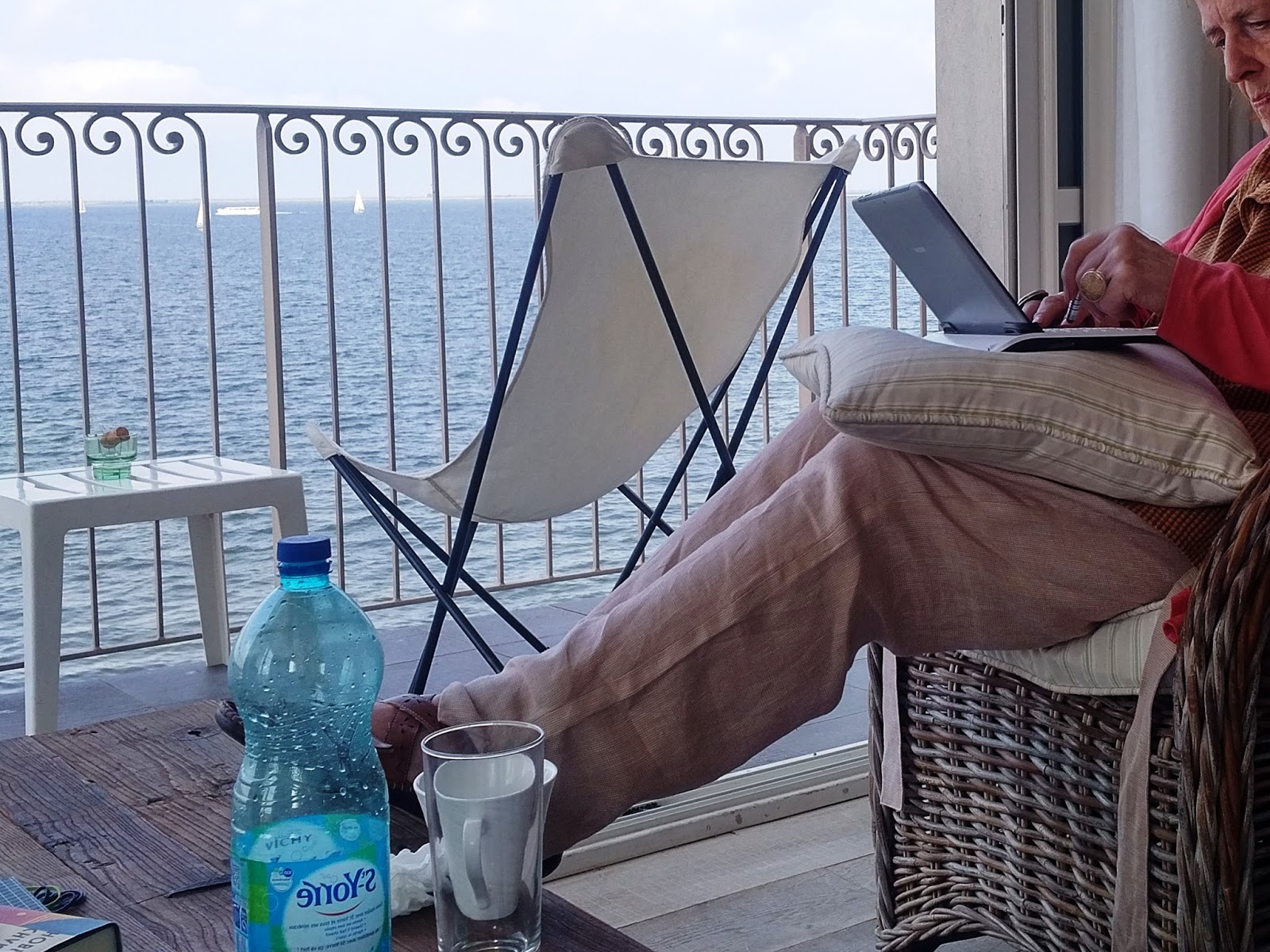
 I returned much refreshed from my recent very welcome holiday with two favourite people with whom I share a good deal, including a joy in reading.


We all have busy working lives, so time spent in easy sunshine beside a Mediterranean lagoon is to be  relished. Truly the thought of a week reading at leisure in the clear southern light becomes a distinct and positive pleasure, even for Mme Lickedspoon and me   who read and write for a living. For us, reading of all kinds – even fiction - is also work or some kind of research
.
But it doesn’t feel like work here in the bright French sunshine, overlooking the silvery lagoon. No hurry. No politics. No commitments. Just the pleasures of the place and the language in the air and on the page.  Then there is the communication with each other: the deep breathing, the smiling, and the relaxing. And the food

As the weeks went on I became interested in the fact that the three of us read with equal enjoyment but at very different speeds.


M. Lickedspoon  is not a writer and doesn’t read fiction as part of his busy day job. On holiday he made his way through the most books in the three weeks. He does read for leisure though, in his normal life. Among other books he likes thrillers and detective stories and easily moves between Kindle and paper forms. I thought you might be interested in his impressive list of books read over three weeks.

1. Blackwater Lake - Maggie James (Kindle)
2. All Kinds of Dead - (Inspector Carlyle Book 11) - James Craig (Kindle)
3. Hunted - (Detective Mark Heckenburg, Book 5) - Paul Finch (Actual Book)
4. Strangers - (Detectiv Lucy Clayburn, Book 1) - Paul Finch (Actual Book)
5. Stalkers (Detective Mark Heckenburg, Book 1) - Paul Finch (Kindle)
6. Sacrifice (Detective Mark Heckenburg, Book 2) - Paul Finch (Kindle)
7. Stop for Breakfast (Augill Castle Book 2) - Simon Temple-Bennett (Actual Book)
8. The Killing Club (Detective Mark Heckenburg, Book 3) - Paul Finch (Kindle)
9. Guapa - Saleem Haddad (Kindle)
10. Dead Man Walking (Detective Mark Heckenburg, Book 4) - Paul Finch (Kindle)

This total is an improvement on that of Mme Lickedspoon and myself  - the two of us who write for a living. Between us in those weeks we read – and very much enjoyed - a total of four books and one Kindle:


1.   Commonwealth: Ann Patchett 
2.   Hot Milk: Debora Levey
3.   The Vanishing Futurist: Charlotte Hobson
4.   The Burgess Boys: Elizabeth Strout (See my comment on this novel in my last post on Lifetwicetasted>
5.   New edition of Jilly Cooper’s whimsical; Class – read on Kindle by both of us. But this doesn’t count as it is better labelled work/research.

I’ve been wondering if I could come up with an explanation for this gap - this difference.


Some Possible Reasons?

·        We all agreed it wasn’t a competition.*
·        Madame L and I cannot resist enthusiastic discussions - on the balcony or in the café on the quayside - about what we’re reading. Time consuming of course. But then, for once, we did have the time.
·        Madame L had a commissioned article to write. So she did have some work to do.
·         As for me I spent a good time listening to Hilary Mantel’s clever, insightful Rieth Lectures – even making notes. This was surely research but it was the same time totally enjoyable – the line between work and leisure entirely blanked out.  Then because we were there we had to make time on the balcony to discuss the importance of Mantel’s ideas to any writer.

Anyway when I got home - fully rested and inspired by France as well as Madame Lickedspoon and Hilary Mantel - I rushed to order Jean Rhys’s luminous Dark Sargasso sea, (which had come up in a discussion). I also ordered Hilary Mantel’s A Place of Greater Safety, set in the French Revolution. 

The books came yesterday and I spent the day curled up reading the whole of The Wide Sargasso Sea – a brilliant slender volume of a hundred and twenty pages. Mantel’s novel is a heavier tome at eight hundred and twenty pages and could, I suspect,  take much longer than a day to read.

Portrait of the charismatic Camille Demoulins.


Perhaps another holiday? Another balcony?


* OK! Monsieur Lickedspoon definitely won!


Sunday, 27 January 2013

Writer’s Notes 3: Hilary Mantel’s Bring up the Bodies


Bookies William Hill have declared novelist Hilary Mantel, winner of the Costa Novel Award with Bring Up the Bodies, (her sequel to Wolf Hall) , as odds-on favourite at 5-4..Having won the Costa prize for fiction, she is in line to win the Costa overall book of the year. Very good luck to her.

The media will be vibrating this week with informed comments about and reviews of this book.

But in this highly personal series here on Life Twice Tasted Bring Up The Bodies  happens to be one of the books which I listened to when ill after Christmas in unabridged audio form. 

My present project is to embark on a series of Writers’ Notes inspired by a focused audio-reading of these books. I have posted Writers’ Notes on earlier books (see below).


Here are my notes on Bring Up The Bodies.


Research;
Inevitably one must comment on the wide-ranging deeply investgated research that underpins this novel. She has absorbed the complex research in an all-ecompassing fashion, almost magically transforming it into flowing prose.
Style
Every paragraph densely - sometimes poetically - worked to a point of transparency with the aim of giving us access to a formidable clever, self-consciously powerful man. Evident familiarity with the documents, literature and linguistic rhythms of Tudor history renders the prose authentic and peculiarly modern at the same time. This shows a touch of genius. The speech –extensive use of diaplogue p renders the reality.
Point of View
Mantel very cleverly manages to tell the story in the first person dressed up in the third persom. Working from the inside of his mind she refers to Thomas Cromwell as he, or he – Cromwell.  It is an intimate and very subjective characterisation dressed up as an objective account by the use of he. So very clever.
Character
I read somewhere an opinion that this writer was in love with her subject. To me it is rather she is her subject and that is why the continuous narrative rendered through the mind of Cromwell works so well. Her affection for the dour Cromwell sings gracefully out of every line, every page. The writer expresses the subtle politics of the court, the continent of Europe and those times. 

So we are treated to Cromwell’s own subtle take on his obstinate loyalty to the selfish, quixotic Henry the Eighth, his cold passion, his political and psychological insight into court politics, his high intelligence, his puppeteer’s control over the objects of  his power – particularly Henry’s current and future Queens Anne Boleyn and her family  and Anne Seymour and the Seymours.

His battle with, and ultimate revenge on, the manipulative Boleyn (formerly his ally) is the dramatic thread in the narrative. Mantel’s  account through Cromwell’s mind of the imprisonment and execution of Anne Boleyn is the most gruesome piece of writing I have ever read.

So, it seems we should dislike Thomas, but the quality of the imagination and the writing here ensures rather that we understand, even like him. We get to see him as a dour but honest man, pragmatic with regard to the power of his role. But his dourness is shot through with a sense of irony. Witty asides demonstrate his insight into the machinations of those around him. His coolness is balanced with his clear fondness for his much milder and quieter son and for his political protégé  Ralph Sadler whose house (shared with his wife Helen, also one of Thomas’s protégées, is wonderfully and intricately rendered here – a kind of loving evocation of a life which contrasts with his own lonely home life.

Thoman is no cold shallow man. We feel with as he mourns for his wife and two little daughters. And we share with him his anger at the cruel execution of his mentor Cardinal Wolsey. The expiation of this anger, and vengeance on those who plotted his death, is another strong strand in this narrative.

 Some prose gems among hundreds – read the book again to re-discover them::
He treats doors as an enemy.
He slides his hands into his sleeves
Passage where an old knight advises to the young about jousting Very detailed. and full of pathetic tragic commitment


What have I learned from this book?

  • An exhaustively researched, beautifully written and constructed novel set in a certain time space does not have to be lumped into a genre called The Historical Novel. It does not ‘date’.
  • The rich possibiloties of in depth use of that very close third person
  • The possibility of showing unlikeable characteristics in a likeable way
      
  • Showing power positions through well conceived dialogue
  • Best to challenge oneself and be ambitious and not ‘serve’ the market.
Last note; Don't care for the cover - dour and unexciting. Other editions have better covers, But does the cover really matter?


Wednesday, 16 January 2013

Me and Stephen King and the Attraction of the Audiobook.


 Being - for the last fortnight - unable to read or write properly or do anything requiring energy I resorted to listening to audio-books. I don’t often resort to this as I like words on the page, be it paper or Kindle screen.

However the concentration for pure reading deserted me alongside my appetite and my energy. So, by means of the audio-books in the last week I have ‘read’ three books: The Forgotten by David Baldacci; Zoo Time by Howard  Jacobson; Standing in Another Man’s Grave by Ian Rankin. Waiting for me to enjoy are ring Up the Bodies by Hilary Mantel; Where There’s a Will by John Mortimer and Victorian London by Lisa Picard. I have also managed to read on the paper page The Examined Life: How We Lose and Find Ourself by Stephen Grosz.

(Should you be interested -  my next post here will be my personal notes on these individual books…)  

But I have to say that this experience has made me reflect on the audio-process. First, how wonderful that these texts were unabridged. When I think of the care that we writers put into every word, every paragraph of a novel it seems some kind of heresy to abridge it to make it fit into a required audio timescale. So the audio-time is anywhere upwards of ten or eleven hours.

Also, being read by accomplished readers, the rhythms and nuances of the prose enhance the meaning - perhaps more than the echoes in the head that emerge from reading on the page.

It certainly improved my line by line attention as I have to confess, as a lifetime reader, to a well entrenched and somewhat destructive habit of speed-reading and skipping. With audio books you can’t skip; you have to let the story unfold at the author’s designated pace.

It could be the euphoria of the illness but I would swear that I have enjoyed these books much more intensely than usual. As I come back to life and writing and work I’m certain I’ll use this form of reading into my book habit more   regularly in the future.

And then I suddenly remember I’m not alone. In his exceptionally good book On Writing author Stephen King urges all writers to read widely, wisely and well for their own self education. He lists the books he read in a single year. His list is enormous. Then he tells us that he had read a great proportion of this list by audio-book.

I suppose I could declare an interest here. All my books are now on Kindle - just got the stats – they’re trickling out very well there (except for Family Ties. Do give it a try. One of my best, I think) . But as well as thise= they are also out there in audio-book form. An Englishwoman in France looks very fine in its audio-book packaging. They’re available through libraries to order borrow and download. Or through companies like Audible.

And now I’ve had my own valuable and enlightening audio experience I treasure the thought of my own readers enjoying my novels in this steady appreciative pace, read by the brilliant actresses who give them their voice

NEXT: Tomorrow my appreciative notes on the audio books I have read this week. By David Baldacci, Howard Jacobson, Ian Rankin, Hilary Mantel, John Mortimer   Lisa Picard, Stephen Grosz.

LinkWithin

Related Posts Plugin for WordPress, Blogger...