Sunday, 7 July 2013

Postcard from Agde Last Day Blues

 From my notebook, written in the café the day  I came away:

Last day

Last morning sun hits the pavement     
glittering through plane trees

Last walk around the market,
dazzled by bright colour

Last laden market stall,
selling striped tablecloths

Last encounter with the Russian,
three euros for café crême

Last laden woman,
straw basket on each arm

Last child on bright bike,
racing round the fountain

Last walk down narrow streets,
making for the shady side

Last circle of old women
on plastic chairs, talking.

Last man with dog in basket,
pushed under the table

Last sight of two men kissing,
clasping hands in greeting

Last taste of peaches,
juice dripping down chin

Last loving touch, dressed up
in careful cuisine

Agde 2013


Wednesday, 3 July 2013

Postcard From Agde: Elen in Trier - Work in Progress


The Porta Nigra.
The Porta Nigra Trier 
 A sense of place has been the theme of my recent posts. My new novel  has three locations – Romano British Wales, the Brigante North, and Roman Trier.

Here is a girl who  has risen to great heights  but still longs for home

Elen in Trevorum: 383 AD

‘….One big problem here in Trevorum is the heat. There are times when I dream of the storm rain coming off our great inlet at home; and I dream of the cool air on my face as I walk down the mountain to the Other Place. And in my dream I feel the wind in my hair as I urge my grey horse forward on the track by the salt flats. Most of all I dream of that first time I met Macsen in the Brigante North when I was washing my hair in the cool water of the holy well.

…I met this man in the great receiving chamber in Trier. Macsen and I were sitting on our thrones – a great throne for Macsen and a smaller throne for me. I have to say that ne either of them is as grand as my father’s throne at home, made of the tusks of a great dragon that roamed our land in ancient times. They’re not even as grand as the gold and silver throne of my Brigante grandfather. But I suppose they w’ll have to do.
… In those early months I’d got used to the parade of people coming to pay tribute to the new emperor. They are escorted into the chamber and bow and scrape and luxuriate in the ceremony. They bow deeply before Macsen and less deeply to me. Truly these people only have eyes for the new emperor. After a while the ceremonies make me weary, especially now that I have this wriggling child growing inside me.
But on this day, just as I about to rise and tell Macsen I need to rest,  I keep quiet, aware of a mutter of expectation among the crowds of people in the long room. All eyes turn to the great golden doorway. Some of the people are standing on tip-toe to get a better view.
That  was when a tall rangy man in very simple clothes walks in. Macsen mutters in my ear. ‘This is Martin, the holy man out of the city of Caesarodunum. Remember I told you about him.’ As he approaches I note a big bluff fellow, more farmer or fisherman than priest; in height and girth and straight gaze he reminds me of my father. 
He approaches the throne and greets Macsen first with the soldier’s greeting of a hand slapped across the chest. Then he bows to him. I know from Macsen that he was twenty years a soldier before he became a holy man.  Now he turns and bows equally deeply to me and looks me closely in the eyes….
Model of Augusta Trevorum - Roman Trier 


Sunday, 30 June 2013

Postcard from France: Living Inside Your Own Stories

It can be a problem, as a writer, to know where work starts and play ends, or work ends and
play begins. This is never more so than on holiday when I feel I am living inside my own stories.

So, here I sit, in this café at the end of and ancient quayside – in use since this town was a Phoenician trader’s port in 600BC. Like the 17th century Maison D’Estella where we stay the quayside plays in a recent novel :


… Now we’re on the quayside and I stumble on the uneven lava blocks that pave it and – quite naturally – he takes my arm. I can hear the jingling of boat tackle and the shout of seamen’s voices but these there are no boats drawn up on the quay just waiters and waitresses setting out cutlery and napkins in the smart pontoon cafés huddling here in the place where ships once docked, drawn up side by side, ready to unload. Madame Patrice said that, didn’t she?
‘You know Madame Patrice? You said you knew her,’ I say.
‘I think I probably do. I knew her husband Ettiene from another time. He was a great scholar. And I am acquainted with Madame Patrice. But I’ve not been here so long, this time...’ From my novel An Englishwoman in France.

And this week I walked around the corner fromthe Maison d’Estella  to a tall thinhouse on the Place de la Glacière – visiting the apartment of my writing friend Avril. This is in another ancient building which has cut into its roof the highest terrace in the town. Here from the same novel the time slips back to 300 AD and nine year old Tib is looking down over the town from the ramparts of the house of his father, the Roman governor of this part of Gaul.  

;…Tib: Good Fortune, 301 AD
A warm, salty breeze lifted the bright reddish hair of the boy, sometimes called Tib, who was sitting with his legs dangling from the flat roof of the house of his father, Helée, governor of this city which was now laid out below the boy like a map.
In front of him the neat road – square blocks of basalt – led straight down to the busy river harbour, widening halfway where it joined with both the straight road down from the barracks to his left and the narrower road to his right  that led down from the  graceful Temple of Venus. The clusters of houses on either side of the road were laid out in a grid, their black stone walls relieved by clumps of wild fig and bulging garden plots.
Tib raised his eyes and watched closely as the elegant ships hauled down their sails and resorted to the power of muscle and oar to manoeuvre their vessels into the teaming river port finally to squeeze into spaces alongside vessels already drawn up at the long harbour wall.
But however fast or elegant the ships were in reaching and tying up at Good Fortune, they had to wait their turn to be unloaded by the labourers and slaves working for the long-haired man – looking more like a pirate than a harbourmaster – who goaded them on with a combination of roars and threats which they answered in good measure. Even up here on the hill Tib could hear the deep, gravelly sound of their throaty curses.
Tib felt proud of the order and efficiency of hundreds of years of harbour routine that drove the port to such success. His father’s tax scrolls were witness to that. Now he watched the shouting workers on one part of the dock heaving ashore great jars containing fine goods – silverware, spices, pottery and wine imported into Gaul from lands across the Great Inner Sea. Then he leaned sideways to see slaves manhandling racks of  the equally tall earthenware jars now containing wine and grain, salt and oil , ready to take them in the other direction,  to the Imperial City of Rome…’ Also from my novel An Englishwoman in France

These days, of course the pink tiled roofs of 2000 years of town development obscure the grid and prevent a direct view of the quayside. But, further to the right within  the sweep of the River Hérault - whose wide estuary attracted the Phoenician traders to build the port – is the exquisite Art Deco façade of the early 20th century Maison Laurens.
Avril Joy's image of the Chateau Laurens
 from her terrace....
Now then, this location on the river plays a part in my new - not yet published -  novel to be called The Search for Marie France. In the novel I have a fictional building used as the headquarters of  the occupying Germans. In the real history of this town the Chateau Laurens actually did fit this ambiguous role. 
‘… Alone at last, Marie France could glance around herself with open curiosity at this familiar yet not familiar place.  She thought of the day she saw the cloister opposite - now just a pathway to the orchard -  used for target practice.  She wrote in her notebook:   “Three soldiers, two with their jackets loosened and one in his shirtsleeves (as white as Auguste’s mother could wash them) cleared the cloister and   brought out a sweating, terrified man – a Gitan by his looks - and tied him to the medieval stone column which must in its time have absorbed the sound of a thousand plainsongs. The soldiers took black pistols from their leather belts, exchanging grins. Other soldiers strolled across from their trucks and motorbikes to view the fun. Auguste, fear in his own eyes, backed away into a corner of the opposite cloister.
Then the three soldiers began to play this strange game - a not-to- kill game - where the soldiers fired at the man with orders not to kill him. He jumped and jerked as the pistol shots splintered the old stone around him. The soldiers jeered as the poor man wet himself and held their noses and shouted ‘schmutzigen Zigeuner‘ when he shit himself. It was a relief when he was dragged off, eyes rolling but physically unharmed, out to a truck then onto the camp down the coast where we know now that gypsies, politicos and people like my own mother and father were interned  before being transported East. The cloister smelled differently then. The scent of blood and excrement was in the air.”  Marie France put down her pen and absently rubbed the swollen joints on her writing hand…’
From The Search for Marie France.


I’m now - fuelled by great company and wonderful imaginative food from Licked Spoon - working here on a new novel  at the Maison D’Estella.
More about that – actual work in progress! - before the end of this week.

Certainly, alongside bookish company, drinks on Avril’s high terrace have been an extra inspirational treat this time.

Wish you were here

love

Wendy

Wednesday, 19 June 2013

Post from Agde 2: The Window


Early dry thunder then swirling seagulls precede the dawn. They hawk and laugh like old men at a wedding. Now later some smaller bird is chirruping. Not a starling. I’ll ask around.

The sky is overcast this morning but the air is warm and soft with the sea.

I’ve finally set up my writing table beneath my bedroom window which overlooks the courtyard with
the staircase that goes nowhere.

This morning I intend to venture into the flea market in the market place. This was where last year I bought a 1940s leather handbag, and three wartime postcard messages from occupied France in World War 2. 

 This reminds me that these objects feature in my novel which will be titled The Search for Marie France – which is not quite out there yet. perhaps today I'll find some new inspirational objects.

And I recall that  this house The Maison D’Estella and this town Agde both feature strongly in my novel An Englishwoman in France which is out there.

Wish you were here
Love
Wendy


Tuesday, 18 June 2013

Postcard from Agde: The Courtyard


Balsalt Paving
Escaping the cluttered house and the cluttered life and the writing of an intense (though not cluttered … ) novel, I am now at the Maison D’Estella a medieval house lodged tightly in the centre of the  2,700 year old small Languedocean  port town of Agde - my favourite place in Europe apart, perhaps, from Bishop Auckland.

Originally built by Greek traders and occupied by the Romans, who both left their marks on the town it ‘s now an intricate,un-touristy coastal town in the Languedoc tidying itself up for next year’s election.

New door in old doorway
Around us are doors and windows
 from several eras
of this mediaeval building.
We have our breakfast in the high walled courtyard which is paved with blocks of volcanic basalt,


Windows are set in older doorways. Doorways are set in older doorways. There is a medieval staircase which leads nowwhere.

Breakfast is fresh bread and croissants, made this morning, with fresh butter and marmalade made at home and brought here by Licked Spoon.

And a little posting.

Heaven or what?


The biggest problem here is to decide just what I want to read. More about this later.

Monday, 27 May 2013

Chelsea and The Accidental Gardener


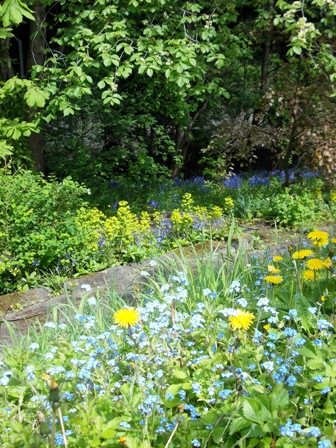
The lower bank. If you leave this land alone at all
 then bluebells sprout up everywhere.
(More pictures below...)
Walk around my garden with me...
I spent some coffee times last week enjoying the elegant and perfectly coiffed perfections of the Chelsea Flower Show. Debora   was there, as was gardening friend   Gillian. My friend Avril  was going to go but did not quite make it.                                   

 I did not envy them, as for one thing I don't like crowds; for another I am merely an accidental gardener. Oh and there's this third thing - flower names do not drip off my tongue like honey. The only one I remember is Alchemilla Mollis because its name scans and because it holds drops of rain like tears in its exquisite leaves. And it thrives in shade and my garden has lots of that . Oh, and I know Forget-Me-Nots and Love-Lies-Bleeding from my childhood fascination with the names.

Many years ago I did plant and grow things fairly successfully but once  I plunged myself into the compelling career of writing it totally engulfed  my planting, growing and making instincts,my hot-housing  and propagating energies. I stopped sewing too.

More then thirty years ago we bought this house in the middle of a small market town,  Built in 1870, the land on which it was built was carved out of a bit of ancient woodland. So  apart from a useful  lawn, our garden is  mostly trees and a long lumpy  bank. And it cannot be tamed; it  can only be gardened by accident.

I have featured the house - in various guises - in several of my novels but only this year in my new novel has the garden appeared as a significant part of the story. To do this I had to imagine this plot of land 1600 years ago when this area was a forest. That was fun
Extract: (Elen) '... No wonder they call this Oak Place. I walk and walk and the trees open out making a green space on each side of a trickling spring which steadies itself in a pool then spouts down the hill to join the bigger stream that I’ve just crossed.  Around the pool is a low wall cunningly built without joining mortar  - a thing they do very well in these parts. In one place the wall widens into a shelf lined with golden stone. Here are wilting flowers crowded together and already smelling of decay;  three finely crafted clay jugs;  two glittering bronze bracelets and in the corner  a sheaf of barley. I add an offering from my mother for whom this pool holds happy girlhood memories: a silver pendant set with green glass. As I set out on this journey she told me she hoped Branwen would be here at the pool to meet me....'                                                  Work In Progress,
Walk around my garden with me ...

Last year we cut down this giant tree but left the base as natural scuplture.


These grow wild right at the bottom of the garden, beside the long wall.


Companion growing - bluebells and well behaved dandelions


Forget-me-nots tumble onto the curving path

Bluebells are promiscuous. They go with everything/

Bluebells against the long bottom wall. I think the deep blue says these come from seed through several years, not from old bulbs. Here and there we have white flowers which I think suggests ancient bulbs still flowering.
The bottom bank. There was an old apple tree here once, but we lost it,

Glorious greens with Love-Lies-Bleeding


Dandelions mingling with buttercups and bluebells.

Champion campions keep the bluebells company

Trees dominate the garden,

Forget-Me-Nots and bluebells near the bottom path.


And more trees 

Neighbours through the trellis in what is, after all, a town garden.


Monday, 20 May 2013

A Surreal Treat from The Pied Piper of Cullercoats


On Saturday our Room to Write Trio ploughed through walls of Northumberland Rain to spend a day at IRON AGE a very different literary Festival in the little fishing village if Cullercoats  on the North East Coast.  For five days the village hosted  the fortieth anniversary of IRON PRESS (set up in 1973): an example of independent publishing  to be celebrate in these days of depression and downgrading in the broader field of publishing.  


IRON PRESS is the literary child of one-off writer, playwright, cultural entrepreneur Peter Mortimer. Over the years what started out as the influential  literary magazine IRON  in the 1970s has evolved into a full blown independent publisher IRON PRESS,  dedicated to finding and publishing writers and poets of quality and originality.

Vintage IRON magazines in the window
of Oliver's bookshop on Cullercoats.

The festival was presided over by Cullerocoats' most illustrious literary resident Peter Mortimer who like the Pied Piper had enticed here hundreds of the literary and musically  minded young at heart  from across the north, including writers, poets, musicians - some to bread or perform, some to just relish the special atmosphere that seems to gather around Peter who has managed to sidestep the be-fogging bureaucratisation of the arts and retain his originality and iconoclastic vision of the nature of artistic enterprise.


Peter Mortimer: A literary Pied Piper - funny, clever, the doyen of original writing in the North East. Every region should have one.    


Novelist Kitty Fitzgerald reads a short story from her new collection Miranda's Shadow.  The talented Kitty works alongside Peter Mortimer as editor and quality controller to ensure the high standard ot the IRON PRESS list. She has been the other  key player in the success of this vivid festival,


One venue for the readings and performances was the Lifeboat Station witt this marvelous view of the Cullercoats harbour. Very moody. Worth a poem in anybody's page.

Despite the weather they built a symbolic Flat Iron 'birthday cake' on the beach,complete with candles and the Number 40. Worth braving the weather.


The Carnival band played, making us dance about under a canopy in the rain, then led brave souls  onto the beach to march and caper around the 40th birthday cake.


Musicians in red and black
Blue sails of the Lifeboat Station in the background

Sweet music! On Saturday night  Bridie Jackson and her stunning group Arbour made ethereal music in The Community Centre, warming us up for  before the headlining David Almond event.

 (And more music in the evening when David's daughter  Freya Grace and her friend sang a set for us alongside the poets  in the pub.)

After the Arbour performance David Almond read from his retrospective IRON PRESS publication NEST.
Listening to him read his own work is like listening to music crafted in spoken words. David is a friend so it is hard to reach for the proper superlatives. So i'll l let others speak for me....
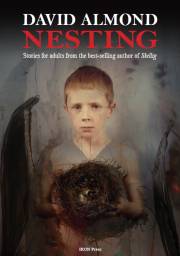
Nesting - Short Stories by David Almond

  
"There is nobody quite like Almond writing in adults' or children's fiction today. A writer of visionary, Blakean intensity."
The Times
"David Almond's books are strange, unsettling wild things. They are, like all great literature, beyond classification:"
The Guardian


In a street a bit back from the harbour in Cullercoats we found this beautiful bookshop.


The interior could very well be an atmospheric setting for a  labyrinthine thriller.
     

Thank you Peter and Kitty for bringing true cultural warmth to a rainy day. 


LINKS FOR YOU

Iron Press:  Iron Press 

David Almond  lDavid Almond
 Kitty Fitzgerald /Kitty Fitzgerald
Bridie Jackson  Bridie Jackson
Room to Write Room to Write


Wednesday, 15 May 2013

A Writer's View of Youthful Romance

A little bit stir crazy and crazy to write, I  found myself in a local hotel with its own ancient history but  with modern spa facilities that mean as well as  the usual through-put  of ladies lunching and businessmen meeting and lovers assignating, you are sometimes treated to the sight of women with their hair up in toweling robes resting, after having a flash of fitness. 


Writing in such neutral places - escaping, relaxing entirely separate - can be a flash of fitness for a writer too. I've posted here on the blog before about the joys of  Cafe Writing. This evolves in a changing world.

I can be invisible in such places - useful for a writer who needs to think and imagine. Here I draft an introduction to the new book. I  think of where it goes from here. I estimate its direction and audit its possible impact. I write some notes on aggression that might end up as a poem in a year or two. Probably never. But at least that aggression is expressed, which could be therapeutic. Unexplored emotion can be ugly on the page.


While I've been busy in my other writing world a young couple enter the deserted lounge. They buy a beer and a latté and play musical chairs until they find just the right place to sit before a window on a deep couch.

She has her natural hair swept up and not a speck of make-up on her face.  With his stylish specs he is handsome in that geeky way that is so fashionable these days.

At each station they flip open a miniature laptop and peer at the little screen, saying nothing - squandering,  in my view,  a clear  opportunity for intimacy.

But who am I to judge the reality of this situation? This is surely only the modern version of the back row of the cinema where you listened to the dulcet Americanised tones of stars and looked at  the iconic images of great films, This was always so useful to cover up the tongue-tied awkwardness of that first or second - or tenth - date.  I remember you would both  look hard at the screen in silence while his hand crept along the back of the seat.

But then - if I remember rightly - that screen was very big: much larger than life. This screen in the silence of the hotel lounge is very small - no larger than the palms of two hands. And this girl and boy could very well be  guests at this rather sweet hotel where there are other spaces to get closer, and to say more.

Nothing like that in the 1960s. More's the pity.
WX

Sunday, 12 May 2013

Writing Out of Your Comfort Zone and the Perfect Apple Pie

Back to basics notebooks
Notebooks help you work outside
of your comfort zone.

Our second Back to Basics workshop seemed to go very well. 


More than twenty eager and interested writers focused with energy on  series of challenging tasks that related to the equally challenging tasks they completed last week.

After many years of organising workshops, this time, as mentioned in the earlier post  we have dispensed with the read-around and the more or less friendly talk-about-yourself interludes. I reckon now you don’t have to be somebody’s best friend to write alongside them.

One problem with the read-around  is that – apart from being time-consuming – it can be off-putting for neophytes and and occasionally vainglorious for the already experienced or talented.

(All this, of course, can be different with a much smaller longer-standing group where reading out and tutor led evaluation can be a learning experience for all.)

So this time, no ‘this is me’ no 'am I better at this than you or worse than this?’
Instead we had two hours of hard work and attention to almost minute details. You could almost hear the brains ticking, the thinly veiled anxiety/excitement.

We did relax a little over coffee, looking at writing in action in notebooks and reading hand-outs of inspirational quotations on this week’s theme of Place. There were some sidebar conversations about the sometimes confusing nature of memoir and the intriguing evolution of fact into fiction.

One very nice writer, nursing her coffee told me. ‘To be honest, last week’s session, though I enjoyed it, got me right out of my comfort zone about writing.’
‘Pleased about that,’ I said.’Out of your comfort zone is a good place to be. It’s from there that you make progress as a writer.’

The place for comfort zones is writing groups. They are brilliant support and interest groups. They are great at providing short term targets for specific pieces of writing.They are wonderful places to meet people of like interests.

However to stick too closely to this process can allow aspiring writers to stay fast in their comfort zone. In time it can be difficult to make real writing progress from within that comfort zone: the accomplished polish their accomplishment; beginners can flounder and not make progress. Even if you get better at the small steps it bresembles making a perfect apple pie every time and not extending your cuisine.

I related the 'comfort zone' comment to the larger group. To my relief there were nods of agreement all around, so I may have got that right.

So some hard work was achieved in this session where our dominating theme was how the nature of Place works to earn its space in our prose writing. The response was intense and lively, as our ‘out if comfort zone’ workshop went on its merry way.

It felt so much better than making the perfect apple pie yet again.

I’m looking forward now to next week  when we'll be thinking about the large scale creativity of the memoir or the story in fact and in fiction – a smorgasbord rather than an apple pie, perhaps.

I'm also looking forward to seeing some of the written outcomes of all this hard work ...

  Happy writing
Wx

Sunday, 5 May 2013

The elegant Nicholas Evans talking to the twinkly James Nesbitt


I enjoyed watching the elegant  Nicholas Evans talking to the twinkly James Nesbitt  on the recent  Sky Arts Living The Life. I particularly identified with Nicholas Evans when he asserted that for him the great thing was thatevery novel is a very different thing. ‘Of course the publishers agree with this but in reality what they want is the same thing time and time again.’

When you think that this ‘same thing’ is the phenomenally successful Horse Whisperer you can have a smidgin of sympathy with the publisher, while still bewailing their lack of creative understanding  and obsession with the ‘safe bet’. They and their accountants would clearly wish for more of the same,

I’ve heard similar regrets from equally successful writers whom I will not name as we all know  criticism of one’s publishers is a tight rope to walk.,

These days  there is so much advice in the widespread HowToWrite industry about knowing your market and building your brand – as though novels were soap-powder or mobile phones. We’re urged to become our own agents, editors, PR people and publicists and developing our brand.  

That leaves in fifth place the hardest and the most original aspect - the actual invention of a world, giving the breath of life to a cast of characters, the driving of an arc of narrative and the spending of a year or three actually putting coherent words on the page.

I had no such insight when I started.  I had written this novel about a very special girl of fourteen in the year 1926, I called the novel Lizza after the main character. Not having read any How To books I chose a publisher at random (Hodder and Stoughton).and posted the package in the large slot at Spennymoor Post Office and they published it in hardback and paperback in the next year.
This novel was bought by libraries and was still being borrowed ten years later.
The Woman Who Drew BuildingsThey said it would be great for their Young Adult list. I’d never heard of Young Adult or any other genre. I wrote three more novels – very different to each other - which they guided into their young adult list.

But  all I did was write the novels that I wanted to write.

Then – still writing what I wanted to write -   I started to write bigger novels with a wider range of characters. These, I was told, were adult novels.  The first of these – a well researched intergenerational  historical novel - was taken by another publisher who slotted it very easily into what they were now calling the Saga category, Other novels followed – each very different - which also slotted into the convenient publishers’ category. They did moderately well sitting on the middle of the publisher’s list and were borrowed in hundreds of thousands from the libraries.

Then I progressed – pursuing the commitment that each novel should be different – to less easily categorised novels still with my focus on  good stories, original authentic characters moving now to accurate  twentieth century and contemporary historical backgrounds. Really my work was slipping out of the clearly marked saga territory and was, I sup[pose,  more difficult to market.

 Although distinctively twentieth century historical, Sandie Shaw and the Millionth Marvell Cooker and The Woman Who Drew Buildings are not by any manner of means sagas. Nor are my later novels An Englishwoman in France (a slightly spooky novel about a woman whose daughter has been murdered).The same goes for my most recent novel - first called The Art of Retreating, now renamed The Search For Marie France which recedes from the present day to France during World War 2.

So, in my writing life I’ve kept my faith with myself and written the novels I wished to write. Then my very decent publishers – along with most other publishers – lost their faith in the popular well written mid-list.

The paradox is that, without exception, my novels continue do very well in libraries where the greatest readers follow their fancy.  Readers have followed me as I kept faith with myself and wrote the novels I was impelled to write. They just seem to turn up again and again to read something with my name on the cover, whether or not it looks like a saga cover, (Surely in twenty first century business-speak this should count as the best focus group ever??)

Where was I? Oh. With the elegant Mr Evans and the twinkly Mr Nesbitt
Their discussion was imbued with an almost feminine insight (compliment, that..) about their common  and uncommon backgrounds. We learnt about the bad karma of great professional success surfing the wave of personal misfortune. They spoke movingly about their mothers and with dealing with their different but equally tragic deaths.
It was fascinating watching these very different men with substantial artistic egos winkling from each other revelations which would have been unavailable in professional interviewers. There were signs of editing and cutting which indicated that it was part of a much longer, perhaps more rambling (perhaps even more interesting) conversation,
This is a great  format for exploring the field of popular culture. I would watch it again if your machinery allows it.

If this has caught a smidgen of  your interest – all my novels are in your library, on Amazon or on Kindle . Click.
Or to see a complete list of possibles categories  click here

Thursday, 2 May 2013

Stop Press! Great Workshoppers.


Wednesday's workshop was great - more people that I'd expected but everyone set to with such a will, tackling the series of challenging tasks with energy and imagination. Some great words are emerging and two new people have asked to come to next week's workshops. They will be very welcome.

Wednesday 8th  2pm Bishop Auckland Town Hall. 
(Scroll  down to last post for details.)  

I was touched that my lovely sister Susan did
some great research  and found the house
 in North Wales  where  our
grandmother was born in the 1890s.
Now, there's a story there...

LinkWithin

Related Posts Plugin for WordPress, Blogger...