Sunday, 8 August 2010

‘Theft’ – The Very First Novel Adventure

How ‘Theft’ came to be published is a story in itself. At that time I was at home with two small children. I loved this time, letting the dust build up somewhat and writing when they were asleep. That was when I wrote Theft. It seemed a time of such freedom.

At that time I was a member of an association called The Federation of Children’s Book Groups which aimed to get more books into the hands of more children. This nationwide forum was lead by a very charismatic young woman called Anne Wood who lived in London but came from my home town and had been to my grammar school, although I’d never met her. One day she came North to visit her father and we had a little meeting in my house,  with other like minded people.  Towards the end of the meeting I mentioned that I’d just finished writing this children’s story called Theft. She asked if she could read it. I handed it to her, apologizing for the rather scruffy copy, as this was my only spare. I was pleased that anyone at all would take the trouble to read this, my first full length novel.

The next morning she rang me to tell me how much she liked it. I was so pleased, as Anne was so informed, so savvy in the field of children’s fiction. Then she continued. ‘So I think we’ll take it.’

We?’ I was puzzled.

‘Corgi Carousel. That’s Transworld.’ That was when she told me she’d just been appointed the first editor for Transworld’s new children’s imprint and had the power, there and then, to say ‘Yes.’ Magic.

Even more interesting than that, this was the Anne Wood who went on to set up an independent TV production company, ‘Ragdoll’ which produced, among other excellent programmes, Rosie and Jim, Tots TV, Teletubbies, and In the Night Garden. This was the Anne Wood who was listed as the third richest person in British broadcasting in 2001, with the value of her business estimated by Broadcast magazine to be £130m. Her charity, The Ragdoll Foundation went on to lead the field in imaginative philanthropy aimed towards children.

I met Anne when she was on the cusp of all this. I sometimes wonder if, like me, she ever got  ‘lines’ at school for reading at the dinner table.‘

This is an extract from ‘The Romancer’

an attempt to mesh together my life and my books.

* After Theft  there was a three year  novel haitus while I pursued my academic career. Still writing, though, I went on to write three more ‘young adult novels (for Hodder & Stoughton) before embarking on full time writing and long adult novels.

Posted by Wendy R at 11:10

Labels: Anne Wood, Theft, writing

Avril said...

The Romancer promises to be an extraordinary and fascinating book.
What a coup getting your first novel published in that way and how modest you were about your talent - great story Wendy.
A x

8 August 2010 12:18

Thursday, 5 August 2010

Writing Before Writing

IMG_1917

I could write before I could read or write.

Picture this. A little girl less than three years old, playing outside a house in Lancaster. With her head of Shirley Temple curls she is winsome, prettier than she will ever be in the many years to come. She is chalking on the sill of the big bay window vvvvvvvvvvvvvvvvvvvvvvvvvvvvvvvvvv

She stands back. That looks right. Just like she’s seen her mother do. But then she frowns her characteristic frown. Is it all in one, or are there breaks in the line of squiggles? She runs inside the house and climbs onto the mantelpiece where she knows there are letters behind the clock.

Letters are big in her house these days. There are letters from Daddy who’s making aero engines in another city. Mammy reads these out to them all. They always end love Bill. There are letters from Cy, the Canadian soldier who stayed once and carried the little girl on his shoulders. Her mother smiles as she reads them. Then there’s the letter that made her mother cry, about Jimmy, whose plane crashed in America. There’s a photo of Jimmy on the mantelpiece in uniform: a sharp face with smiling eyes.

The little girl takes one of her Daddy’s letters and looks carefully at its neat loops. Ah yes. There are gaps between the squiggles. So she goes outside and with the corner of her cardigan – knitted in Fair Isle by her Auntie Louie – she rubs the sill so there are now spaces between some of the squiggles. Now she has done some real writing.

Vvv vvvvvv vv vvv vvvvvv vvvvvv v vvvv vvv

wx

Wednesday, 4 August 2010

Radio Gremlins!

As you know here, I am enjoying the work for The Writing Game, my community radio programme all about writing. It is hard work but good on all kinds of levels.* I’ve had good personal response and the people I work with from the station are so kind and clever.

But if you managed to get to hear Tuesday’s programme you will think I’m crazy.

I have to admit that I myself listened with increasing consternation. Gremlins were dancing around in the works. The very good reading by writer Geri Auton was cut altogether; the beginning was cut; the book sequence was cut so that one crucial title was missed. Adverts blasted into the centre of the programme and at one point screeching music from some other line intruded. I have to say I cringed. 

It honestly was a case of crossed wires and probably really nobody’s fault. However, James, the Programme Director is on the problem and he and I are going to re-edit the programme this week and it will go out next Tuesday at seven in its proper form. That version will be on the podcast. He tells me all the podcasts should be available, The previous programmes should be podcasted soon. I’ll let you know here when that happens.

Certainly my learning curve is climbing! Things can only get better from this.

wx

For example, I had the enormous pleasure yesterday of recording a long interview with the extraordinary , iconoclastic Terry Deary, writer of the worldwide best sellers, The Horrible History series. He was talking about his new -  longer-  World War Two children’s novel. Put Out The Light. We have so much to learn from Terry about the Writing Game. This marvellous conversation will go out on The Writing Game the first Tuesday in September.

Friday, 30 July 2010

The Romancer

Nice to see you again. Lifetwicetasted has been a bit of a no-go area for me in recent weeks – in fact since I came back from France. I know I’ve blasted off here before, about how I don’t believe in writer’s block, but somehow my writer’s mind has a been like a ticking engine turning over but not ready to go.

Study Window 004Of course I’ve been doing some bits of writing, and I’ve been working on the Radio Programme (see sidebar) but this great surging desire to charge into the next BIG THING has been waiting in the wings, not centre stage.

I have not been unhappy but felt I’d somehow turned to a column of wax, unable to melt back into the writer I am.

But if you wait, what’s meant to happen, will happen.

The other day, for my radio programme, I had a conversation with gifted literary biographer and great blogger Kathleen Jones (see my sidebar…). We talked about her new biography of Katherine Mansfield and many aspects of the writing game but I was most intrigued by her typically erudite analysis of the academic and literary disciplines of the biographer - the symbiosis between the writer’s life and the writer’s work.

My dears, the wax started to melt! In between putting the new programme together with James at the radio station, trying to get the house back together after the big paint job and talking with A. about the meaning of life and the balance between nature and nurture, the big idea emerged.

I began to think it’s time I carried out an audit on my work. After all, I’ve been writing all sorts of things for publication for the last twenty five years. It finally dawned on me that I should write an autobiographical monograph outlining my own symbiosis - my non-parochial life here in South Durham and and the novels and stories that have been inspired by it.

Don’t get me wrong – this is not an act of pride, it’s a matter of intellectual organisation and rationalisation. It will be fun to write - in part it has been inspired By how much I love writing posts for my blogs - and will allow me properly to reflect on my life as a writer.

It will be short. I see it as fourteen essays incorporating true elements of my life and the stories that were inspired by them. The quality of the writing will be paramount. As with this blog, there will be pictures. I will publish it myself as an exercise in private publishing, to make the whole book just as I want it to be.

What a treat! Enough to melt any candle.

But first, the title!

There is this saying in County Durham. ‘Oh, him, he’s a proper romancer!’. meaning someone who lives on the borderline between truth, fantasy and lies. I wanted to call my novel about the (alleged) County Durham serial killer Mary Ann Cotton, ‘The Romancer’. My editor didn’t like it. (It became A Woman Scorned’ – a much lesser title for what was a great story.)

Now I know why it was saved. My autobiographical monograph will be my called The Romancer. Perfect! It will be launched on November 24th in the art Gallery at Bishop Auckland Town Hall, alongside an exhibition of all twenty four of my books, a timeline with all the books in and of their times, a collage of some of my articles.

They’re calling it ‘ A Retrospective’. Well, if artists can have then so can writers.

PS After all this excitement I looked up the word ‘Romancer’ (see below) and was moved to see what I came up with. So many of these words fit the way I think I am. I was called dreamer in my family from when I was very young….WX

*********

Romancer’ :Don Quixote, Quixote, anecdotist, daydreamer, dreamer, dreamer of dreams, enthusiast, escapist, fableist, fabler, fabulist, fictionist, idealist, lotus-eater, mythmaker, mythopoet, narrator, novelettist, novelist, prophet, raconteur, reciter recounter, relator, rhapsodist, romancist, romantic, romanticist,sagaman, seer, short-story writer, spinner of yarns, storier, storyteller, taleteller, teller of tales, utopian, utopianist, ustopianizer, visionary, wishful thinker, word painter, yarn spinner reamer of dreams, enthusiast, escapist, fableist, fabler, fabulist, fictionist, idealist, lotus-eater, mythmaker, mythopoet,narrator, novelettist, novelist, prophet, raconteur, reciter, recounter, relator, rhapsodist, romancist, romantic, romanticist, sagaman, seer, short-story writer, spinner of yarns, storier,storyteller, taleteller, teller of tales, utopian, utopianist, topianizer, visionary, wishful thinker, word painter, yarn spinner

Romancer’ A mysterious or fascinating quality or appeal, as of something adventurous, heroic, or strangely beautiful: "These fine old guns often have a romance clinging to them" (Richard Jeffries).

Saturday, 3 July 2010

The Sadness of Leaving.

Journey back tomorrow. I am sad. As regular visitors at Lifetwicetasted will know, I feel I have been here before and am writing my second novel springing from this place.

As well as my notebook I always have my little camera. I’m no great photographer but now my camera is my second notebook and continues to provide inspiration and sustenance in my other special place t- he moody, complex north of England. I thought I would stick my last images together for my friends – as a kind of handful of postcards from the edge, with no message.

Here , the medium is the message, perhaps:

Light and Shade

window M D'


Wendy 


Shades of Red  Pezenas

 Street Aesthetic

Joute boat in shadow


Always a feast for the eyes


Notebook

 Last images 011


the blue blue sky

A bientot…

Tuesday, 22 June 2010

Return to La Guinguette

La Guinguette 001

Allan and Nira Allan and Nira,  who own the Maison d’Estella ,cycle along the river to meet us for lunch at la Ginguette. (See last year’s Post Last Walk To La Ginguette). This is the unique the open air cafe  situated where the silLa Guinguette 004ver-green River Hérault joins a spur of the limpid green Canal du Midi. The Café  has a small stage and a tiny dance floor and we talk, eat and drink to the mournful heartfelt romantic songs of, among more contemporary singers,  the French chansonniers – the traditional singers who are said to be the last vestige if the medieval troubadours.

On the walls are poster images of singers and crooners from across the world but an especial place is saved for louche retro images La Guinguette 018of great French chansonniers such as George Brassens and Jacques Brel. I searched the walls of La Guingette for an image of Jean Sablon, a favourite of my mother’s. I have some scratchy memory of my father singing one of Jean Sablon’s songs  -J’Attendrai – to my mother when I was small. As my father died when I was nine and couldn’t speak French this should be impossible. But if it’s a false memory it’s rather a nice one.

Whether that is a true memory or not here on wall are images  of these  fabulist singers  talking and smoking with a sophistication lost in our own age,

As it is lunchtime rather than evening at La Guingette, there is no dancing,  and the music is on tape.  But still it enhances the raffish atmosphere generated by the posters and the  distinctly  improvised decor as we eat from plastic tables among  rustling greenery.

Adopting something of a louche style ourselves we enjoy the food and wine and talk about books we’re reading, exchanging titles and favourite writers as readers do.  La Guinguette 014We share news about current creative projects and family events. Nira talks about the new novel she is reading; Allan is developing a new painting studio; I’m writing my new book; Avril’s thinking about her new poem; Debora’s writing her excellent articles and thinking about a book; Sean and Bryan are talking about our journeys; we hear stories of  Allan and Nira’s son Tom who working as a crew member on a luxury yacht taking a three year journey round the world.

Nira says she’s  waiting for my new novel Starr Bright to come out, as it’s set in this,  her town, in the Maison d’Estella, the house where we’re staying. (One day a group of tourists peered through the big wooden door and the leader asked about the novel  – whether it would be available in a French edition...) I’ve been thinking I might change the title but more news of in another post.

Later in the afternoon Allan comes over to the house  by arrangement, so he can tell me a very interesting true story from his home ground of Somerset, set at the turn of the twentieth century. I ask lots of questions and we record his story on my radio recorder for future reference.

I find myself listening to a wonderful intergenerational tale emerging from a small run-down fishing port in Somerset. It involves generations of seafaring men and their widely interlinked families. Into the lives of these ordinary people an important artist comes. There is even a prince involved.   And at the core of this story, in my view, there is this surprising coincidence to do with painting and art and this practically minded  sea-going family.

Although he is sceptical I suggest to Allan that he himself, in a way,  personifies somewhat that coincidence: a painter first and foremost, he is an accomplished sailor – although he insists it is the aesthetics, not the athletics, of sailing that he enjoys. And  it occurs to me later that the kitchens of their houses here - which he develops himself – seem to me to have the polished wood and shipshape design of a boat’s cabin.

I don’t know that he agrees, but it’s an interesting thought.

Will Allan’s Somerset tale make a novel? Surely. There’s only the matter of the four or five years it would take to research and develop it of course,

One thing’s for sure. Stories pop up everywhere in this place.

wx

 DSCN2667

Monday, 14 June 2010

A Tale of Three Boys and Diving for Treasure

The courtyard is in shadow but the sky above is bright blue. My problem is that  the wonderful Agde sun waited to come out out until the day my friend Pat caught her plane home.001  I’ve spent the week telling her that usually it’s warm and very bright here in June: protesting in defence of my favourite French town.

At least on the morning of her departure as the sun started to show its face and we made it to the picturesque Pezenas market. We sat drinking pezenas 12 June 2010 012 coffee and pastis watching ladies try on hats at the hat stall. We decided that it would be rather nice if we renewed the  custom of wearing hats every day .  It would get rid of the problem of  bad hair days but I suppose would present the challenge of wearing hats with jeans.

The rain and glowering sky had not prevented us -  on - Tuesday from visiting the exceptional Museum of the Ephebe, close by in Cap d’Agde. 

The Ephebe is a   stunning near life-size bronze of a post-adolescent boy which was plucked out of the River Herault in 1964 by submarine archaeologists.

On the wall in my study at home I have a giant poster of the Ephebe, brought back from my first visit here.That first time   I was fascinated not just by this exquisite bronze  treasure  but the moving portrait of this beautiful young man who who was alive thousands of years ago. At that time there was no information about who this elegant, thoughtful person might have been. P1150826But I do have my own thoughtful, intelligent boy and my poster always reminds me of A, the boy who likes chocolate,  He is alas, not staying here this year.

My poster came into my mind on later visits here when I became fascinated by St Thibery, another young man emerging from Agde (his father was the Roman Governor of Agde)  early in the fourth century AD. Thibery was a gifted boy, a healer of the insane who cured people in the name of Jesus Christ.  He and his beloved tutor Modeste were  martyred and executed in the small Village of Cessaro close to Agde.

Renamed St Thibery, this village became a place of pilgrimage throughout the middle ages, for those seeking a cure for insanity.

These events inspired my new novel Starr Bright*** which considers madness and serious depression in the present day. In the novel we see a troubled woman in the present day who experiences the joys and ultimate sorrows of  intimate contact with Thibery and his charismatic tutor Modeste.

So it is that this  whole novel started with my fascination with the Ephebe those years ago. In the years since archaeological scholars have concluded that this formerly anonymous figure is in fact a portrait of a young Alexander the Great. How wonderful.

This habit of diving for treasure is an old one here. This town has been a port for more than two thousand years – at one time a crucial Greek and then a Roman port  - for exporting and importing all kinds of goods between Gaul and the countries around the Mediterranean basin.

There were battles , pirates, great storms and flooding – here called les inondations. In the last century archaeological treasure seekers started to dive for all kinds of treasure – treasure with both intrinsic value and historical fascination - from swords to nails,002 from intricate tripods to  cooking pots and votive treasures. And there are  so many amphorae – terra cotta jars of every size which carried everything from wheat to wine, from oil to cloth. (Pat says they are like the cardboard boxes and packing cases of their times.)

Whatever their size, amphorae  were  usually pointed at the bottom so they could lie snugly together in the hold of the great sailing ships, like piglets snuggling in rows. And there are glasses and bottles -  whole and in fragments – alongside bowls and cooking pots demonstrating a thousand years of the potters’ craft.

All this treasure was hauled from the river by twentieth and twenty first century adventuring submarine archaeologists who are named and described with pride on the walls of the museum. They are an essential  part of the whole story.

Another part of the story are the citizen-beach-combers who, on a rare very low tide on the estuary,  harvest  their own collections of finds and fragments which reflect this same history. This house where I am writing is sprinkled with a number of these objets trouvé which make  me feel I am living in history - as does Estella in my new novel Star003r Bright.

As a footnote my fried Avril, says these  glass and  pot fragments  remind her of ‘boody’  which I mentioned once on my Bishop Blog.  Perhaps that’s our country’s archaeology although  so far the the River Wear had never offered up our own Ephebe.

I suppose, really,  writing novels is a kind if diving for treasure…

w

***

So what about…

Starr Bright?

……You might find it strange that through all this mad time I still did my astrology columns, recycling old stuff, free-basing new stuff, making new money to prove I was alive, adding it to the stash that came from my dear mother’s foresight. I worked through the night and slept through the day, only rarely catching sight of a perplexed Philip. I cut down on my antidepressants because there was the possibility that the numbness might make me renege on my deadlines. And I realised that they were giving me suicidal inspiration and I wanted to stay alive to see Siri again.

On many nights I would cast and recast Siri’s chart for the time then and the time now - for the day of the murder and for this same date - one, two, three years later. And again and again I would stare in the mirror and wonder why, why on that day I should have told her, ‘Yes love. You go and get some fresh air!’ What I should have done is shackle her to the fridge, the bed, the washing machine. Anything.’

I looked at her constellation Virgo in the night sky and willed it to bring her through to me from whatever fog she was in, so I could see her. These days, angry at the man called Ludovic who started it all, |I no longer sought out The Great Bear in the night sky,

Even worse, I was perpetually seething with anger at Philip for just being normal. This anger and my nocturnal habits drove an ever widening wedge between us. Where there had been kindness there was now rancour. Where there had been tolerance there was blame and disbelief. He saw me as crazy and incomprehensible. I saw him as hard and unfeeling….


wxx

Friday, 11 June 2010

Settling into The Maison D’Estella

The town is unchanged. But then it’s only a year since we were here and the town has been here for two and a half thousand years, give or take.

002 The Maison d’Estella still has its star picked out in stones on one wall and - like the town of Agde - still shows its own layers of time,  here so carefully uncovered by its owner Allan, who restored the house and brought up his  family here.

We managed one blue sky’d fine day when we went along the estuary to the sea at Grau d’Agde where we walked along the wonderfully kitsch Adge June 2010 063promenade,  ate  highly specialised ice creams and watched men who looked like pirates disentangling their fine nets from the detritus from the last trip. They could have the right bloodline. Real pirates were a feature of life here in the seventeenth century.

But the wind whistles round the courtyard and we keep protesting to our friend Pat, who is with us this year,  that the weather has not been itself. The skies have been grey and lowering, T here has even been a patter of (warm…) rain. We have been looking out our wraps and  jackets. We keep telling Pat how usually in June it is fine and bright. Honestly.

My friend Avril arrives on Wednesday to complete the party and tell us that it is raining cats and dogs in England.

But despite the lack of blue sky it’s all still wonderful here. Yesterday was the big market day. I sat on the corner and watched again the kaleidoscope of faces and types. Lots of children. I smile at a  glorious cherub and he pulls his tongue out at me. I go with Debora and Sean to the food-market  and am dazzled again by the colour and variety and freshness of the food laid out there with artistic precision and artisan pride..

A very handsome young man with dark curly hair selects large tomatoes one by one for Debora, who tells him she’s making stuffed tomatoes for our dinner. She buys courgette flowers which, she says, she will stuff with cheese and deep fry for starters.

There’s talk in the house of football and some concern that the referee for one of the England matches who has a questionable reputation. There is the problem of where to watch the matches significant to us –  on the small French TV in the house or out at the Sports Bar down the street, among the French fans.

(I might have an eye to the football but really I’ll be reading Wolf Hall, a reward for ploughing through The Girl With The Dragon Tattoo with mounting disbelief.)

Things are looking up. Last night before dinner we walked along ancient basalt pavement of  the quayside through the heavy scent of Jasmine 001 a  fantastically blossoming jasmine. We went  to the cafe on the Place de La Marine for a pastis. whose owner  recognised us from last year and gave us a hug, pleased that we had returned.

Later we had the courgette flowers (stuffed with cheese, covered in light frothy batter) and the stuffed tomatoes. There was applause.

Exquisite.

Next – another walk to la Ganguette..

Adge June 2010 072

Friday, 4 June 2010

Away To France

Away to France at 4am. Here are some not-quite poems that I wrote last time. clip_image002 There will be more this-time writing…

Agde Haiku

The sound of swallows

Clouds salmoning the morning

Coffee steams gently

A Child Stretching

A child stretching

Hauling up the base of her spine

Through her shoulders

Along her arms

Right down

To her fragile wrists

More cat

Than anything

Striding with Bread

They all do it -

Young, not so young

Smart, not so smart

Morning and afternoon

Carrying long loaves

From the artisan baker

clip_image004

Greek Frieze

Trim measured borders

Three figures under arches

Framed with rays of basalt light

Crudely carved and very potent

One is a draped

A pious creature turns to one side

His features all scratched in

A garland on his head

The next one is naked, all

voluptuous, curved breasts

and copious belly

She holds flowers

The third is naked too

But moves briskly to the left

Like a business man in a hurry

To get to work

The Painter

She walks with a cheetah's grace

Her face golden, her drawn back hair

The colour of gleaming putty

Her smile as ancient as the town

She says she paints while keeping shop

Splashes of deep ochre and Agde yellow -

Airy spaces, unfinished figures

Brief encounter

With colour and light.

(Photo Thank you Sean)

Friday, 28 May 2010

Crime on The Writing Game

clip_image001Novelist Anne Cleeves in conversation on THE WRITING GAME. “What do you need to be a writer? The biggest thing is concentration – because you need to create this fictitious world and if it’s not solid and real in your head then it’s as though you’re writing from memory, not imagination, and you can’t expect your reader to join you in that world..…

(About her success) There was the chance of being on Shetland one winter and people on Shetland encouraging me to write that first Shetland novel. And then having a wonderful editor who will get behind you in a good publishing house you need an advocate for your book within the house. Mine was wonderful. She did things like send the first chapter to all the reps. She really got behind it.

I’m still of this big learning curve with my community programme The Writing Game but am making progress. I now know how to edit my own tapes that comprise the segments of the programme and spent yesterday afternoon with James Burrage of Bishop FM putting the segments together into one smooth flowing programme. (A new process which I’m just learning…) I glowed with pride when James nodded wisely and said the tapes were spot on. o now that one is put to bed ready to be broadcast next Tuesday 1st June at 7pm. Do listen if you are in the area or watch out here for the podcast.

It has been worth all the work because the production on this programme is much better. One improvement is that, on the advice of Al from Australia (he got hold of the podcast of Prog 1) I have not used music links. He was so right. Thank you Al. So my Crime Writing programme features conversations with Anne Cleeves the Gold Dagger Winning Crime Writer, Peter Walters: Wear Valley Writer Leader and a new Crime Novelist and we have Crime Novels of the Month from Glyn & Gillian Wales.

There is so much great stuff on there. Such great voices. Listen to Ann Cleeves dispensing fresh wisdom about her particular writing game. She's very generous and inclusive and has lots of really fine advice for new writers.

Part of my contribution was …

“‘Perhaps we all think we can write a story with a puzzle, a detective and a solution! Perhaps we could all have a stab at exploring the dark recessed of a criminal’s mind! Crime Fiction is the most widely read field of fiction and covers a whole range of styles from cosy whodunits to murder most gruesome. In this programme I will explore how working writers tackle this widely differing genre. Listen in on June 1st and share their world, and perhaps be inspired to have a go yourself…”

Happy listening. Happy writing.

wx

Friday, 21 May 2010

Ah, Bluebells…

and more

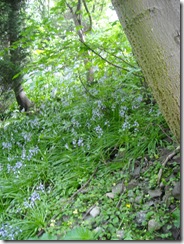
In this household we know that the summer is on point when the bluebells arrive to strut their stuff our garden. We have this bank to the side of the house which, if left to its own devices, sprouts thousands of bluebells. In recent months/years it has rather been left to its own devices because of writing and other work. So up sprout those bluebells. Everywhere.

I read somewhere that when this happens it’s a sign of very ancient woodlands, even a thousand years old. As this house is in the middle of a small, busy town I think this is very precious.

G is setting up his very neat vegetable patch G Keeping and eye one things down at the bottom, with its small miracle of carrots, garlic, leek and cabbage, all now putting their tiny seedling heads above the parapet.

cABBAGE

But it’s a bonus now, in going down there, to relish this mall miracle and be reminded that the large thousand year miracle of the bluebells and more b...is still with us.all set with 140 year old wall

Another bonus is witnessing A, the boy who likes chocolate role-playing a social realist Russian Poster of the 1930s…

Angu being a Russian Social Realist Poster

bluebells again

Ah, bluebells…

wx

Thursday, 20 May 2010

Getting Off The Gear

There is no Idea Dump, no Story Central, no Island of the Buried Night VisionBestsellers; good story ideas seem to come quite literally from nowhere, sailing at you right out of the empty sky: two previously unrelated ideas come together and make something new under the sun. Your job isn't to find these ideas but to recognize them when they show up. Stephen King

‘….He himself was lately dodgy rather than just dodgy because the gear started to make him throw up and he had somehow heeded the Dire Warning from a guy called Cragan whom he met in the Black Bull.

Cragan – a strange, uneasy sort of man - turned out to be a doctor and it was he who got Tegger off the gear. Cragan convinced him that he didn’t have an addictive personality. He’d just been having a really bad time and was self-medicating. They only ever met in the Black Bull but in those months Tegger got himself clean. He’d even shown Cragan some of his writing. There was trust between them. That last time they met Cragan brought him a pile of novels - battered paperbacks - and said he was going away to America, where he’s got this job in a psychiatric hospital.

Tegger never saw Cragan again. He read Cragan’s books, line by line and as he read them it was as though he were in the Black Bull with Cragan, arguing the toss. In the stories were people he recognised. There were even people like himself…’

wx

Monday, 17 May 2010

Writing and Knowing

Writing teachers invariably tell students, ‘Write about what you know.’ That’s, of course, what you have to do, but on the other hand, how do you know what you know until you’ve written it? Writing is knowing. E L Doctorowhats etc 042

‘As the plane taxis, charges, and then rises into the sky, I find that Aurelie is a businesswoman to the fingertips. The free way she talks about herself and asks me questions tells me she’s not English. It seems she’s a buyer for superior English shops, shipping all kinds of goods from France to England. ‘And you? What is it you do, Ruthie?’ she murmurs.

We finally dispose of the fact that I’m a writer and she’s never-heard-of-me-but-will-look-for-my-books-in-the-future, when the flight attendant comes with her trolley.

We have tea and – at Aurelie’s insistence – brandy. Then we sit back in our seats, assessing each other as people do. Aurelie is tall, anything between forty and sixty years old. She’s fine boned, with a delicate, intricate face. In her faintly accented English she begins to speak of her love for the English countryside and I find myself telling her about the Foxe’s house and my plan for writer’s retreat. ‘In the end,’ I say. ‘It didn’t quite come off.’

Wx

Wednesday, 12 May 2010

Text , Sound and Cultural Taboos.

Putting your head above the parapet is often proscribed by powerful cultural taboos.  This is particularly so in the regions of the English working class from where I emerge. The old childhood maxim of not ‘making a show’ of yourself or drawing attention to yourself can bite deep into quite mature  personalities.

As a child and young woman I was achingly shy, didn’t like encountering strangers or being at a crowded gathering. In those early days, not ‘making a show’ of myself suited me fine. But it seems to me now that underneath the surface self of this watchful, tongue-tied girl, a raging exhibitionist was hiding.

It was hidden well. When I first went to college I lost my voice for a week before things normalised, But the inhibitions stayed. When I first started teaching I lost my voice for two weeks. I had this very boisterous class of twelve year olds in my first school. So I had to write QUIET!! in very large letters on the board quite a few times in those two weeks. They were great kids, though.

All that time,  though,  the exhibitionist was at work - writing articles, stories, mapping novels. It was a secret  nobody knew about. Writing was a perfect medium for this shy tongue-tied girl. She could say, imagine, invent what she liked without drawing attention to herself.

But the fact is that in teaching it only works if you do draw attention to yourself. Teaching children taught me not to hide behind my shyness, to let the exhibitionist inside have her airing.  She could be funny, daring, expressive. She could be herself. The children loved her, They didn’t know you shouldn’t put your head above the parapet or make a show of yourself so it was OK. That was a comfort.l

After that  working with adults in large groups was a very big leap for this shy girl, But she’d learned in school that there was something in her that could really teach people, really do this thing,  as long as she became her other, more exhibitionist self.

Then, when the books and stories began to be published it seemed that I was not just looking over the parapet , I’d leapt onto it. But now  I had the book to protect me. Or the books. It was not really me, it was them. They were the things  ‘making the show’. The shy, embarrassed  person that is still me was only holding them.

And now we have the crazy situation of the community radio programme. This voice that repeatedly let me down in the early days is put to work, up there to be judged.  I hear my voice on the tapes and think how strange it is, how thin and nervous I sound. But I’m pleased now that I’ve learned the basics of sound editing. Editing sound means that I can nip and tuck the excesses of the reluctant voice.  Just as I nip and tuck the texts of my novels and the stories, making them their best selves, I can begin to nip and tuck my voice so its becomes its best self for the programme. Which best self it expresses, the shy girl or the exhibitionist, I’m not quite sure.

I’m loving the creativity of putting The Writing Game together, and talking to and listening to these great writers and readers. Still though, the shy girl and the exhibitionist live on in me side by side and I have to deal with them.

The learning curve continues.

wx

Sunday, 9 May 2010

The Joys of Cranking the Engine of a Novel

Recently, for the programme, I’ve been asking other writers how they start a novel and how they get on with completing it. I’ve also spoken specifically about how I was inspired to write my own novel The Lavender House. So, as I’m beginning a new novel, I thought I’d tell you how this process works in my case.

All writers work in their own way. I think I must be a seasonal writer. For years now, in late Winter/ early Spring I will be puzzling, speculating, making false starts, writing sketches (short scenes that may/might be in the novel) waiting for characters to walk onto my roughly prepared stage, into my dreamed landscape, demanding to be named and styled.

Notes, labels, names, sketches, images and maps start to litter the walls of my little room. My computer becomes petalled with notes and reminders. The novel grows first in a kind of impressionistic collage. The big table is stacked with opened books post-it-ed and ticker-taped with wild notes to myself.

In real Spring ( when the bluebells at the bottom of the garden are out) I feel impelled to start to write, to get into gear properly with this job . The story is bubbling up from the depths of my imagination, throwing up sentences and paragraphs like fire and gas from a volcano.The characters are elbowing their way out of the wings into the spotlight, moving from monologue to dialogue. Occasionally there are shrieks. Let me out! Let me out!

This is when I’ll write novel-stuff in my notebook wherever I am – car, cafes, hotels, park bench - taking pages like stored treasure back to the little room for the painstaking and rewarding process of transcription. Sometimes I’m amazed how brilliant the scribble is. Sometimes I can’t make it out, so perhaps it was too brilliant for this world… It's a mad, mad phase. I become more and more excited, and as the Summer moves into place I am buzzing away, writing every day, living the narrative and not noticing too much around me.

Sometimes at this midpoint there is a worrying haitus. Is it really a novel? Am I kidding myself? Am I deluded into thinking I can do this very hard thing? (Some people label this the Writer’s Block. I think it’s just the imagination muscle screaming for a rest.) So I take a good breather then I go back to the beginning and move more slowly forward again, editing and writing as I go.

With the coming of Autumn the days draw in and the growing darkness helps me to focus more closely on the way the narrative works. These latter stages are just as demanding and interesting but are as much intellectual as imaginative. This is the time when the firecrackers that I set away back in early Spring have to take their place in a coherent and interesting story. And in the end the form has to be right, The facts have to be right.

I don’t at all see this part of the process as a chore – it’s the final careful, creative act in making the novel work. It's like taking a garment you’ve just designed and made, and pressing it with care to make it fit and elegant for anyone who chooses to put it on.

By the beginning of December, with Winter set in, the novel is complete and ready to go on, on its own hopeful journey.

But now, with this lovely new novel (called so far XXX), I’m just at the beginning of this journey. I relish the familiar delight and and excited tension threading through my body. Writing like this is a visceral thing. Of all the things I do, my novel is where I am completely myself – travelling alone and enjoying it.

wx

(Pic tomorrow…)

Friday, 7 May 2010

Books on The Writing Game

(Stop Press - Was invited by Norman Geras be profiled on his great weblog You might like to check it out Wx - http://normblog.typepad.com/normblog/2010/05/the-normblog-profile-346-wendy-robertson.html )         Now back to books…

One feature of my radio programme will be a focus on the delights of reading, and how writers can use their reading to inform their writing. In the May programme we featured:  Books of The Month - chosen by Gillian Wales (Chartered Librarian & Ex Arts Centre manager) and Glyn Wales (Historian, ex Head teacher & University Lecture ).Their criteria are – Plot, Place, Character & StyleBishop FM etc 001

Their choices this month choice were   Chris Mullin: A View From the Foothills. (Profile Books) ‘A political diary of a Labour MP from 1919 to May 2005. Reading it restores some of my (Glyn) faith in MPs for it shows a humanity, selflessness and humanity notably lacking in the present parliament. The book’s also witty and entertaining and throws light on the roles of a back bench MP, a home affairs committee member and Junior Foreign Office minister. Uniquely Mullin remained a minister despite his opposition to the Iraq war… A man of principle.’(Timely in this week where we are left with a hung parliament. W)
David Lodge Deaf Sentence (Penguin) Good on style and character. ‘Retired professor coping in a good humoured was with the vagaries of the post professional and eccentric family life Touches on themes of a recession his and an increasingly electronic world of 2009 2010 Britain, Recommended.’

William Boyd: Ordinary Thunderstorms. Chatto and Windus
Better in plot and place, we think, though perhaps not so good in style. A conspiracy novel – a sort of 39 Steps for the Naughties It is about a man’s loss of identity and flight from pursuers. The Thames from London to the sea mirrors the hero’s own journey into the depths. A good read.’
Margaret Forster Isa and May – Deals with the relevance of the grandmother in today’s society and the controversial question of nurture versus nature. Novel will keep you guessing right to the end, despite, we think, an occasional overload of information
Philip Pullman The Good Servant Jesus and the Scoundrel Christ. Pullman’s retelling of the gospels. Here Jesus and Christ are a pair of twins. Pullman destroys the gospel story and articulate his own disbelief in the myth of Jesus Christ Pullman believes in the democracy of reading and doesn’t think it’s the task of the author to tell the reader what the book means. He says he is in the “Once Upon A time business” not the “Message” business.’

And Some Books Mentioned during the Programme Avril Joy:     The Sweet Track: Flambard Publishing In her interviAvrilBookHomeew Avril talks about the significance of place in her writing – in this book, the Somerset Levels

Wendy’s Novels    I used my novel The Lavender House (Headline Book Publishing) to demonstrate the slender and exciting starting points when setting about writing a novel.
Wednesday, 5 May 2010

On Air and In Shock

Well, the Writing Game went out last night on Bishop FM!!

It’s been the epitome of the cliché of a steep ‘learning curve’ in the Radio Times 002 Lisettelast month, learning absolutely new skills and gathering together ideas and people to generate this one hour radio show for this community station.

The programme was now all on tape so a few of us gathered to listen to it in my sitting room over glasses of white wine. Writers Lisette Rebecca Grout and Geri Auton were there already to record their piece for a future programme, and Avril was there for moral support.

The programme before The Writing Game was a very jolly, chatty, drive-time music show presented by two lively gRadio Times 001uys who were obviously having a good time. Like me they are amateurs but they sound so much more confident and polished than I know I feel about all this.

Then my music (Dave Brubeck) and my show. It’s very scary. I do sound nervous but I think I get better during the hour. I hope I’ll get more laid back and natural with more experience. My commitment shows through, I think. The contributors – Avril, Eileen, Hilary, Debora, Gillian and Glyn – are all marvellous. Apart from Debora, it’s their first time too. I have to say I feel there’s good, interesting content in the programme for both readers and writers.

Radio Times 003 Geri

Despite the great efforts of the lovely James Burrage of Bishop FM the continuity is just a bit bumpy – all my fault and I know I’ll make it easier for James next time.

One thing that surprised me was the surge of the sound of the advertisements half way through – a big contrast to our restrained voices discussing books and things, I’d forgotten about the advertisements. But it was very reassuring in its own way.

It finally dawned on me that this was the real world. That my programme, my Writing Game was really out there. On the radio. On air. Crikey!

*****

People have been very kind – here are some reactions:

First from Station Manager Gillian Campbell

‘Oh, and the show was fabulous - thank you. I had a house full sitting
around the radio staring at it (that doesn't happen very often in my
house, trust me!)’

…and …

Fan mail already - wow, I'm very impressed - well done! ‘

From people who listened

  • ‘Congratulations. The Writing Game was such a success - a brilliant new programme that will be a treat to look forward to each month.’
  • ‘Congratulations! All your hard work paid off and The Writing Game comes across as well presented, interestingly structured and inspiring, The features were short enough to hold the listener’s interest and sufficiently varied as magazine-type programmes ought to be. Well done.’
  • ‘Many congratulations on a good first programme.. Here's to many more.’

That’s it – here’s to some more. Crime next time. I’ll just go and put a cold compress on my head

wx

Monday, 3 May 2010

Crime , Ann Cleeves, and The Art Of Interviewing

On Saturday we drive across the moors to the HexhamAnn Cleeves Book Festival. PD James, whom we hear speak later, says she’s rarely up here but how wonderfully beautiful is the countryside her. Perhaps, she suggests, we don’t talk about it much because we didn’t want people coming up in hordes and spoiling it. Well deduced, PD.

We’re in time to witness this Empress of Crime Writing in conversation with the shrewd, flamboyant and generous VaL McDermid. This is no ordinary interview. It’s a merry, respectful conversation between two fellow professionals who know their art inside out. The generation gap between them is invisible. Their mutual admiration is evident. It’s all peculiarly intimate, given that they’re before a tiered audience of several hundred people.

The informality of the conversation is deceptive. It fosters a stream of insightful talk about the nature of the crime novel and its place in literature. It celebrates the diversity of the way writers work and think. It allows us to grasp something of the high professional commitment of this woman who has operated on top of her game through forty years who is till playing hard. She talks of just one more Dagliesh novel…

Then we have a rather surreal lunch at a Wetherspoons pub located in a rather lovely Art Deco venue that was once a cinema. (This reminds me of the Golden Age of Crime Fiction – ladies sweeping down staircases flaunting cigarettes in long holders, and all that.)

As well as sustaining the life of unusual buildings, these Wetherspoon pubs never fail to interest me in the diversity of their clientele – families equipped with drawing books, lone fathers with their children, brooding individuals, men in work clothes, blokes in groups, ladies who lunch lightly. It’s not Groucho’s, where like seeks like and where wannabes try on the Emperor’s New Clothes. It’s much better than that. More stimulating, So much more real life.

But the real purpose of my day is to interview crime writer Ann Cleeves for The Writing Game, my new community radio programme. Ann, Avril Joy and I sit in an upstairs room and talk about Ann’s writing life and how - after writing steadily for twenty years or so - she became an overnight success when she won the crime writer’s Oscar, the Golden Dagger Award and has not looked back since. Translations, film series have followed. One of several keys to her success has been the locating of the last series of detective novels on the Shetland Isles. She has a great sense of place. In fact she’s off to Fair isle tomorrow to celebrate - along with her agent, her publisher, her friends, fans and press - the launch Blue Lightening the last of her Shetland Quartet.

That will be some journey (13 hours from Aberdeen and then another boat trip…) and some party!

Our conversation is wide ranging and absorbing, reflecting, I think , the writer-to-writer style of the on-stage conversation this morning between Val McDermid and PD James. I know for certain that listeners to the programme with be fascinated with what Ann has to say about writing, crime, location and success.

Ann’s interview will go out in my second programme on Crime Fiction on Tuesday 1st June. I hope you get to listen to it.

wx

PS I’m getting used to the little machine with the formidable general 009 broadcasting power, but on the way back over the moors I had a terrible panic that I'd not switched it on properly and the magic moment of this lovely interview was no more. When I got home and slotted it into my laptop, there is was, in all its verbal glory. Phew! I almost cried with relief. It was like one of those silly moments when you think you’ve left the iron on and your house is burning down …

Just to remind you:

The first programme will go out on Tuesday May 4th at 7pm and after that will be available as a podcast to download from http://www.bishopfm.com/.

This first programme focuses on starting points in writing and features Avril Joy in her role of published author, and local writers Eileen Elgey and Hilary Smith.

Forthcoming programmes:

June 1st Crime Fiction Featuring Ann Cleeves

July 6th Children’s Fiction Featuring David Almond.

LinkWithin

Related Posts Plugin for WordPress, Blogger...