Showing posts with label Archaeology. Show all posts

Wednesday, 21 August 2013

Elements of Place and Time in writing an historical novel

-Lutetia - Gallic Roman city.
 
Eventually to become the city of Paris
.
I wrote here in February 2012 about elements of Place in the writing process.

 Among other things I said: Element Two is the need to locate the characters and action in a place that adds to, that underpins, that shows rather than tells of the main themes of the novel. Think of the psychopathology of cities such as Dickens’ London and de Balzac’s Paris, of Martin Amis’s London and Ian Rankin’s Edinburgh.  Think of the drawing rooms of Jane Austen, the muddy nightmarish battle trenches of Pat Barker, the Gothic moorland of the Brontes! 


Model of Roman Fortress of Chester
Deva (Chester)
But what if the fuzzy knowledge of much more distant times suffers from a stereotyping of mis-understood history. Part of the text-book rhetoric regarding so-called  Roman Britain involves the taken-for-granted view that the Romans brought everything that is civilised and cultured to these islands.  

For me this is rather like saying that the British  brought all that was is cultured and advanced  the far reaches of its world empire...Or that the Germans brought efficiency and order to the muddled and inefficient European countries they conquered in WW2
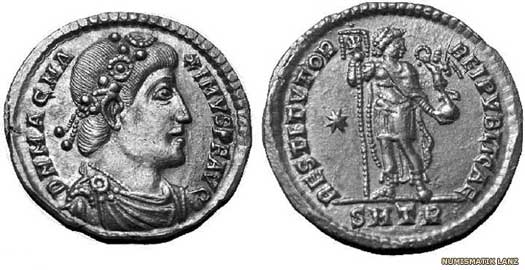


Magnus Maximus coin

Coin issued by Magnus Maximus (Macsen Wledig)
during his reign as  co-emperor, holding a laburnum
and Victory on a globe.


But what if - as is the case in my novel - the elements of place are differently located, differently named and exist in a very different time? How can I keep the reader's imagination operating alongside the narrative? What if there is almost no unbiased written evidence to support one side of the story?


With my present novel - set in British/Roman times (AD 383) this factor of elements of places sits in a kind of crosspiece with history. Normally, when one says London, Paris, Edinburgh or The Somme our readers - even if they've not been to those places have an intuitive, residual intelligence of the location of our novel

One way  I am approaching the issue in this novel is to use material objects and artefacts  to supply the incidental close detail of place and time. These are  embedded  within the narrative like fine stitches in a piece of embroidery. My approach is to try to do this without telling or describing (not so easy!). Such objects and items,  after all, are part of the taken for granted world of my characters. In the world of Elen, my main character, The  threads that make up this embroidery would include naming of places and characters, the nature of the  built world and the landscape,  the spiritual beliefs of the communities and the skill sets of individuals.

If this subtle process works then I trust my reader will stay with me throughout the narrative  in this similar-but- different land and in this different time, where human motives and preoccupations are identifiable with those that exist in our own modern world.

The other thing I've done for my reader is to include -  in a section at the end of the novelI call Author's Extras  - annotated lists including one  of places in the ancient world. Another is about people. Another is about subsequent history and events. These are appendices as applied to  fiction. The reader may use them if she or he chooses to further locate  the story in place and time. For some this may not be necessary. For others it may add to their understanding and enjoyment of the novel.


Here is one Author's Extra - this one regarding elements of place for this novel:


Place names in Elen’s World


Note: Wales as an entity did not exist in Elen’s day. I have named her territory West Britain which reached as far north as York, as far west as Caernarvon and as far south as Caerleon.

AgathaPort of Agde in South West France

Aquileia – an ancient Roman city in Italy, at the head of the Adriatic at the edge of the lagoons, about 10 km from the sea

Armorica – The name given in ancient times to the part of Gaul between the Seine and the Loire rivers, extending down the Atlantic Coast.

Luavalium - Carlisle Cumbria UK

Castra Deva – Chester UK

Deva Fluvius – River Dee UK

Eboracum – York UK

Hispania – The Roman name for the Iberian Peninsula

Isca – Caerleon in South East Wales UK

Lugdunum  Lyon in France

Lutetia - Gallic Roman cityEventually to become the city of Paris.

Massalia – French city of Marseilles

Mediolanum – Milan Italy

Segontium   Caernarfon, North Wales UK.

Trevorum – Trier -  Ancient German city on the banks of the Moselle.

Vinovium – Roman Fort  near Bishop Auckland in County Durham


File:Geograph-2436823-by-John-Lucas.jpg
Welsh landscape with pathway. 


Saturday, 3 July 2010

The Sadness of Leaving.

Journey back tomorrow. I am sad. As regular visitors at Lifetwicetasted will know, I feel I have been here before and am writing my second novel springing from this place.

As well as my notebook I always have my little camera. I’m no great photographer but now my camera is my second notebook and continues to provide inspiration and sustenance in my other special place t- he moody, complex north of England. I thought I would stick my last images together for my friends – as a kind of handful of postcards from the edge, with no message.

Here , the medium is the message, perhaps:

Light and Shade

window M D'


Wendy 


Shades of Red  Pezenas

 Street Aesthetic

Joute boat in shadow


Always a feast for the eyes


Notebook

 Last images 011


the blue blue sky

A bientot…

Monday, 14 June 2010

A Tale of Three Boys and Diving for Treasure

The courtyard is in shadow but the sky above is bright blue. My problem is that  the wonderful Agde sun waited to come out out until the day my friend Pat caught her plane home.001  I’ve spent the week telling her that usually it’s warm and very bright here in June: protesting in defence of my favourite French town.

At least on the morning of her departure as the sun started to show its face and we made it to the picturesque Pezenas market. We sat drinking pezenas 12 June 2010 012 coffee and pastis watching ladies try on hats at the hat stall. We decided that it would be rather nice if we renewed the  custom of wearing hats every day .  It would get rid of the problem of  bad hair days but I suppose would present the challenge of wearing hats with jeans.

The rain and glowering sky had not prevented us -  on - Tuesday from visiting the exceptional Museum of the Ephebe, close by in Cap d’Agde. 

The Ephebe is a   stunning near life-size bronze of a post-adolescent boy which was plucked out of the River Herault in 1964 by submarine archaeologists.

On the wall in my study at home I have a giant poster of the Ephebe, brought back from my first visit here.That first time   I was fascinated not just by this exquisite bronze  treasure  but the moving portrait of this beautiful young man who who was alive thousands of years ago. At that time there was no information about who this elegant, thoughtful person might have been. P1150826But I do have my own thoughtful, intelligent boy and my poster always reminds me of A, the boy who likes chocolate,  He is alas, not staying here this year.

My poster came into my mind on later visits here when I became fascinated by St Thibery, another young man emerging from Agde (his father was the Roman Governor of Agde)  early in the fourth century AD. Thibery was a gifted boy, a healer of the insane who cured people in the name of Jesus Christ.  He and his beloved tutor Modeste were  martyred and executed in the small Village of Cessaro close to Agde.

Renamed St Thibery, this village became a place of pilgrimage throughout the middle ages, for those seeking a cure for insanity.

These events inspired my new novel Starr Bright*** which considers madness and serious depression in the present day. In the novel we see a troubled woman in the present day who experiences the joys and ultimate sorrows of  intimate contact with Thibery and his charismatic tutor Modeste.

So it is that this  whole novel started with my fascination with the Ephebe those years ago. In the years since archaeological scholars have concluded that this formerly anonymous figure is in fact a portrait of a young Alexander the Great. How wonderful.

This habit of diving for treasure is an old one here. This town has been a port for more than two thousand years – at one time a crucial Greek and then a Roman port  - for exporting and importing all kinds of goods between Gaul and the countries around the Mediterranean basin.

There were battles , pirates, great storms and flooding – here called les inondations. In the last century archaeological treasure seekers started to dive for all kinds of treasure – treasure with both intrinsic value and historical fascination - from swords to nails,002 from intricate tripods to  cooking pots and votive treasures. And there are  so many amphorae – terra cotta jars of every size which carried everything from wheat to wine, from oil to cloth. (Pat says they are like the cardboard boxes and packing cases of their times.)

Whatever their size, amphorae  were  usually pointed at the bottom so they could lie snugly together in the hold of the great sailing ships, like piglets snuggling in rows. And there are glasses and bottles -  whole and in fragments – alongside bowls and cooking pots demonstrating a thousand years of the potters’ craft.

All this treasure was hauled from the river by twentieth and twenty first century adventuring submarine archaeologists who are named and described with pride on the walls of the museum. They are an essential  part of the whole story.

Another part of the story are the citizen-beach-combers who, on a rare very low tide on the estuary,  harvest  their own collections of finds and fragments which reflect this same history. This house where I am writing is sprinkled with a number of these objets trouvé which make  me feel I am living in history - as does Estella in my new novel Star003r Bright.

As a footnote my fried Avril, says these  glass and  pot fragments  remind her of ‘boody’  which I mentioned once on my Bishop Blog.  Perhaps that’s our country’s archaeology although  so far the the River Wear had never offered up our own Ephebe.

I suppose, really,  writing novels is a kind if diving for treasure…

w

***

So what about…

Starr Bright?

……You might find it strange that through all this mad time I still did my astrology columns, recycling old stuff, free-basing new stuff, making new money to prove I was alive, adding it to the stash that came from my dear mother’s foresight. I worked through the night and slept through the day, only rarely catching sight of a perplexed Philip. I cut down on my antidepressants because there was the possibility that the numbness might make me renege on my deadlines. And I realised that they were giving me suicidal inspiration and I wanted to stay alive to see Siri again.

On many nights I would cast and recast Siri’s chart for the time then and the time now - for the day of the murder and for this same date - one, two, three years later. And again and again I would stare in the mirror and wonder why, why on that day I should have told her, ‘Yes love. You go and get some fresh air!’ What I should have done is shackle her to the fridge, the bed, the washing machine. Anything.’

I looked at her constellation Virgo in the night sky and willed it to bring her through to me from whatever fog she was in, so I could see her. These days, angry at the man called Ludovic who started it all, |I no longer sought out The Great Bear in the night sky,

Even worse, I was perpetually seething with anger at Philip for just being normal. This anger and my nocturnal habits drove an ever widening wedge between us. Where there had been kindness there was now rancour. Where there had been tolerance there was blame and disbelief. He saw me as crazy and incomprehensible. I saw him as hard and unfeeling….


wxx

LinkWithin

Related Posts Plugin for WordPress, Blogger...