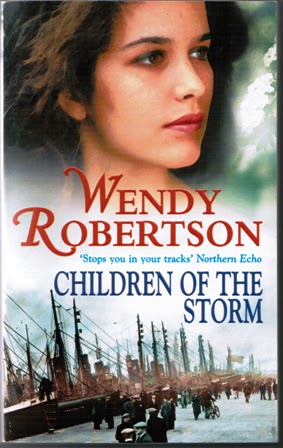
How
does a trilogy happen? In my case it certainly was not planned.
When I
completed the novel Kitty Rainbow
instead of the sense of closure which can come at the end of a novel I was
haunted by the still powerful presence of the charismatic and complicated Kitty
Rainbow. There seemed to so much story untold.
I was compellers by this
feeling made me to embark on a sequel with the idea that this novel should stand
alone, apart from Kitty Rainbow but
could also be read in sequence. Hence I embarked on my only trilogy.
So it
happens that Kitty Rainbow emerges again, dominating the background of Children of the Storm. Kitty learned
her lessons in life from retired fighter Ishmael Slaughter and has become the proprietor
of Rainbow and Daughter a very
successful draper’s shop in the Durham market town of Priorton. She is life
partner (but never married – very scandalous in those days) to William Scorton
inventor and manufacturer whose factory in this novel has been turned over to
the making of shells in the Great War.
In the
foreground of the novel are her stepsons, Samuel, Michael and Tommy, and Leonora
and Mara, her children with William. Taking place between 1915 and 1921 the novel
tells the story of this complex family, set against the dramas of war on the
home front, on the Somme, and on the bloody Russian Front where Russia is
slowly disintegrating into full scale revolution.
In her
fifties now, Kitty is very involved with her business, William has retired to
make clocks and invent a signalling mechanism for railways, middle-aged Michael
is running the armaments works, Left-thinking thirty eight year old Samuel is in Russia writing
journalist, acting as a go-between and perhaps a spy, thirty seven your old Leonora
is working for the Russian Red Cross in field hospitals, seventeen year old
Tommy is kicking his heels dying to be a
soldier and fifteen year old Mara is a
pupil teacher in a school in the coastal port of Hartlepool.
The
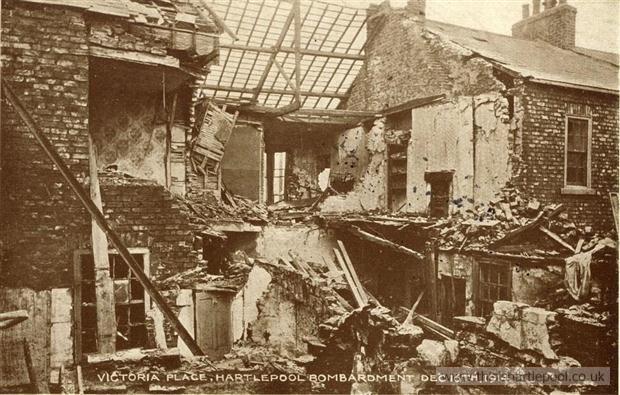
event at the beginning of the novel – the bombardment of Hartlepool – sets away
events impact this family to its core
and reflect the destructive ripple, rippling impact of war on the individual.
For
You, if you have just a few more minutes
Some Extracts
In Hartlepool fifteen year old Mara
arrives at school early in the morning reflecting on the difficulty of the task
she has taken on and the fear she has of the domineering head teacher Mr
Clonmel.
...
He was nodding now, a slight
smile on his face. ‘Then you too are an example to our children Miss Scorton.’
She struggled to
think well of this, but was uncomfortable again at how he could turn even this
fascinating idea into a lecture. She was relieved of the responsibility of
answering by a heavy rumble from the direction of the harbour.
Mr Clonmel turned
his head. ‘Guns,’ he said. ‘The soldiers in the battery must be practicing.’
She was just glancing past him, looking for some means of escape when the earth
beneath her seemed to ripple like thrown silk and the whole building about her
shuddered like a restive horse. For a second even the dust in the air seemed to
be suspended. Then there was a creaking and groaning of wood; every pane of
glass in the partition cracked like a rifle.
Then everything
went black.
When she came to,
Mara found she had been flung into Mr Clonmel’s arms. ‘Mr Clonmel!’
There was no
reply. Desperately she pulled herself out of his frozen clasp and he fell,
insensate. The shriek of a bursting shell pieced the fabric of her brain. She
struggled to her feet and looked at the crumpled figure on the floor. She
leaned over and then recoiled from the mass of blood and brain matter spilling
from the back of his head.
‘Let’s at him,’
Miss Scorton. Give us a see.’ Joe Bly knelt opposite her and put a blackened
hand on Mr Clonmel’s scrawny neck.
‘Is he dead, Mr
Bly?’
Joe shook his
head slowly. ’Nothing so sure, Miss Scorton. Dead as a doornail. Seen a few
like that in Africa, fightin’ them Boers.’
Having
worked as a governess in Russia 37 year old Leonora Rainbow has volunteered (as
some British women did) to work for the Russian Red Cross.
She resisted the temptation to
smooth down her grey dress and white apron or to tuck a wandering curl under
her white veil. The other fifteen nurses all younger than her stood as still
and rapt as the icons around the walls, their eyes glued to the gold-clad back
of the priest as he made his way to the alter.
The perfume of incense wafted
across and made Leonora’s nose itch. The breath of the priest iced on the air
as he made the signs of the cross. She was used to these elaborate rituals,
having quite regularly attended services with the Poliakovs. In fact her young
friend Lucette Poliakov was here, first in line waiting for the priest’s
benediction.
Now the priest was turning to
face them, causing a ripple of indrawn breath, a rustle of feet as he held out
the crucifix to full view of the congregation. He blessed the heap of red
crosses then, having asked the name of each girl, blessed her, presented her
with a red cross and offered her his crucifix to kiss. ‘To you Leonya, child of
God, servant of the most high, is given this token of faith of hope of charity…thou
shalt tend the sick, the wounded, the needy; with words of comfort you shalt
thou cheer them.’
…
Standing in the shadow of the
great door, and tall man in high boots and a shaggy hat carefully scrutinised
each veiled face. Suddenly Leonora’s hands were grabbed and she was pulled
against a great chest in a bear hug which brought with it the smell of snow and
tallow candles, of pine forest and tobacco. She struggled to free herself and
stood back to identify her assailant.
‘Leonora! Leonora!
Leo!’ The voice that clipped its way through the massive beard was English and
she knew it as well as she knew her own reflection in the mirror,
She drew closer
to peer into the man’s face in the pearly half-light that strayed into the
cathedral from the snowy square outside. ‘Samuel!’ She finally got the word
pout/ ‘What in Heaven’s name are you doing here?’
AND STILL THERE WAS MORE STORY IN THE FASCINATING RAINBOW FAMILY -
SO TO COMPLETE THE TRILOGY I MOVED TO WORLD WAR 2
WITH THE THIRD NOVEL IN THIS TRILOGY
A THIRSTING LAND:
More about this one anon ....
Scroll down for notes on the
Kitty Rainbow novel itself and the
Priorton Map and for inside info on Kitty Rainbow
Riches of the Earth, Under a Brighter Sky,
Land of your Possession and A Dark Light Shining.
| I hope you are enjoying or will
sometime enjoy them all |
 ‘Mara turned a corner by one of the shipyards and nearly tripped
over a man in
‘Mara turned a corner by one of the shipyards and nearly tripped
over a man in