Showing posts with label Novel Research. Show all posts

Wednesday, 17 April 2013

Half Way Through: Ten Tips for Editing Your/My novel


I’ve spent a week or two now carrying out an in-depth edit on the first half of the new novel and am very much reminded of  the words of John Braine in his 1974 book How To Write a Novel 

'The most difficult task for a novelist is the movement of people between time and place.'   

This deceptively simple statement occurs to me every time I embark on some heavy duty editing.


For me beginning a novel, involves researching, thinking, imagining, writing sketches, making bubbles of action and linking them into some kind of loose structure. It involves collecting images, drawing people and pictures, making maps (see my post about Mapping the Imagination).

So now, I’ve just finished the half-way-through-edit and here for you  is my new list of

 Top ten things to do on a half way edit.  

This involves: 

1.     Gradually recognising and refining your own style (always learning …)

2.     Establishing the strong foundation on which you will build the rest of the novel

3.      Inserting earlier the significant detail now emerging in the narrative.

4.     Reinforcing time/place where it seems useful

5.      Ensuring consistency in place and characterisation

6.     Checking continuity of action 

7.     Changing, evolving and establishing names as characters reveal themselves

8.     Recognising and endorsing the significant characters and points of view

9.     Ensuring that the structure is doing its job for the reader. - This could include the way the
       chapter and part structure work

10.                        Recognising structural implications for the rest of the novel
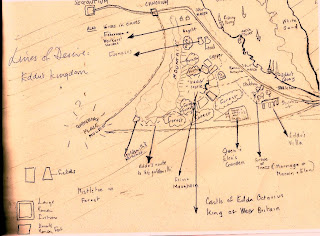
After that at last you (and I!)  can think forward to the second half of the novel. For me this means more thinking, more imagining, more images, and … er … another map…


I thought maybe you’d like to see some Work in Progress
… Lleu raises his hand. I close my eyes and think of the statue of Branwen in the centre of the pool in my father’s house. Then I raise my hand and, side by side, Lleu and I begin, steady step by steady step, to walk on fire. We do not hurry.  The crowd breaks into great applause as finally we leap back onto the grass at the far end. The old priest, still standing there at the end of the fire pit waves his staff across us and sings a blessing. I am filled with energy and delight and smile broadly and wave at the great circle of people there. Lleu holds up his arms in a victory salute. The young stick fighters beat their sticks against each other making a rattling rhythm. A pipes-man squeezes out a few notes. Another man makes his elk horn pipe squeal.
Lleu smiles and shushes the crowd. ‘Would any here like to walk the fire as do my sister and I?’ He grins broadly at the chorus of groans…


Thursday, 28 February 2013

Listening to the Past and Moving Through The Fair


Much research for fiction involves listening to the past. It so happens that in Researching this new novel I am becoming absorbed in all things Bronze Iron Age and British-Roman. 


Then the ineffable Lola Borg drew my attentions on Twitter to the programme Soul  Music on Radio 4. Lola said,  "All about dreams and longings and unexpressed desires". If you just missed this on She Moved Through the Fair 
  
The programme  featured commentators and singers - most centrally Sinead O'Connor  -   trying to nail the peculiar magic of this song.

 It's a song sung on international stages by celebrities and in pubs and  hearth-gatherings of families and friends by un-lauded singers. Sinead tells a story on the programme that at the end of the  funeral after the early, unexpected death her partner Padraig they played a recording of him singing this song. As it's a story of the fragility of human experience and of obsessive love that lasts beyond the grave this was curiously appropriate. She said,  'My dear one had departed. He always had  a huge sympathy for people who were in trouble. He was an old soul and a very kind man... He 'sang' at his own funeral. I found it consoling.'  

Perfect circularity.     I listened and was  swept away.The song and its music have been whirling in my head ever since. Apparently the music is older than the song they are both lost in ancient times.
black swan
There are words here about worries rooted in the soul. There are strands of meaning here about collective memory and human history. The song and its music ask questions to which we can only invent an answer, Line by line the words are perfectly honed to pose the questions and offer answers in shades and revenents.

Every  lines (in full below) are worth quoting but  the I particularly like the lines -

Then she went her way homeward with one star awake/
As the swan in the evening moves over the lake 

- which are full of pain and with the keening sounds of the ancient music allow the singing of this pain. 

The Soul Music programme showcases several versions of the song including that of Sinaed O'Connor herself and Van Morrison and The Chieftains.  I have found many versions and everywhere the meaning of the words and the music transcends style and fashion. 

I liked this one by Loreena McKennit. 

-  Although the setting is rather grand for such an apparently simple song, she sings - very appropriately -  to the harp and she definitely looks the part,

(LATER) And the lovely blogger 60 Going on Sixteen (See comment below) recommended the purely exquisite 1941 version by the legendary John McCormack. I see he is accompanied bu Gerald Moore, the equally legendary  pianist. Give yourself a treat and listen to the past in two dimensions - World War 2 and The ancient past.

(EVEN LATER...) and this version by Van Morrison and The Chieftains appropriately sung - almost spoken  - by Van Morrison  shows the tragic young man at the centre of the story.


Listening to the past makes sense not just for writers but for all of us who are trying to solve the puzzle of what it is to be human and spiritual at the same time.


She Moved Through the Fair


My young love said to me, my mother won´t mind 
And my father won´t slight you for your lack of kine, 
And she stepped away from me and this she did say, 
It will not be long love ´til our wedding day. 


She stepped away from me and she moved through the fair, 
And fondly I watched her move here and move there, 
Then she went her way homeward with one star awake, 

As the swan in the evening moves over the lake. 


The people were saying no two were e´er wed, 
But one has a sorrow that never was said, 
And I smiled as she passed with her goods and her gear, 

And that was the last that I saw of my dear. 

I dreamt it last night that my young love came in, 
So softly she entered her feet made no din, 
She came close beside me and this she did say, 

It will not be long love ´til our wedding day.

LinkWithin

Related Posts Plugin for WordPress, Blogger...