Thursday, 29 April 2010

Just A Hole In The Ground?

G has decided he’ll make a vegetable garden in the sunny corner on the bottom dRAIN hOLE WITH PATHright hand side of our garden. It’s the only flat square patch on that side of the house which is really a long bank with a few large old trees,  soon to be  undercut with thousands of bluebells – a glorious sight for a week or so but a bit of a flopping- about mess afterwards. But worth  it.

I read something somewhere which said that when bluebells pop up anywhere and everywhere like this – as they have here for thirty years - it’s a sign of ancient woodland. I love that thought.

When we arrived here all that time ago this bottom right hand corner actually was a vegetable patch. I remember in those early days we found a lady’s silver watch down there. (Lost again now…) Drain Hole 2 But we were too busy writing and working to earn our living to grow vegetables and the corner became overgrown. I do remember planting some herbs down there once. My gardening - like most things then and now - happened in my head rather than on the ground. I dream a very good garden just like I dream a very good dinner.

So G, armed with two reference books and tips from his Auntie Susan who is a brilliant gardener, got down to digging and  clearing this patch,, doing a brilliant job.   Then one day there is this long whistle and G shouted up the bank, ‘Come and see! Come and see this!’

‘This’ is a yard deep hole in the ground. In the bottom of the hole is a terra cotta drain. G has just pulled off a long capping stone.

He tells  me that this is a Victorian dRAIN hOLE WITH HOUSEwater pipe, a drain to lead the water down the bank and prevent it from being a swamp.

On the other side of the boundary wall is the filled-in stone arch of a drinking trough which this pipe must have lead to. The narrow road beyond it was once the main road through this small town. The stream, now piped underground,  must have fallen down this slope before this house and the other houses in the road were built a hundred and forty years ago.

Before our road existed this area  was a flattish plateau  called a Garth, owned by the Dean and Chapter – that is the Bishop Of Durham. G knows all of this because for his dissertation for his history degree he researched the land, the houses and the people who eventually lived in these streets after 1860;. It’s a fascinating stDrain Hole 1udy.

Now we think there must have been a stream meandering across this land. And probably a well. One clue to this is that  our house has always had Springwell in its name. We didn’t really know why, till now. As we are talking we look down at the drain and it has filled up  with a good trickle of water. The stream is still running. – well, trickling!  This feels like magic. It’s so touching that I could cry. G leans down and touches the pipe and says with a craftsman’s  reverence,

‘I was thinking that the last person who touched this was the guy who put it in some workman in the 1860s.’ So many levels of time are sitting in the air around us. We have always shared that wonder.dRAIN hOLE 5

When everyone – including neighbour Terry who took these pictures - had actually witnessed this marvellous hole in the ground, G  rebuilt the stone slab and tile super-structure of the drain and filled in the hole.

I looked up the hill and realised that the stream  must have originally flowed through my kitchen. Still running water, then.

We’d acted as good archaeologists and documented the find (see Terry’s pictures here…) and replaced it as we found it.  The plot is now beautifully dug, raked over and criss-crossed with stamped-down paths to make six small beds. The potatoes are in, as are the garlic and carrots. There are more plantings to follow.

I think they’ll crop well. They’ll certainly never be short of water.

w

Drain Hole 3

Saturday, 24 April 2010

Writing, Planning, and The Tentacled Monster

‘Fantasy abandoned by reason produces impossible monsters; united with it she is the mother of the arts and the origin of marvels.’ Goya.

Writing novels is both a simple and a very complex process.

On the one hand I just sit down and write and write and write - and write - until the words on the page grow into the story that - in some ghostly pre-knowledge – I know it always was. This organic model is very attractive – it implies that we writers are extraordinary vessels for a pre-existing story, conduits that act to give form to random elements of our subconscious.

This makes great sense to me.

On the other hand my novel can become a wild creature. It can grow tentacles and flail about. It can grow wings and fly. It can spurt legs and go clumping down the road away from me. For a time this is exhilarating, exciting. Fantastic.

Again, this makes sense to me.

Then there comes a day my monstrous story gets wild, too wild to hold onto. I have to rein it in, to give it form, to shape it up. This process, done well, can have its own more intellectualised creative charge, profiting from the conscious rather than the unconscious mind.

Each time I ask myself how is it possible to pull this material into a readable state without losing the original organic energy?

One name for this process is planning. The very word sounds deadening, institutionalised doesn’t it? Like forcing the tentacled, winged, heavy footed creature into a rectangular box. But there comes a time that I must think of cause, consequence and shape, and make the novel do its work to transform the organic material into a coherent form. This is the other, necessary side of the creative coin that spins, eventually, into a publishable novel.

For me this more conscious planning happens in stages as the whole story evolves. Inside these stages there have to be open cycles of organic speculation, feeling, risk-taking. But it is the planning that takes the story forward.

But I’m becoming aware that when one has written quite a few novels, as I have, there’s the real danger that the planning itself may have become too embedded in the subconscious and can stifle the organic energy of the first writing. The creature’s wings are clipped and the tentacles not allowed to flail.

So I've made a decision to cultivate the wildness, the riskiness again, to let the creature rage, to grow tentacles and wings. And fly.

So far, so very exciting

w

Thought You Might Like To See The Press Release …

Been working hard on this project for the last month so I thought you’d like to see -

THE PRESS RELEASE!

clip_image002

The Writing Game

with Wendy Robertson

Bishop FM Community Radio

Author Wendy Robertson is embarking on an exciting new venture – a monthly, hour long, radio programme aimed at both writers and readers, and broadcast on community radio Bishop FM 105.9

Wendy’s programme will feature discussions and interviews about all aspects of the writing process which will be of interest to both aspiring and established writers and to readers. During the programme Wendy will give her informed take on the world of writing and its craft – The Writing Game. As well as this The Writing Game will feature conversation with authors of national standing and will act as a showcase for a wide range of new, unpublished writers.

Joining Wendy as regular contributors will be Avril Joy, Gillian and Glynn Wales presenting their Books of the Month selections, Theresa Robertson carrying the banner for children’s books,. and Debora Robertson who will have spot talking about quality food writing and journalism.

The first programme will go out on Tuesday May 4th at 7pm and after that will be available as a podcast to download from http://www.bishopfm.com/. This first programme focuses on starting points in writing and features Avril Joy in her role of published author, and local writers Eileen Elgey and Hilary Smith.

Forthcoming programmes will feature conversations with:

· Crime writer Ann Cleeves, winner of the Duncan Lawrie Dagger Award

· Internationally acclaimed David Almond, winner of the 2010 Hans Christian Anderson Medal, the world’s most prestigious prize in children’s literature

‘Our intention is that the programme will celebrate and showcase the fact that the north east of England is an acknowledged hotbed of literary talent.’ Wendy Robertson

What do you think???

wx

Sunday, 18 April 2010

Congrats to Grazia Magazine

I rather like Grazia Magazine. I’m told its informal category is ‘News and Shoes’ which fits very well. It is a glossy weekly magazine that’s not really glossy. (It has a pleasing matt finish.) It cites celebrity but does not lean back on it. It highlights style and beauty without being slavish. Most importantly to me, it highlights significant public issues without being preachy or didactic.

Last week, amid the shoes and scandal, was a very good piece focusing on women candidates of all parties who are standing in the forthcoming election. These are women who don’t just sound off about subjects; they step up to the mark in their high heels and say their piece. They are young and savvy and all have their own particular ambitions and sense of their potential for power. They don’t want to be anyone’s babes or beauties. They don’t want to be trophy female politicians. They want to be politicians and they feel they can make a difference.

Recent research among young women indicates that when asked to name women in politics, they name Mr Cameron’s wife or Mr Brown’s wife. Politics by association rules. It is no coincidence that these wives/women are bright and well turned out and attractive role-models for young women of this generation.

The inability of these young women to name an actual woman MP could be down to the fact that as a group, women MPs are on the tidy side of dowdy and often sound defensive, even when what they say makes sense. Their earnestness comes over as uncertainty and lack of authority. (Unlike the tousled, charismatic ex MP Shirley Williams who is a delight when she turns up on something like Question Time and exudes knowledge and authority. And smiles. The other exception was the charismatic equally tousled late lamented Mo Mowlam.)

I hope that this collection of potential female MPs produces some sound parliamentarians who don’t dowd down like the current crop and don’t have their bright ideas dumbed down by the processes of a male dominated parliament.

Articles like this in popular women’s magazines are a great source of informed insight for young women who can’t be doing with the effort of burrowing through the pages of The Guardian or The Telegraph for their political education. The are intelligent and can enjoy their political education alongside the latest shoes and celebrity fairy stories.

Why not? I say.

One proviso - I wish Grazia had carried a coverline on its front about this excellent article. You’ve got this level of credibility, so flaunt it…

w

Thursday, 15 April 2010

Auntie Mim and Her Talent With Bullets

Auntie Mim 

Auntie Mim’s name was really Alice but throughout her life she was known  as Mim. They said it was because as a small child she would say me-mim-me a lot. She got a lot of attention.

Like all in our family she was fascinated by words. Her brother, my father, wrote wonderful letters and read and did crossroads. My brother not only did crosswords but made them as well. My sister has written and was a keen cross-worder until seduced by Sudoku.  I write. My daughter and son write and love words.  And so- on …

In the present day this blog is part of contemporary word-play, as is Twitter,  which I have just begun to ‘play’.  For the uninitiated this involves writing something in 140 characters or fewer and posting it  (see sidebar here). Then anyone who reads it can respond to it  in 140 characters or fewer. And so on. Anyone can respond to anyone.

They are all out there. There is a lot of verbal  flotsam and jetsam floating about.  But the ones I enjoy are cryptic, punchy, imaginative, speculative, fluid, quick. It’s amazing what you can get into 140 characters (ie letters, not words…)

Back in Auntie Mim’s day she was obsessed with this thing called Bullets. I can remember her hunched over a competition in either the People  or the News Chronicle  where you created cryptic phrases of under so many letters (can’t remember whether it was 140 but it was tight) creating cryptic phrases for the ‘Bullets’ competition and sending them away. She won prizes now and then.

In recent days,  getting to grips with Twitter, my Auntie Mim came to mind for the first time in some years. It occurred to me that she would have loved the mental gymnastics of Twitter but would have been disappointed, I think, that there were no money prizes involved.

I thought you might be entertained by a few of the tweets cooked up by me in response to those of others. The other people are highlighted if you want to know what they said…

@paulmagrs Friendly Whitby ghosts mean I can be there in spirit, writing.

@nwndirector Alnwick Castle water falls beat all earthly dress, even Phillipa's

@daneetsteffens Truth is only the first step to understanding perhaps. Or understanding is a precondition for truth, more likely.

@normblog An old friend of mine had a party to decorate her straw coffin, thus introducing meaning to her funeral - but not yet...

 about @Adelica Politicians wives wheeled out to order, in the old tradition of the vicar's wife or the wife of that old devil at the manor?

I have to say, as a word-junkie, Twittering is fun. As I say, Auntie Mim would have loved it.

wx

Monday, 12 April 2010

Radio Times and Cafe Writing

Cafe Writing 001

There is a myth or tradition in the writing game to do with writing in cafes. I have written about it here. before but this is to show that I’m not a one trick pony and the cafe habit still continues.

On Saturday morning I attended an induction programme for our local community radio station Bishop FM to learn just how such a place works. This is because I have agreed to present a programme for them that I’m calling Writers Readers and Books. First programme is out in May and I’m learning a lot.

After the meeting I went to the Cafe on the Corner and made a few notes so I would remember the main points of the meeting. Then I took out my other newer notebook the one which is dedicated to my newest novel – as yetunnamed.

One way in which I like to start a novel is to get to know the people involved. These notes come in the form of a kind of chapter about that person – which might or might not end up in any part of the novel. Whatever happens, it helps me to know the person.

I have written four of these character/ chapter/fragments already. So, after scribbling my radio notes I wrote a thousand words or about on of my new characters, Anne Marie

…’Anne-Marie always travels light

- One pair of ventilated trainers. (She had paid too much for them, encouraged by her young friend Celine, who had more money than sense.

- Two pairs of serviceable canvas trousers . One pair is very old, bought in the Army and Navy Stories in 1975. They washed very well.

- One pair of very expensive slim sandals – again Celine having her say.

- The shirt blouses - Lands End – such good value!

- The usual Marks & Spencer’s knicker-stuff,

All these went into the bottom of her carry-on case. On top of these she pressed her vary fat notebook and a very slim laptop - a present from her agent when her seventieth birthday coincided with the publication of her thirtieth book. On top of all these she pressed copies of her two latest novels in case anyone didn’t believe her.

Beside them she squeezed in the ancient plastic bag that she bought in Harrods in 1950. Such quality then. Quality lasts, that what she always said.

Last but not least she pressed in her plastic box of ‘bobby pins’ . These magic clips have transformed her thick straight (once red, now white) hair into a cloud of curls every single day in her life since 1945 , when an American she met – who became her first her first husband – presented them to her, saying, ‘All the rage in the States , honey. My mom and my sister swear by them.

At first Anne Marie had been irritated when Celine got her involved with this French thing. ‘Just think of it AM.,’ she said .’Ten days in the sun! The company of writers! They’ll take care of you, cherish you, darling.’

Celine – first her editor, and then her dear friend - was always very keen to find people to take care of Ann Marie. She had never quite got to grips with the fact that Ann-Marie needed a friend like a fish needed the safety of nets.

But still, thought Ann Marie, Celine mean twell and that went a long way in terms of forgiveness. ….

Nots The Art of Retreating 001

And, sitting there at my corner table looking out on the market place I wrote more about the remarkable eighty year old Anne Marie and the journey on which she was about to embark. When I walked out of the cafe I knew a lot more about Anne Marie than when I went in. She has now found her place in my story.

Two more people to go, then I’ll start my new novel. Now I’m experiencing the real relish – even exultation - I feel when begin something very new.

wx

Another aspect of exultation: if you like cooking as well as writing and reading check out my dear daughter’s blog called Love and A Licked Spoon at (http://lickedspoon.blogspot.com/ It has just been selected as one of the five best blogs by Psychologies Magazine. Hooray I say. I’m proud of my girl.

Thursday, 8 April 2010

Changing Lives and the Boston Connection

Avril J’s comment on my last post on the seriousness with which many Americans take their literature reminded me of an experience we shared ten years ago when I was writer in residence in a prison picture 31 of 65 in series bs in directory 2002/12where she was teaching. We became interested in Changing Lives Through Literature American project lead by Professor Bob Waxler of the University of Massachusetts. There instead of prison, some offenders – armed robbers, thieves – were sentenced to a twelve week seminar on Modern Literature lead by Bob Waxler.

At that time I was reading substantial literature to and with the women in my care and delighting in the reactions and changes of view that that brought about. So we inaugurated our own small Changing Lives project from the inside. Of course this was different. Even if they did volunteer for my project my students had no option but to be there in prison.

In Boston prisoners up before certain judges participating in the scheme, were allowed to choose the Changing Lives project instead of a custodial sentence.

This groundbreaking initiative came about after a discussion between Professor Waxler and Judge Robert Kane (I think it was after a game of squash or tennis or something) when the Judge bewailed what the swinging door experience where he sentenced people again and again they came back through the swinging door of his courtroom. Bob Waxler said that the judge should sentence them to six months in his seminar room and maybe the door would swing less.

In the American way, this came about. If you are interested in the details of this and its qualitative success, read my article Erasing The Chasm between Bench and Dock which is on my website (link below). You could also look at their now very sophisticated Changing Lives Website (also link below)

To cut a (very) long story short on blustery, hail-ridded spring, Avril and I eventually went to Boston to visit the project and talk to Professor Waxler, Judge Kane and their colleagues about the realities of this idealistic project.

Three reverberating memories of this seminal visit are

- being cut down by vicious hail-ridden wind on the city’s crossroads

- coming into the glittering city at night,

- and having dinner – early, in the American way – with three judges and two probation officers where the table full of very good talk.

But the most important memory is sitting in the University of Massachusetts, at an almost Arthurian round table alongside eight of the Changing Lives Students, two of the Judges who had sentenced them and two of the Probation Officers responsible for them. The ringleader was the charismatic but laid back (even then I thought this an impossible combination…) Bob Waxler.

The table was round, the ethos was democratic. Everyone – not just the students – everyone had to have read the book and around this table no one had more authority or more right to be listened to than anyone else. They had read the Raymond Carver short story. What Do We Say When We Talk About Love?

The discussion, discreetly chaired by Bob Waxler, was fascinating. This was session twelve of a twelve session course. It was clear that a great deal had been learned by everyone around the table. No-one shouted over anyone else. Each person listened. The discussion was wide ranging and disciplined and lead by the students, who had read this story with an unmatched intensity and expressed unique insights and views which came from their own lives in their home districts.

And later, one by one, the participants told us how the experience of Bob Waxler’s course had changed their lives. The judges told us how their attitudes and understanding had been altered by their experience.

Thank you Avril, for reminding me of all this. The memory raised my spirit in a hard week when the venal media circus of the forthcoming election is grinding to a start.

I just had a thought. This would all make a fantastic film. It would out-poet Dead Poet's Society. Too idealistic for the modern age? We need some idealism.

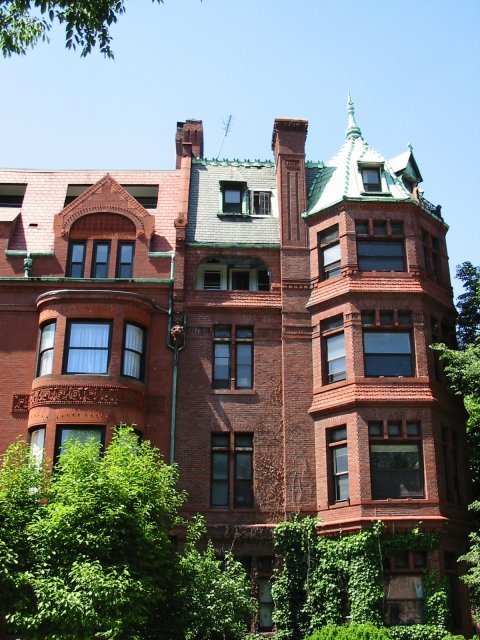
(NB I didn’t have a picture of a round table so I included a picture of a house in the historic Back Bay in Boston – another part of our Boston adventure…)

****************

To read my full article Erasing the Chasm Between Bench and Dock

click on:

http://www.wendyrobertson.com/Articles/Erasing_the_chasm.html

To discover more detail of the Changing Lives Through Literature Project click on their website:

http://cltl.umassd.edu/home-flash.cfm

Saturday, 27 March 2010

Writing America and the Young Man from Texas.

Once I met a young Texan, across in Britain for one year of his university qualifications. He love England, although the smallness of everything was something of a culture shock. One day, standing in Durham Cathedral, he looked up at the exquisite, soaring roof and said, ‘We-ell. I think we might have the space but you guys certainly have the time.’

Being something of an actor he could imitate of all kinds of accents – from cockney to Scottish to northern and southern Irish, to Yorkshire to Lancashire. However he did say the north eastern accent was impossible to ‘get’. I suggested he started with Scandinavian and moved West from there.

He had some interesting observations on what we take for granted, that in our ambiguous society to say what you mean is out. He observed that false modesty and understatement were de rigeur.

For example at an early meeting, the university drama group were asked what they could offer to the upcoming production. He mistook this for a real question, ‘We’ell,’ he said truthfully. ‘I can act, I can direct, I can build and paint scenery, I can do sound….’ He only stopped when he saw the looks being exchanged in the group around him.

I had always loved American writing, from Tennessee Williams to Henry Miller, from Mark Twain, through Emily Dickinson, Harriet Beecher Stowe, Louisa M Alcott, Edith Wharton, F Scott Fitzgerald, Arthur Miller, Tennessee Williams, and Henry James, to Alice Walker and the glorious Toni Morrison. Lee knew as much – perhaps more – about Shakespeare than I did. His grasp on English-English literature was strong, I remember a discussion about the vast archives of English literature at the University if Texas at Austin – original archive material at that time apparently being gobbled up by American money. He looked at me with the wisdom, the transparency of youth. ‘We’ell, Wendy,’ he drawled. ‘It’s my literary heritage as well as yours isn’t it?’

As he could trace his ancestry to the Pilgrim Fathers and I can’t get further back than 1895 I definitely conceded that he was right. He has now vanished into the mists of time, having become a trauma surgeon. As you do…

Lee came to my mind last week when I listened to the BBC’s Capturing America Mark Lawson's History of Modern American Literature which led me to the BBC’s American Collection.(Link below)

From this list I chose to listen first to Mark Lawson’s Interview with the John Ashberry – a writer unknown to me. Ashberry’s voice was hesitant as he searched for the right word. Occasionally there was a chuckle in his voice. He was modest but quite firm. ‘I don’t believe in inaccessibility for its own sake.’ But he thought it was a good thing that the reader has to tussle for his own take on a poet’s meaning. The problem of writing over many years he defined as the tendency to strike the same note. Like seeing an old photograph of oneself.

He described how following great writers as ‘going downhill on a bicycle and having the pedals push back at your feet.’ He talked about fancy phrases jostled by street language. And how in poetry the everyday becomes fixed and transfixed when language goes off on its own and has adventures in words.

All so inspiring. And listening to it reminded me of the young man from Texas and just how much we all – as readers and writers – owe to American literature.

wx

http://www.bbc.co.uk/radio4/features/front-row/american-authors/

Hear among others - Edward Albee, John Ashberry, Patricia Cornwell, Done Delillo, Dave Eggers James Ellroy John Irving Joyce Carol Oates Toni Morrison Walter Mosely, Philip Roth, John Updike, Gore Vidal, Kurt Vonnegut. Tom Wolfe

Monday, 22 March 2010

Getting It Like It Really Was

Very occasionally I suffer from insomnia. I have to get up because of the whirligig of negative thoughts that hammer in my head. I’m too distracted to write, too sleepy to read so I turn on the television and channel - hop to find something soothing to make me forget the hammers in my head.

The other night I hit on an old edition of The Book Show on Sky. One small segment was a visit to a writer’s writing room. So at three o’clock in the morning I reacquainted myself with Diana Athill, the legendary editor of household-name authors such as VS Naipaul . She is also an exquisite memoirist of publishing life in the twentieth century and also the nature of old age. She retired in 1993 at the age of 75, after more than 50 years in publishing. at the point of this interview she was in her nineties, still writing and still being heard,

We are in the top rooms in a house in London. Sitting in a comfortable chair is an white-haired elderly woman who looks tough and solid - anything but fragile. She speaks with the clipped, educated London speech of the nineteen thirties and forties.

Opposite her is a colourful rocking chair upholstered in tapestry, worked by herself. Fine pictures and prints hang in a more or less convenient fashion on the walls. Around her there are overflowing bookshelves and piles of papers and folders. She says, ‘I live in a state of complete chaos. When I was in publishing my desk was famous for the horror of it.’ Her smile has a touch of glee about it

Her wisdom about writing emerges as blazing self confidence. ‘I write on a lined pad of paper, then go across there and put it onto the laptop. There are changes from the scribble on my pad. ‘ She nods towards the heaped desk. Then we see her writing with the pad close up to her face. ‘All my books have come to me spontaneously. I tend to write late in the day.’ She nods. ‘I look up and it is three in the morning.’

‘I write and then I look at it. I find the work is perfectly shaped as though a lot of thought has gone into it. I suspect that for some people a lot of the work is done when they’re sleeping. One’s subconscious is working away at it.’

As her watchword in writing she cites similar phrases from two writers. ‘Jean Rhys said to me, You have to aim to get it like it really was. And Vidia Naipaul said, if you get things right, then people understand. however remote from their own experience it is.’

‘Both these things count for me,’ she says firmly. ‘I feel I must get it as it really was. This is the kind of writing I really enjoy – rather plain, exact writing. That’s what I try to do.’

In 2009 Diana Athill won the Costa Biography Prize, for her memoir Somewhere Towards The End' - a book about old age. My favourite is her publishing memoir Stet. There is a new book out now - Life Class: The Selected Memoirs of Diana Athill. London. These books demonstrate that this tough, graceful writer has succeeded in what she has tried to do.

I have to tell you I went to bed, slept like a baby and woke up fully inspired to get it like it really was and make my writing even more plain and exact than I think it is.

Which is all very good for me as I am embarking on a new novel, which might have been the reason for the hammers in the head.

wx

Wednesday, 17 March 2010

Tracey Chevalier and Stories in Cloth

One of my favourite thought provoking blogs by Norman Geras led me today to a lovely clip from the V&A which has Tracey Chevalier talking about quilts, her own inspiration, and writing a commissioned story for the V&A based on one of the quilts. Reminds me of going to the Beamish Museum with my friend Avril Joy, to look at their fascinating quilt collection. Stories certainly leapt from the intricate fabric crafted by working women. Tracey Chevalier expresses this perfectly.

Click here to see and hear…+

http://www.vam.ac.uk/channel/people/personalities/tracy_chevalier_quilts/

If you are like me you will be inspired…wx

Monday, 15 March 2010

Mother’s Day Signings and the Precocious Child

book signing 009

Saturday was, as they say, well packed.

We had this Roomtowrite Conference at Whitworth where we were discussing how writers could use their reading to develop their novel writing techniques. Or how to steal skills from successful writers . Great group. We worked very hard in a sunny conservatory in a park with deer. Roomtowrite 006

Then I had to skip lunch and go down to WHSmiths at Bishop Auckland where the lovely manager Tony Fox, in collaboration with Headline’s exceptional Gillian McKay, had set up a signing of The Woman Who Drew Buildings in time for Mother’s Day. Well it is about a mother and her son, so it seems appropriate.book signing 011

Gillian, as always, took great care of me, making sure I signed lots of books. One little girl, blonde hair, straight fringe came up for a word. She was all of nine years old. I asked her if she liked reading.

‘Oh yes, I like books,’ she says

‘What do you read?’ I say, thinking JK Rowling of Jacqueline Wilson.

‘Jodi Pecoult.’ she says.

I blink just a little. ‘Very sophisticated. So, which book have you read?’

‘I’m reading My Sister’s Keeper',’ she said. ‘I got it for my Mum last year and we watched the film and now I’m reading the book.’

And her mother came up, smiling, and swept her away.

Afterwards I wondered why I had been surprised. When I was her age I was reading books which followed my mother’s tastes. I remember reading quite erotic books by a writer called Nora K Strange. I looked her up recently to discover that among other things she wrote about Kenya under the British and possibly had some experience of the scandalous Happy Valley set.

Children get their emotional and sexual educations where they can. Novels are not a bad starting point.

Then back to the afternoon session of RoomToWrite where we were discussing beginnings and endings with reference to The Blackbird House by Alice Hoffman, Let It Bleed by Ian Rankin, and The Lovely Bones, by Alice Hoffman. Maybe Jodi Pecoult should have been in there somewhere…

If you are interested in The Woman Who Drew Buildings she is available from all good books shops (WHSmith, for instance) and on Amazon. ISBN 978-0 -7553-3381-3

Afternote. The writers at the RoomtoWrite conference were great. There are some promising novelists there. My writing friend and colleague Avril Joy has posted more about says more about the conference on her blog Writing Junkie.

But for now here are some sunny picsRTW Gillian & Hilary Sunny DayRTW Gillian;

rtw alison

RTW Jackie 007

rtw Avril

rtw Mike

rtw Gerry

Thursday, 11 March 2010

The Best Ever - A Hand Made Birthday


Birthday party 009  

I only started to celebrate my birthday last year, with a small gathering of people - each one a very special writing friend. That was so enjoyable that we had a few more enjoyable un-birthday gatherings during the year. But yesterday my actual birthday came round again and the same small gathering joined me at a round table at the historic  Pump House, Durham to celebrate not just my birthday but ourselves, our own survival in the constraints of sometimes challenging lives.Birthday party 003 Sharon 2 We missed our friend Fadia who was away publicising her book.

So we ate well, drank wine, laughed and talked. (I think we might have been quite a loud table.) We talked of everything – from Hilary Mantel to Will Self, from Michael Foot to Nye Bevan to Barbara Castle, from the Emperor’s New Clothes to surprisingly winning books and films, from misery literature and film to the dangers of voyeurism, to the delights or otherwise of younger men, to jealousy and rivalry in the field of writing, to the challenged state of publishing nowadays, to inheritance of traits and the possibly suspect fascination with one’s own genealogy, to the need to look forward rather than back. Birthday party 008 Liz

In all the talk I discovered that I had only started to know how to be happy – to laugh and see and be spontaneous - when I went to my small rural college when I was eighteen. Then on to the possibility that life might be a series of self –reinventions.Birthday party 004

There was a great deal of laughter. I am a bit of a sober-sides myself but my friends are very witty. I noticed the delicacy, strength and expressiveness of their writers’ hands.

Then I went home to find I had missed a birthday call from my dear friend Judith Gates in Florida and Birthday party 005thought how much she would have enjoyed the party. (She joined us in one or our un-birthday lunches last year…)

And there was a card from my friends Judy who is just now in New Zealand.

I had a little breather then, and watched a  saved episode of House, my favourite TV drama. I looked through my lovely cards which told me so much about myself and how my friends and family see me. Then I started to read a birthday present – a beautiful book about how to draw - and decided that this was the way I would teach myself to relax this year. I would teach myself to draw.

Birthdya Cards 001 Mantelpiece

Then my son and his wonderful family surged in. A big kiss and a hug from my Grahame. Then greetings from Angus and Calum disguised by bunches of flowers, Then a kiss from Kate who was carrying the mandatory bottle of bubbly. The a hug from her lovely mother who handed over two beautifully wrapped square glass vases. And chocolates. And great, great chat.

Then later, just after B and I had settled down to a lovely quiet house, an hour long call from my dear girl Debora, known on this blog as love and a licked spoon. The interesting thing was that our long meandering conversation was a wide-ranging, intensely interesting, one to one version of the round table conversation with my friends this lunch time.

On my birthday this year everything connected, It was the best birthday. Ever. WX

Birthdya Cards 002

Birthday party 002  Sharon

Monday, 8 March 2010

Easington Writers & Pandora’s Box

What Thatcher did with her actions over the miner’s strike was to open a Pandora’s box, freeing up the potential that has existed in this village for generations, unleashing the talent and energy here that shows itself in this book. It is a credit to this community. John Cummings MP for Easington. ‘100_0461[1] (Right, with Avril and myself and his successor)

Now I’ve completed the work on the book I feel differently about the place, I see it with a fresh eye. I see its beauty now, its potential. I am more positive about it now. Agnes Frain Easington writer. (Read her 'Tunnel Vision ' p55 & 'Gladiators' pp 136.)

This project is unique in that the outcome, in this lovely book, is tangible. So many of our projects have intangible outcomes but here we can see the work that has gone into the project and the benefit that is coming out of it. Emma Snowden, of the Lottery Fund.

image

And here is the Book, now available. I has taken eleven people, including nine great Easington writers, Avril. Gillian. and myself a year to write, edit, select, print produce and publish, It was hard work but a labour of love on everybody’s part, and illuminated by the paintings, drawings and photographs of Fiona Naughton. Now it is now out there. It is being snapped up by people who know Easington by residence, association and affection. It is also being widely bought by everyone who knows a good book when they see one.

If you would like a copy it is available through all good bookshops (ISBN 978-0-9564823-0-3) OR through AGNES FRAIN . Email her at agnesfrain@hotmail.co.uk)

On Saturday a crowd of more than two hundred friends, well-wishers and fans the packed the magnificent ball room of Easington Welfare Hall, to launch our book Shrugging Off The Wind. As the writers read their work to this great crowd I felt proud of them and the progress they had made in their writing this year. Aged from thirty plus to seventy plus., each one of them had entered into a contract with me to work hard at their writing and editing, to develop their work and produce something unique in this field of local and community writing. As I say in my preface (reprinted below) I wanted them to move out of the sentimental and nostalgic field of community writing and produce something dynamic and modern which still paid respect to the uniqueness of their own community. On the whole they managed that. Anyone who reads the book carefully will note that the writers in this collection have aspired to that quality and lifted their writing game.

But today we writers were not writing. We were celebrating. We gathered there in all our finery: Agnes and David Mary B in her lace skirt and beautiful beads; Chris with her silver butterfly belt; Ann in her elegant shawl; Joan in her sweet pink jumper; Susan with her new make-up; Terry in full Goth gear, including his stick with its silver skull head; Agnes in her elegant grey jacket; David in his best shirt; Mavis, as promised, in shocking pink; me with my red spotted tie and Avril with her head wrapped in a pretty scarf.

Mary and chis

Terry in Gothid Mode

Barney Preens 048

100_0467[1]

Bookstall with flowers

Gillian, in a lovely tourquoise jacket, took on the selling of the books. She sold more than two hundred….

Joan and Ann

I was going to write here about my perspective in dedicating a year to the project but decided to copy across the preface that Avril and I wrote for to the book, Perhaps it says it all:

Preface

When we agreed with the Easington Writers’ group to mentor and tutor them through their Tall Tales Project, we did not realise what we were getting into. First there was Easington itself. We knew of its strong association with the history of mining, right up to its crucial involvement in the 1984 Miners’ Strike. We also knew that – in common with most mining districts – it had lost its mines and with that its central livelihood and its working energy.

But, until we went there regularly to work with the Easington Writers’ Group in their magisterial Welfare building, we had not realised the beauty of this place, with its long beaches and inlets, its wooded denes and everywhere the sea. Of course there are no gantries and pit wheels but – as at least one poem here shows – these icons of a bygone age are missed and are still seen to have had their own unique beauty.

The other special delight has been the sheer character, energy and originality of the writers with whom we have worked. As these very original writers tackled our writing tasks with open minds, the quality of their writing grew enormously, month by month. They have embraced the challenge of transforming fact into fiction with great imagination and have written pieces which contain gold nuggets of truth for all of us, whether or not we come from Easington.

These writers, having fulfilled their brief to talk with Easington people, have come back with stories ranging widely from well-researched historical tales to tales of Easington before even the railways arrived, to heart-felt narratives based on Easington’s mining heritage to contemporary tales of the disaffection of the young and the social consequences of the lost industrial base. Here also are well-wrought ghost stories and poems of lyrical quality that reflect the poignant beauty of the landscape and its meaning for Easington people. Humour and occasional roguish insight lace many of the stories with the unique quality of the Easington point of view.

Wendy Robertson and Avril Joy

Consultants and Mentors

Easington Tall Tales Project

Thursday, 4 March 2010

One Hundred Posts and Still Counting

I started this blog just about a year ago because I was relishing the thought of my DSCN0316 forthcoming two month stay in the Languedoc and thought it might be a good idea to document that and to go on and write a hundred posts that somehow documented my pre-occupations in what I thought would be an interesting year. I didn’t know whether I would last out but here we are and this is the hundredth post.
The outcome is a book-length text that somehow does document the year – including that endless and too short time in France. Every day there made me reflect on my life and the work I was doing there – posts like sounds not of silence. So now I invite you to join me as I revisiting my posts on a writer's mindset on the house in France and the cafe where I watched and wrote and the joy of beginning and working on the novel that has become STARR BRIGHT and the amazement there in the Maison d’Estella of the first sight of the newly published Woman Who Drew Buildings (now out in paperback) I could not keep off the subject The Miracle of The Woman Who Drew Buildings. Then back to Starr as she climbs a wall. And thinking about Starr again in research leading down strange pathways.
My posts reflect the inspirations of great people – in the flesh and on the page - Mary Davies who inspired The Woman Who Drew Buildings; Sylvia Hurst whose life was more extraordinary than any novel ; the late Julia Darling, indeed a darling of the Northern writing world, my own Angus who is always an inspiration, and John Fowles; and Jane Yolen; Alan and Nira Chidgey. And the sparky and dynamic Easington writers whose book Shrugging Off The Wind will be launched with balloons and rip roaring readings just this Saturday coming (Obviously that will be worth its own special post) .
And more…
And threaded through all this are posts that reflect elements of my own life from my occasionally troubled childhood onwards. There are also also many posts on my sometimes idiosyncratic and obsessive views on writers , the process of writing and aspects of syntax and language - both from a practitioner and mentor’s point of view.
It being World Book Day today I have the thought that I might make a book of all this – a ‘How To Write’ book with a difference. What do you think?
One unexpected joy of the blog has been that need for images to support the prose and to give the reader some colour. So I had to teach myself to take (not very expert) photographs. I have to admit I see these as writer’s notes rather than works of art. But they have been a joyous bonus of writing the blog . So I offer here – in no particular order – some of the hundreds of photos this bloWednesday Agde 047g has taught me to value for their own strange selves. .
A Glass of Wine on the Roof Terrace
Wednesday Agde 059
009
the woman who drew buildings[1]
083


020
P1160135 Boody boody 002River PathDSCN0286

077

Mary Davies 014m17 P1140777 DSCN0144

books Etc 028P1150840P1010046DSCN0317


DSCN0189 (2) DSCN0310 Family Ties 003Autumn 011 Obsolete 121b&w with D


LinkWithin

Related Posts Plugin for WordPress, Blogger...